WORLD NEWS
Rocket trash will hit the Moon at 5,400 mph
A Falcon 9 upper stage launched in 2025 is predicted to hit the Moon at about 06:34 UTC on August 5. It will be moving at roughly 5,400 mph, or 8,700 km/h.
This poses no danger to Earth and is far too small to alter the Moon’s orbit. The exact time and point, the flash and the size of the dust plume can still change as final observations refine the forecast.
Why it spent more than a year near the Moon
The object is catalogued as 2025-010D. It is the Falcon 9 upper stage left after launching the Blue Ghost and Hakuto-R lunar landers in January 2025.
Most upper stages return into Earth’s atmosphere, but this one stayed in a high, stretched orbit. Its roughly 26-day path around Earth will now cross the Moon’s path at the same moment.
How hard it will hit
The predicted impact speed is 2.43 km/s. Current sources differ on its remaining mass, estimating roughly 3.9 to 4.9 metric tonnes.
Project Pluto’s orbit calculation puts the energy at 14.5 billion joules, about three tons of TNT. A fresh crater tens of metres across is likely to remain on the lunar surface.
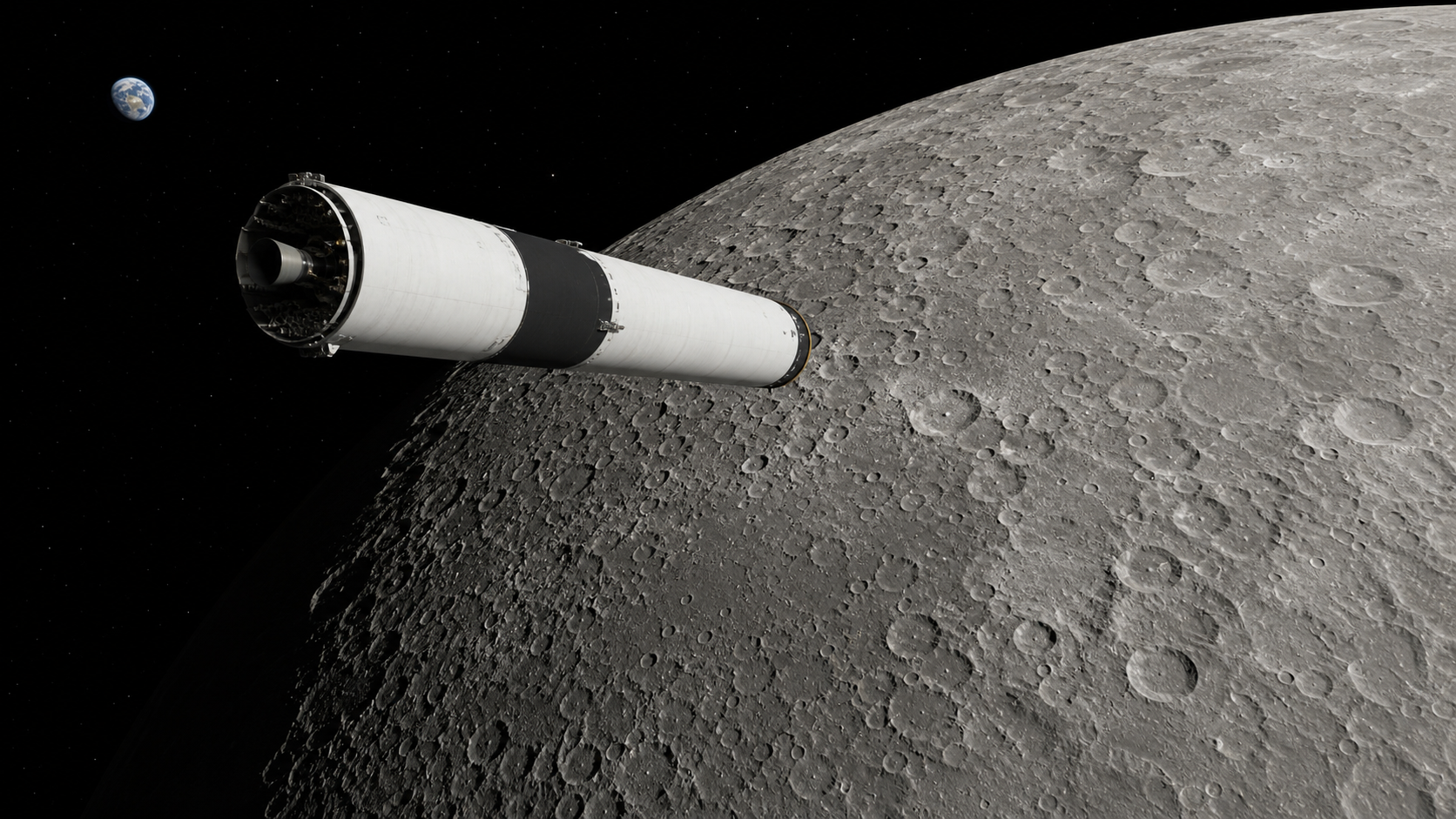
Moon dust could rise as high as 100 km
A separate computer model predicts an ejecta curtain 15 to 20 km high and a central spike of material reaching 75 to 100 km.
Those are simulation results, not observations. The real plume will depend on the surface, the stage’s true mass and its impact angle.
Can anyone see it?
The target is near Einstein Crater on the Moon’s bright limb as seen from Earth. The impact flash will probably be too brief and faint for the unaided eye.
Professional equipment may have a better chance of catching dust rising beyond the limb. Researchers have invited ground- and space-based telescopes to observe before and after impact.
Why an accident can become an experiment
Human-made objects have hit the Moon before. Apollo hardware and NASA’s LCROSS were deliberately crashed, while another spent rocket struck unintentionally in 2022.
This impact is known in advance. Comparing the real crater and plume with forecasts can improve lunar-impact models and tracking of debris in the space between Earth and the Moon.
Official primary sources
Primary source: Project Pluto orbit and impact prediction
Primary source: Observational planning paper (arXiv:2607.14625)