WORLD NEWS
Did the octopus family’s “submarine” start at just a few millimetres?
A millimetre-sized fossil from a very distant branch of the octopus and squid family preserves what may be an early device for controlling buoyancy.
It is a candidate for the earliest cephalopod, not a proven direct ancestor of modern octopuses or a fully developed submarine system.
What was found?
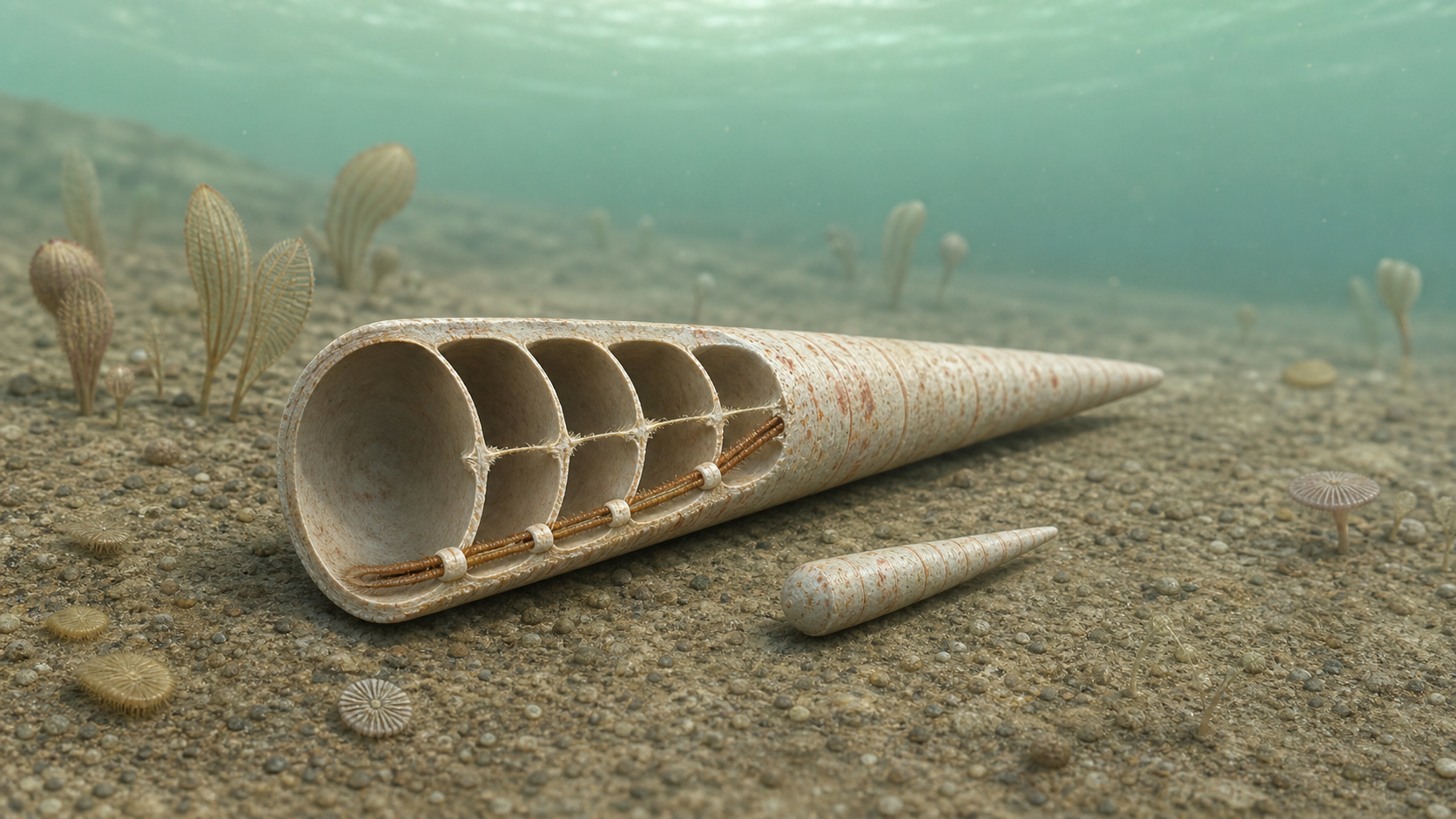
Researchers described Eoceras shaanxiense from an early Cambrian rock formation in South China. Its straight, cone-shaped shell was only a few millimetres long.
Scanning electron microscopy and high-resolution micro-CT revealed several internal partitions that formed chambers. A thin tube also ran near the shell edge and linked the chambers.
Why compare it to a tiny submarine?
A living nautilus rises and sinks by changing the liquid and gas inside its shell chambers. A thin strand of tissue called a siphuncle helps manage that process.
The tube in Eoceras appears to have connected its chambers through minute canals. The team interprets it as a candidate primordial siphuncle, an unfinished-looking stage of the same basic system.
Why connect it with octopuses?
Octopuses, squid, cuttlefish and nautiluses are all cephalopods. In early fossils, the combination of a chambered shell and a tube linking those chambers is a crucial clue to the group.
The oldest widely accepted cephalopods came from the late Cambrian. If this interpretation holds, the cephalopod stem reaches back into the early Cambrian.
Does that mean it swam like a squid?
No. Its anatomy suggests that it may have adjusted buoyancy, but there is no evidence that it swam rapidly, used jet propulsion or chased prey.
“Submarine” is an analogy for the physical principle. The study examined fossil anatomy; it did not observe the animal moving.
What is still uncertain?
Modern cephalopod siphuncles are continuous, while this fossil’s tube is segmented. The paper therefore calls it a candidate primordial siphuncle, not a settled identification.
More fossils are needed to establish its exact place on the family tree. The firmest result is a glimpse of chambered buoyancy anatomy being assembled at a very early stage.