WORLD NEWS
Webb identifies the host of a radio burst that travelled for over 10 billion years
The Webb space telescope identified the host galaxy of a brief radio signal that travelled across space for more than 10 billion years.
This is the most distant fast radio burst known so far, not the most distant object of every kind, and its physical cause has not been established.
One telescope detected the burst, another studied its galaxy
Fast radio bursts are intense radio signals lasting only milliseconds. The MeerTRAP team detected FRB 20240304B with South Africa’s MeerKAT telescope on 4 March 2024. Radio data suggested great distance, but ground-based optical observations could not reveal the galaxy at that position. Webb located the galaxy with near-infrared imaging and examined its spectrum to determine the distance. Webb did not photograph the instant of a radio explosion.
Redshift 2.148 places the signal in a young universe
NASA reports a redshift of 2.148. This describes how cosmic expansion stretches light and places the observed galaxy at about 3 billion years after the big bang. A journey lasting over 10 billion years provides a comparison with the history that unfolded while the signal travelled. Travel time is not the same as the galaxy’s present distance. That calculation must separately account for cosmic expansion.
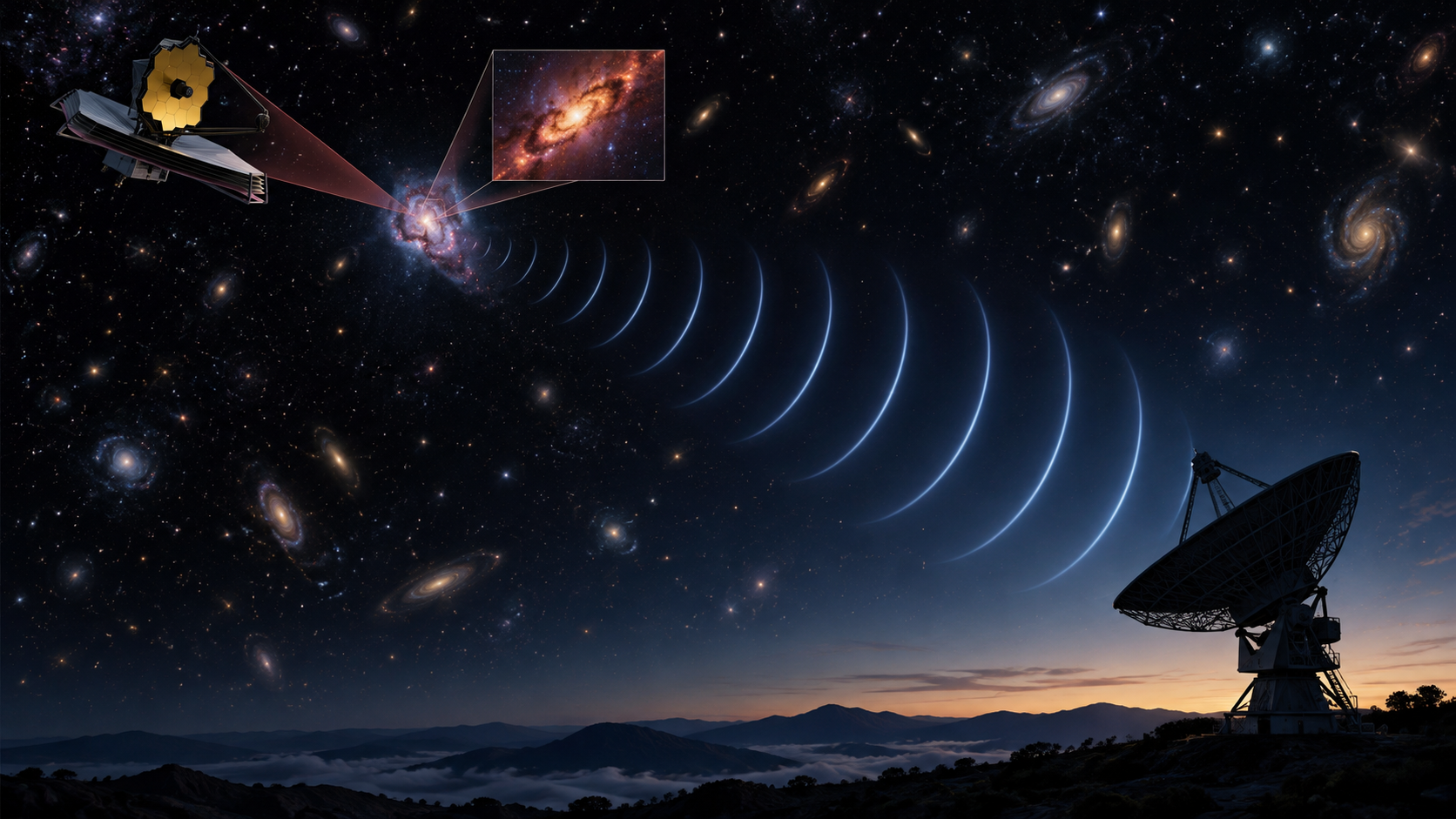
A small star-forming galaxy helps narrow possible causes
The host is a small galaxy actively forming stars. The researchers interpret this young environment as a better fit for a young, strongly magnetic neutron star, a magnetar, than for a merger of two neutron stars requiring a long delay. The environment and timing are clues, rather than a direct observation of the cause. An outside expert interviewed by ABC also did not rule out multiple ways to produce fast radio bursts.
Beyond the record, the signal can trace matter along its path
Matter encountered during the journey changes the arrival timing of different radio frequencies. Distant bursts can therefore probe matter scattered between galaxies, making that measurement an important follow-up beyond the distance record. NASA introduced the findings on 8 October, and ABC interviewed researchers and an outside expert on the 9th. This article uses the overlapping observation and interpretation in those accounts; direct full-text access to the linked Science paper was restricted. Repeated searches for farther bursts and comparisons of their host galaxies are the next checks.
Primary source and independent checks
Primary source and official explanation: NASA Webb Mission Team
Paper reference; full-text access restricted: Science
Independent reporting check: ABC Science
Read in other languages
한국어 · English · Español · 日本語 · Tiếng Việt