WORLD NEWS
Bleached coral recovered in seven weeks after touching a healthy clone
Stanford researchers report that bleached coral fragments recovered within seven weeks in the laboratory after contact with healthy clones.
The small experiment connected genetically identical coral; it does not show that joining arbitrary corals will restore a reef in the ocean.
Is a white coral already dead?
Corals are animals that live with tiny algae inside their tissues. The algae supply nutrients produced through photosynthesis. When temperature stress drives these partners away, coral loses colour and becomes vulnerable to starvation: bleaching. White colour does not automatically mean immediate death, but failure to recover can be fatal. The study explored whether returning these partners could help living, bleached coral recover.
What was touching, and what was the comparison?
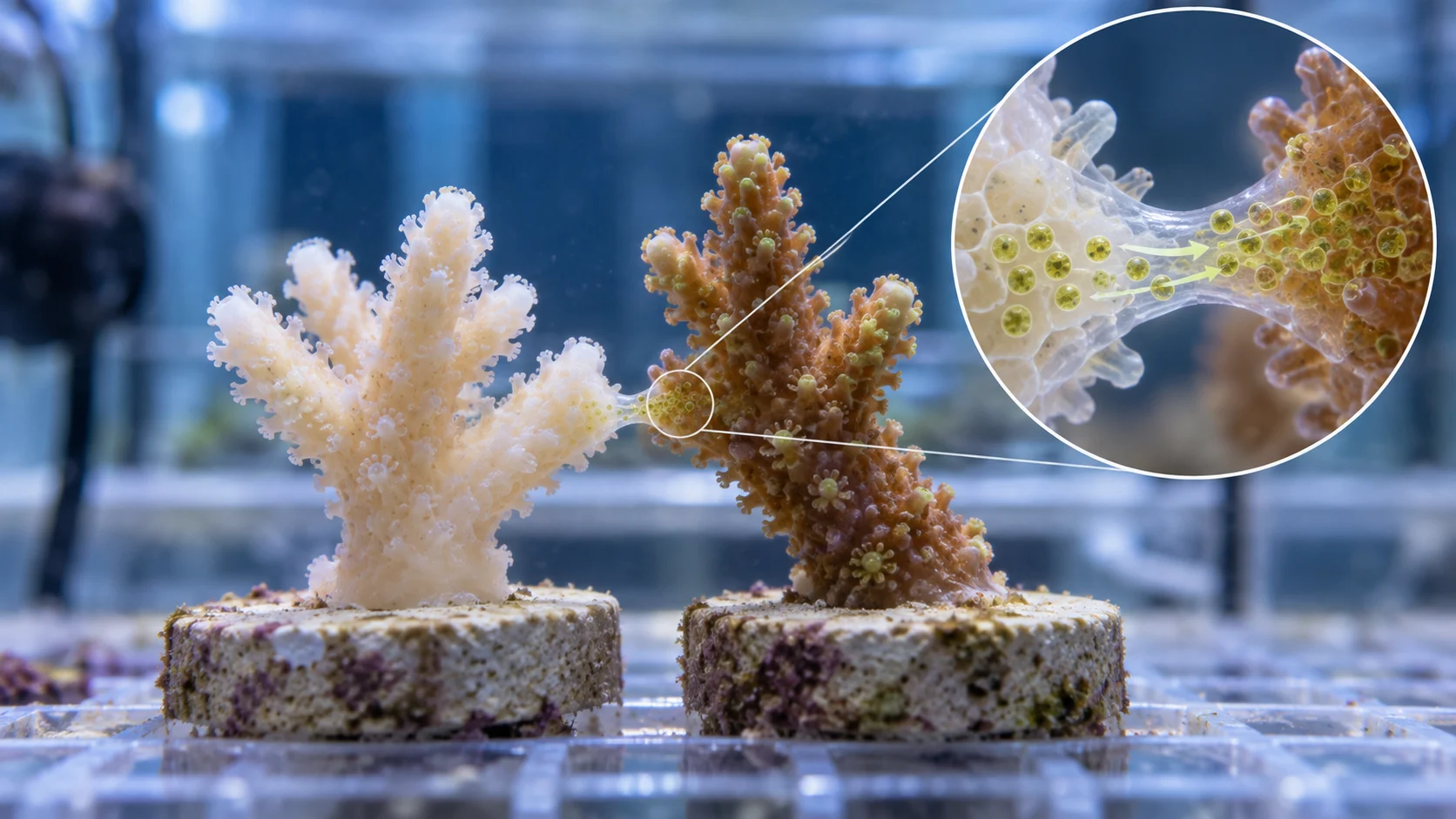
The researchers paired a healthy fragment with a bleached fragment from the same animal. The reported comparison used 10 pairs: five were touching and five were separated by a few millimetres. Bleached fragments in contact recovered within seven weeks, while those kept apart died. This compares actual tissue contact with mere proximity. It is not a large trial measuring a success rate across every species and environment.
What do three days, one week and seven weeks mean?
After contact, tissue channels provided a route for algae and nutrients to move from the healthy fragment. Algal transfer was observed within three days. After about a week of contact, some fragments had enough algae to continue recovering after separation. Neither period means complete recovery had already occurred. Seven weeks describes the recovery outcome; brief contact helped start the process.
Why is this not ready for a whole reef?
The approach requires a genetically identical healthy fragment for each bleached coral, making reef-scale application impractical. The team plans to explore other ways of supplying algae. Effects and persistence still need testing across species, genetic types and natural waters. Stanford dates the paper to October 14. KQED’s independent interviews support the laboratory scope, but its reference to Monday conflicts with that date and is not adopted here. Direct access to the full paper was restricted; this report cross-checked the university account and independent explanations.
Primary sources and independent checks
Research institution: comparison, recovery timing and genetic matching; full paper DOI 10.1126/sciadv.aeh1580 directly restricted: Stanford Doerr School of Sustainability: Katie Jewett, 14 October 2026
Independent interviews: lab, genetic condition and limits; Monday wording conflicts with university date and is excluded; no replication: KQED: Danielle Venton, 14 October 2026
Independent science reporting: tissue bridge and algae; distinct from the original paper or replication: Nature News: Sarah Wild, 14 October 2026
Read in other languages
한국어 · English · Español · 日本語 · Tiếng Việt