WORLD NEWS
Eleven frames connect 100-femtosecond events to 10 nanoseconds in one shot
University of Tokyo researchers developed logarithmic ultrafast photography to connect an event’s earliest instant with what happens afterward in one shot.
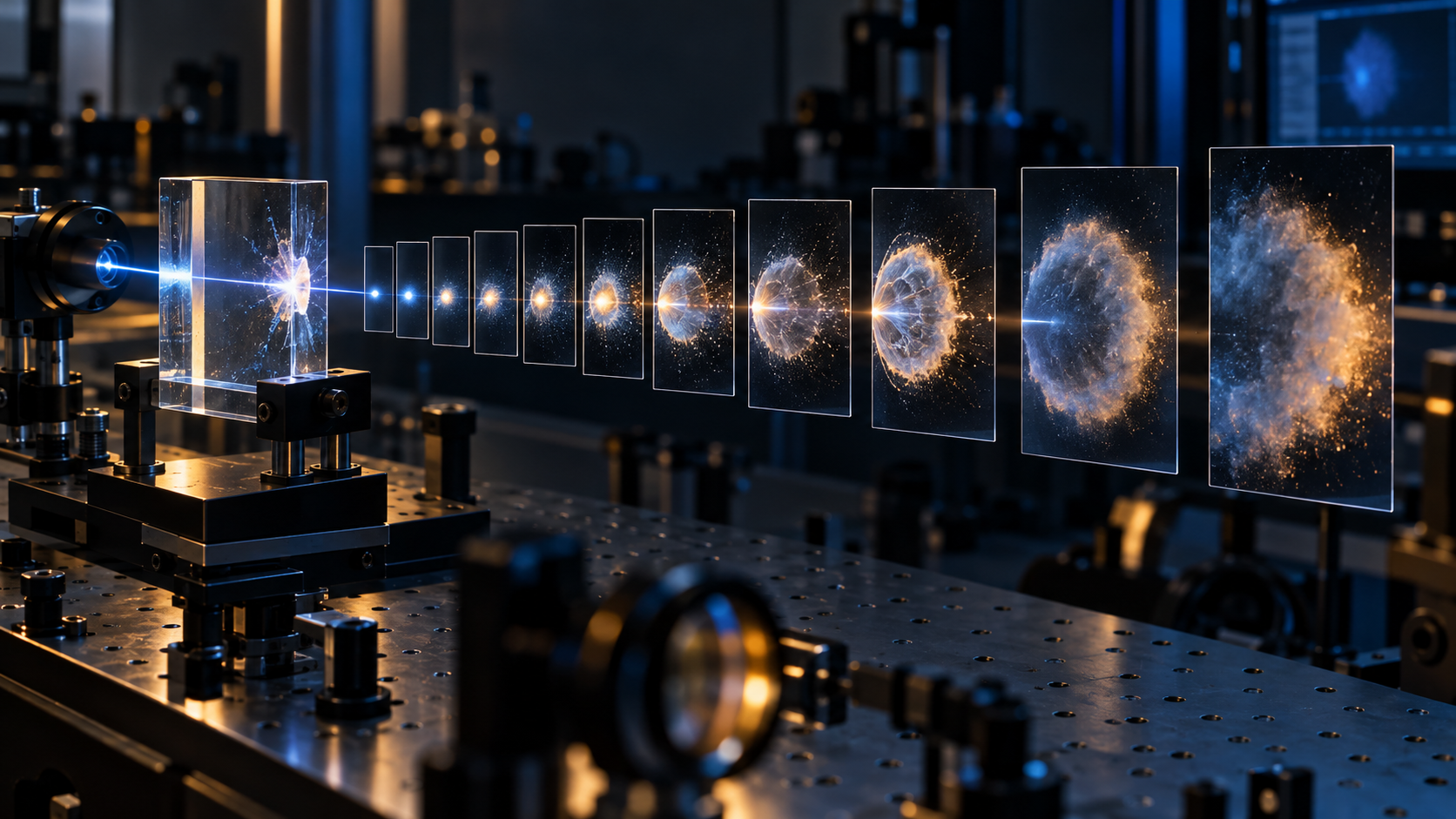
Its 11 frames span from the 100-femtosecond range to 10 nanoseconds, about five orders of magnitude. They are not equally spaced frames in a constant-speed movie.
Why change the spacing
Conventional ultrafast imaging faces a trade-off: short intervals show the beginning in detail but cover little time, while long intervals miss early changes. BRIDGE independently delays different wavelength bands, placing frames densely at first and progressively farther apart.
What was actually imaged
The team irradiated glass and hydroxyapatite, a major component of bone and teeth, with a laser. One exposure followed early plasma-related changes, later shock waves and material ejection in 11 frames, and revealed different late responses in the two materials.
What five orders means
The range stretches from around 100 femtoseconds to 10 nanoseconds, roughly a factor of 100,000. The point is not a record frame rate but connecting multiple timescales during one hard-to-repeat event. Resolution and usable range still depend on the optical setup.
Where it may help
Possible uses include laser processing, plasma, shock-wave and biomaterial research. The paper is a laboratory demonstration, not proof of a medical diagnostic or industrial product. Tests on more materials and less controlled events are the next evidence to watch.
Primary source and independent checks
Primary paper: Optica 원 논문
Institutional or data check: JST 공동 발표
Independent or context check: 도쿄대 공학계 연구 설명
Read in other languages
한국어 · English · Español · 日本語 · Tiếng Việt