WORLD NEWS
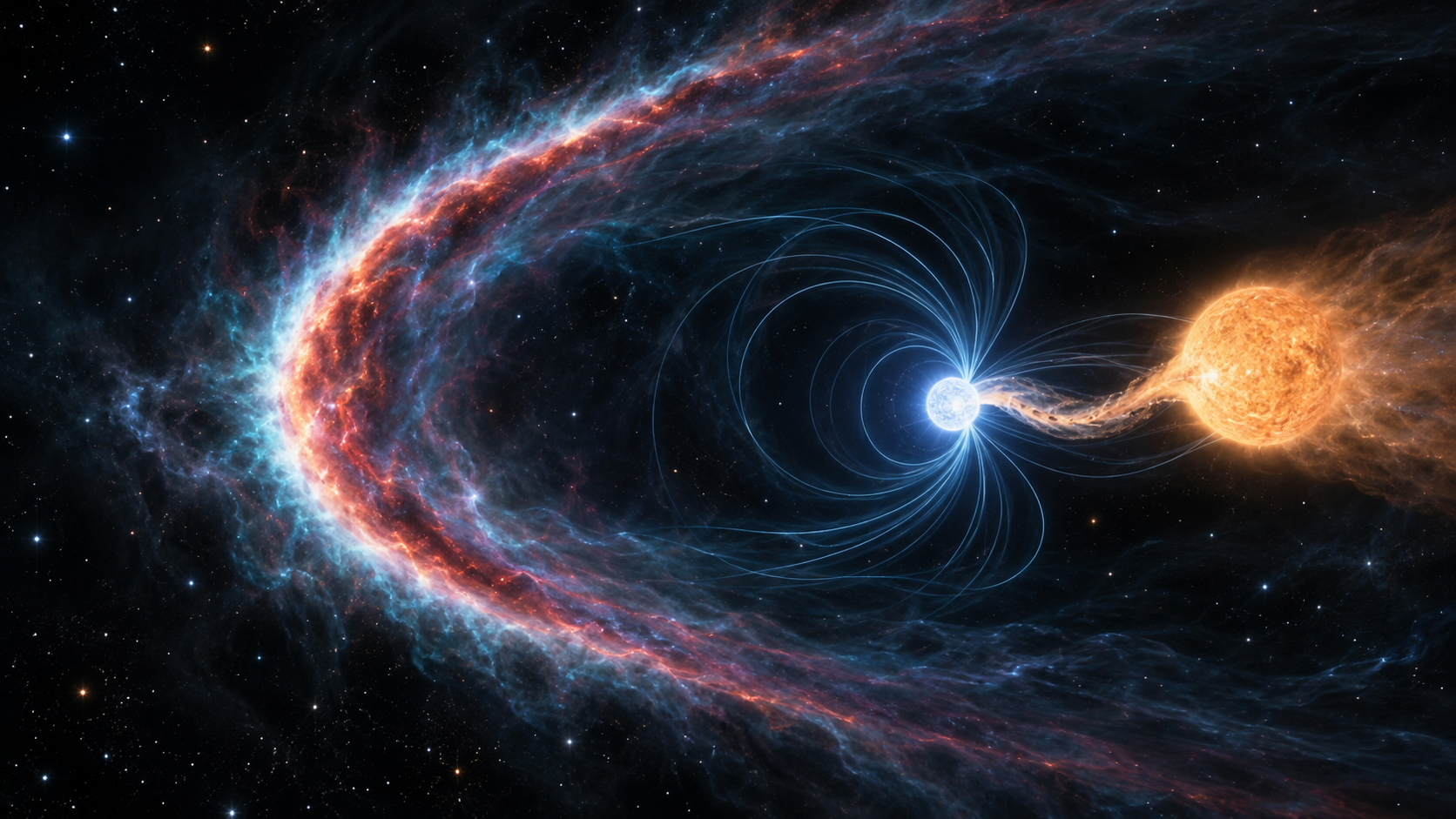
A diskless white dwarf carries a bow shock built over at least 1,000 years
The structure was first seen with the Isaac Newton Telescope and mapped in hydrogen, nitrogen and oxygen with MUSE on ESO’s Very Large Telescope.
Its shape and composition support an outflow from the moving binary striking interstellar gas, rather than an unrelated cloud.
Why the missing disk matters
Transferred matter normally forms a disk around a white dwarf and powers strong outflows. No detectable disk appears here, removing the usual link in that explanation.
The magnetic timescale falls short
The white dwarf’s field is estimated at 42–45 megagauss and can channel matter directly. Yet its present energy could sustain the shock for only a few hundred years, shorter than the inferred minimum of 1,000.
Observation versus inference
The location, emission lines and binary motion were observed. Duration comes from size and speed, while the proposed hidden engine remains a hypothesis.
What further observations can test
Astronomers need more magnetic, diskless binaries. ESO’s Extremely Large Telescope could compare fainter examples and gas velocities to test whether another energy source is required.
Primary source and independent checks
Primary source: Nature Astronomy paper
Institutional explanation: ESO observation release
Independent check: MEDIA INAF independent report
Read in other languages
한국어 · English · Español · 日本語 · Tiếng Việt