WORLD NEWS
White dwarfs need not look white: a study calculates green and pink hues
Some white dwarfs could appear green or pink to human eyes if they could be viewed from close enough.
The finding comes from stellar spectra and a colour-vision model, rather than a photograph showing those colours directly from Earth.
Why can a white dwarf have another colour?
White dwarfs are dense cores left after stars like the Sun end their lives. In research released on 15 October, Warwick scientists explain that atmospheric composition and density can alter apparent colour alongside temperature. Elements such as sodium and carbon in cool, dense atmospheres absorb broad ranges of light, allowing calculated colours beyond the orange, white and blue typical of ordinary stars.
Five unusual colours in a sample of 151
The team also examined 151 white dwarfs within 20 parsecs, about 65 light-years, of Earth. Five had unusual colours: two yellow and three pink. Roughly one in thirty describes a proportion inferred from this sample, not a census of every white dwarf in the universe. The green example WD J1330+6435 should not be counted among those five. Most objects remained close to white.
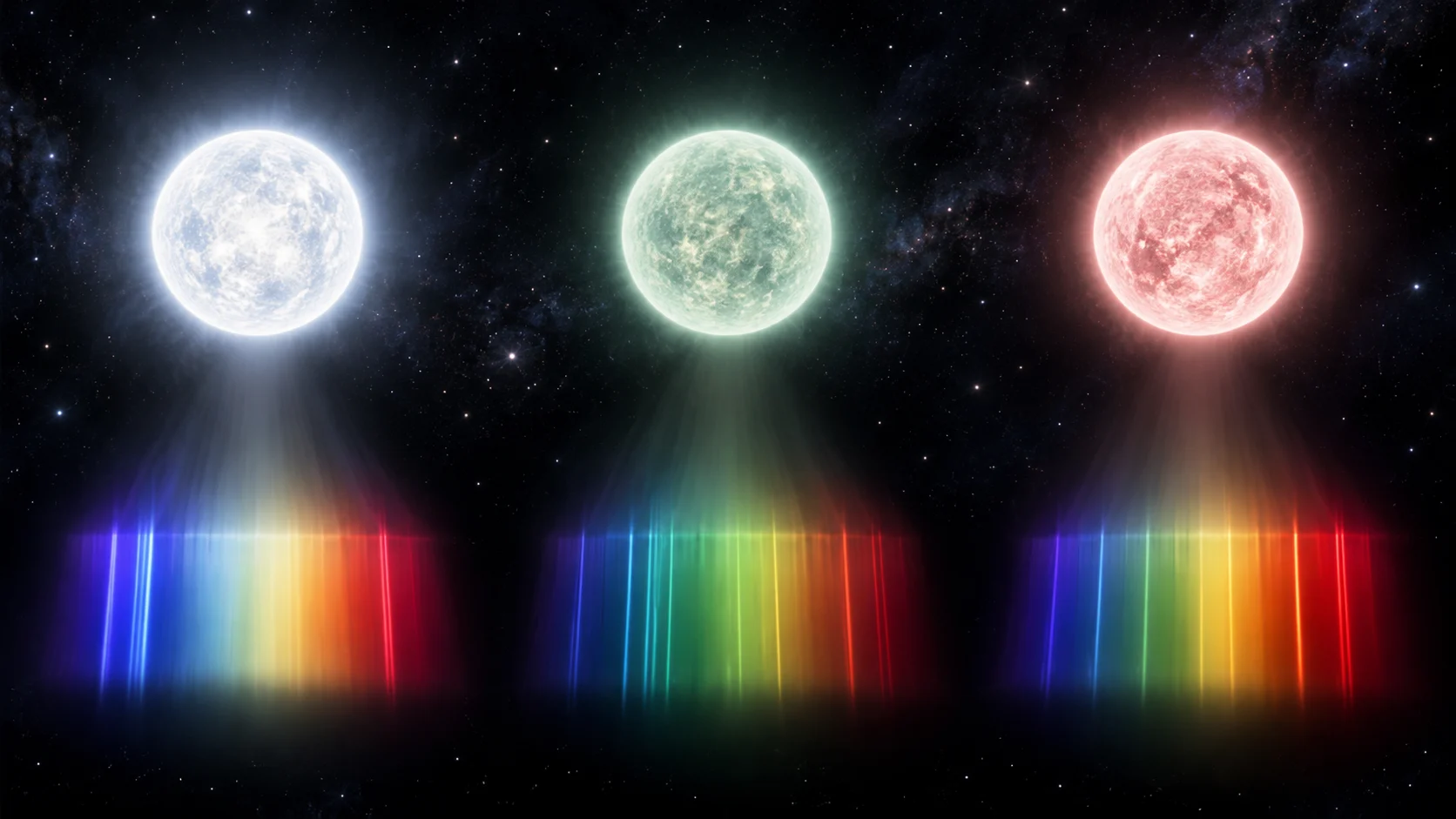
Green light points to atmospheric ingredients
The researchers describe calcium, lithium and sodium from rocky material in WD J1330+6435’s atmosphere. Sodium absorbs orange and other wavelengths, shifting the remaining light towards green. CNN interviewed researcher Mark Hollands and sought comments from uninvolved astronomers Adam Burgasser and Agnès Kim. Kim called the work an intriguing new presentation of existing data, without treating it as necessarily establishing new white-dwarf physics.
Would a telescope show the same colour?
Human colour discrimination weakens for faint objects, and astronomical images can map observed wavelengths into display colours. The calculation is therefore not a guide to seeing those coloured discs in the night sky. More stellar spectra could help test relationships between rare colours and atmospheric chemistry. The AI illustration explains the concept; it is neither an observation nor a colour-accurate rendering of the paper’s results.
Primary sources and independent checks
Research institution: 15 October colour calculations and the composition of the 151-object sample: University of Warwick
Independent reporting: 16 October researcher interview plus comments from uninvolved Burgasser and Kim: CNN / KESQ
Read in other languages
한국어 · English · Español · 日本語 · Tiếng Việt