WORLD NEWS
Antarctica’s “Blood Falls” has marine microbes, but not in the waterfall
Scientists found an active community of complex, marine-derived microbes in red ice, mud and sediment at Antarctica’s Taylor Glacier. RNA showed that members of the community were active when the samples were collected.
They were not detected directly in the salty reservoir beneath the glacier. The study also does not prove that these organisms survived there for 2.5 million years.
Why does the waterfall look like blood?
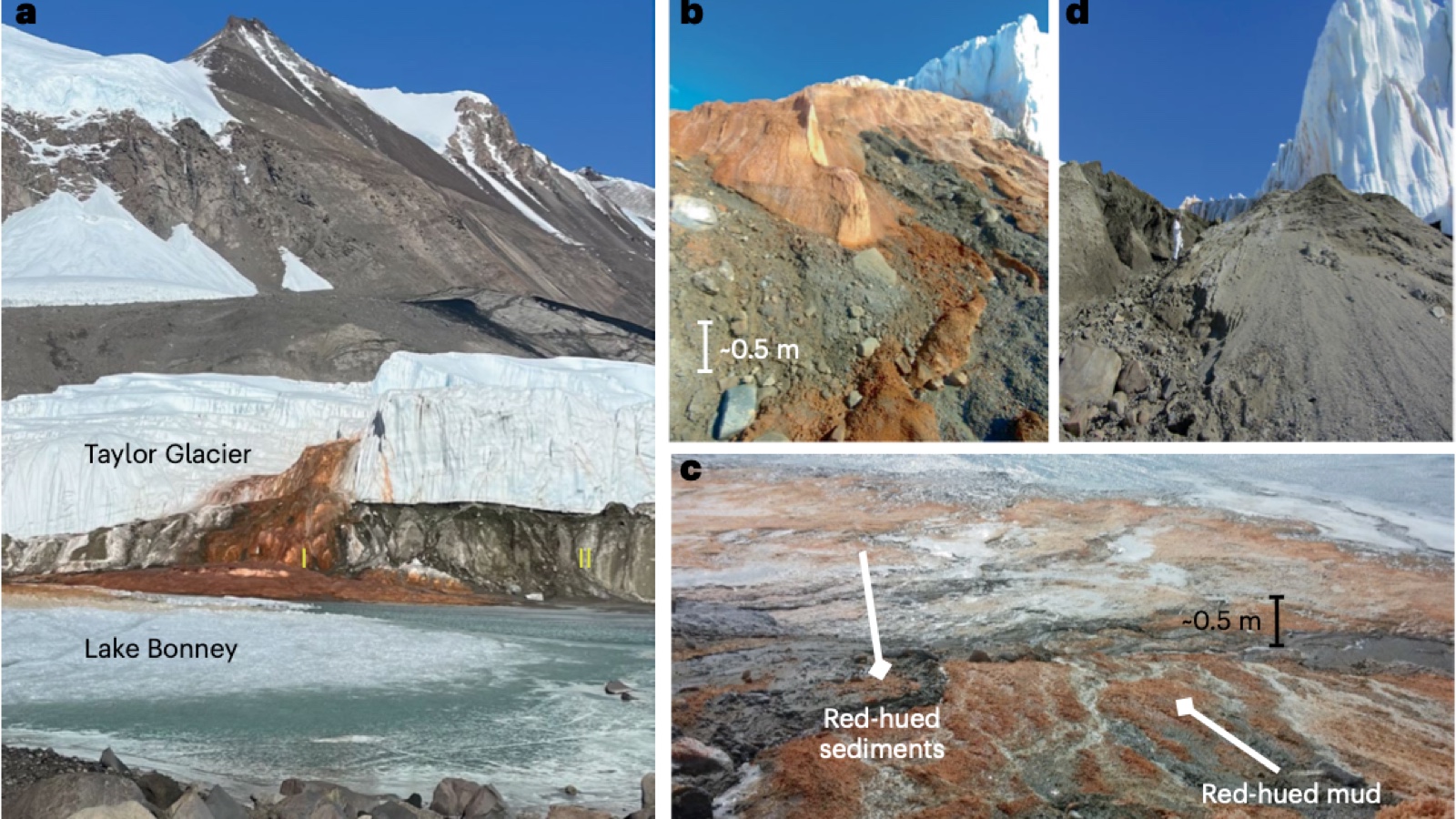
Blood Falls is a place where salty water sometimes escapes from the end of Taylor Glacier. Iron in the water rusts when it meets air, staining snow and rock red. Blood or red organisms do not cause the color.
Seawater may have been trapped as the glacier advanced, forming today’s brine reservoir. Earlier work found bacteria in that water, but not the more complex microbes whose cells contain a nucleus.
What did the team find, and where?
The team collected 167 samples of water, ice, mud, sediment and windblown material around Blood Falls, across the McMurdo Dry Valleys and from nearby marine sites. A distinct marine community appeared in red ice, mud and sediment at the glacier’s end.
It included several kinds of eukaryotic microbes, such as diatoms, dinoflagellates and ciliates. Crucially, the researchers did not detect eukaryotes in the subglacial brine itself.
Were the microbes really alive?
DNA can remain after an organism dies. The team also examined RNA, which breaks down faster. It found signs that light-using microbes were active when the samples were collected.
Pathways for coping with salt stress and repairing cells were active too. This is a snapshot from the late Antarctic summer, not evidence that one organism lived for millions of years.
What connects them to the sea?
The Blood Falls community shared far more genetic types with nearby marine samples than other inland waters did. The overlap was 9.34% at the glacier terminus, compared with 1.15% in other Dry Valleys aquatic communities.
For diatoms alone, the comparison was 20.4% versus 1.5%. Related Taylor Glacier and marine lineages also showed signs of genetic separation, consistent with a long period of isolation.
Modern wind samples carried almost no marine signal. That makes present-day wind alone an unlikely explanation for the whole community.
Are they descendants of 2.5-million-year-old life?
Possibly, but the study cannot settle that question. The evidence fits long persistence after an ancient marine incursion, yet older wind transport and a very small modern input remain possible.
The short gene region used here also cannot establish new species or local endemics. Longer genomes and cultured cells are needed to date the split more precisely.
What is clear is that complex marine-derived microbes are active in one of Antarctica’s driest environments. That gives researchers a new clue to how life can endure a severe environmental shift.
Official primary sources
Primary source: Nature Geoscience original research article
Primary source: Yale University official research release
Primary source: NCBI BioProject raw sequence record PRJNA1268596