WORLD NEWS
The spacecraft sent to rescue a telescope is now spinning itself
The robotic spacecraft sent to lift a falling NASA telescope has started tumbling during its own rescue mission.
Two of LINK’s three reaction wheels are not working, but power, communications, and main propulsion remain available, so the mission is not over.
What was LINK sent to save?
NASA’s Swift observatory has detected gamma-ray bursts and other violent cosmic events since 2004. Increased solar activity expanded Earth’s upper atmosphere, increasing drag and lowering Swift’s orbit faster than expected.
NASA awarded Katalyst $30 million in September 2025 to raise the telescope. LINK was designed, built, tested, and launched in less than a year, reaching orbit on July 3, 2026.
Why did the rescuer start spinning?
Katalyst said LINK spent roughly 72 hours in a multi-axis spin. Communications were temporarily lost and the spacecraft bus reset.
Two of three reaction wheels, internal flywheels used to point a satellite, are non-functional. The small gas-thruster system used for fine control also has only partial functionality.
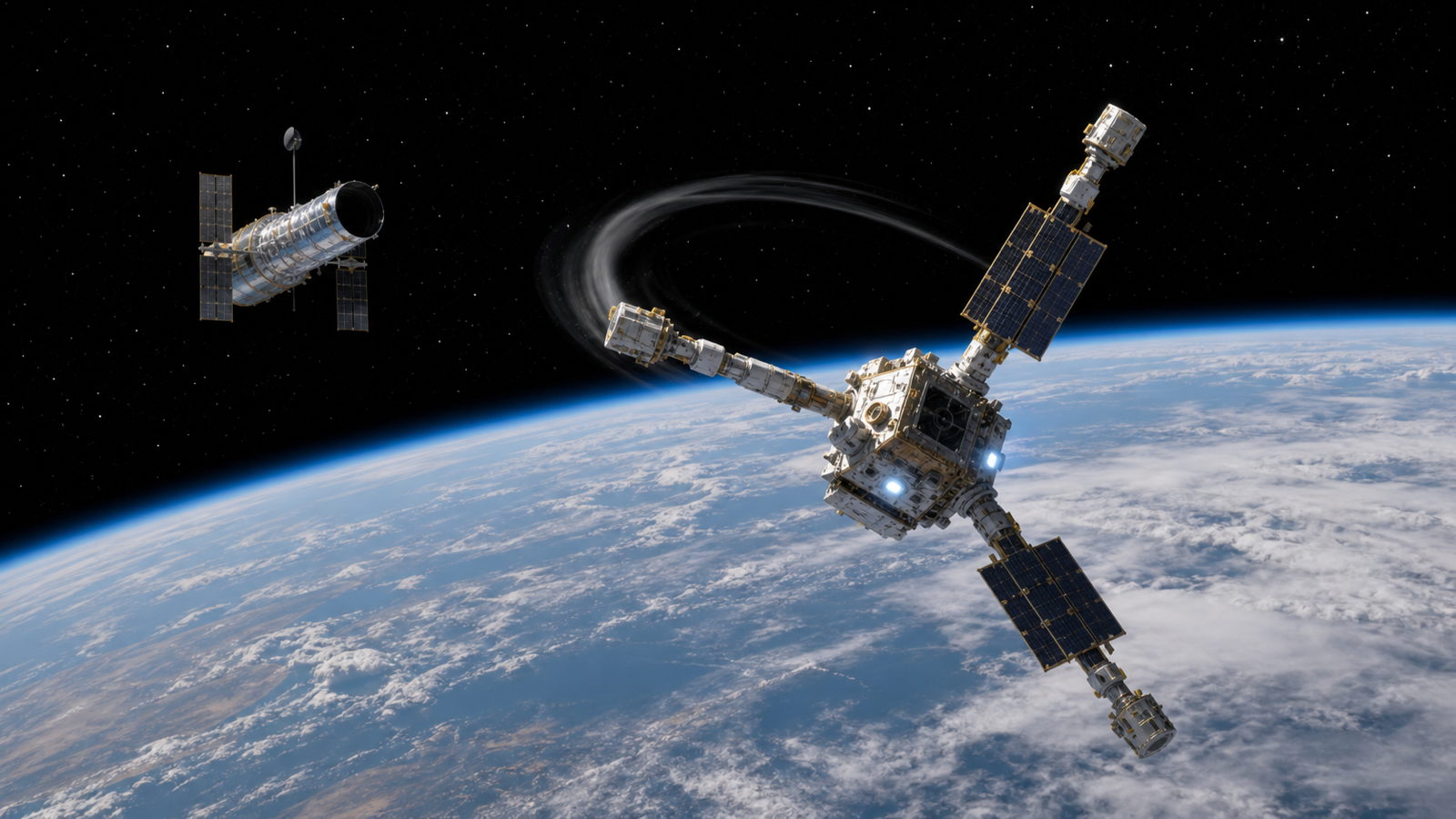
The spacecraft is not dead
Electric propulsion, robotic systems, approach sensors, power, and communications are operating. LINK remains power positive and in contact with controllers.
The team is using steerable electric thrusters to slow the spin. Its July 28 update said those burns had begun producing the intended effect.
Can it still reach Swift?
After stopping the spin, engineers must rewrite guidance and control software for the remaining hardware. Ground tests would be followed by a move into a similar orbit and an inspection of Swift.
Capture will be attempted only if LINK is healthy and the approach is safe. Officials say the mission remains active, not that success is assured.
Why time matters
Swift suspended most science observations in February to reduce drag and preserve altitude. Every delay leaves less orbital margin for a capture attempt.
This is the first planned commercial robotic capture of a government satellite never designed for servicing. It could open a new way to save aging spacecraft, but first the rescuer must stop spinning.
Official primary sources
Primary source: Katalyst LINK mission tracker and July 28 status
Primary source: NASA July 28 commissioning update
Primary source: NASA Swift orbit-boost contract announcement