WORLD NEWS
Jurassic swimmer fossil reveals structures for mammal-like swallowing
A roughly 165-million-year-old fossil from China reveals the body and throat structures of a mammal relative interpreted as an aquatic hunter.
It is not a modern otter, and swimming or milk feeding was not observed directly.
Small body, detailed throat preservation
Megacauda sungei, described in Nature on 7 October, is an extinct animal from what is now Inner Mongolia. The University of Chicago gives an estimated length of 40–50 cm and mass of 1–2 kg. Roughly 165 million years is an approximate geological age. The mass is inferred from fossils, not measured in a living animal; it belongs to an extinct lineage closely related to modern mammals.
What the throat adds
Researchers highlight the throat passage and small bones supporting tongue and throat muscles. They resemble structures allowing modern mammals to swallow chewed food in portions. The team interprets them as evidence relevant to the evolution of swallowing and suckling capabilities. This is a functional inference from anatomy, not fossil footage or direct evidence of an animal nursing a baby.
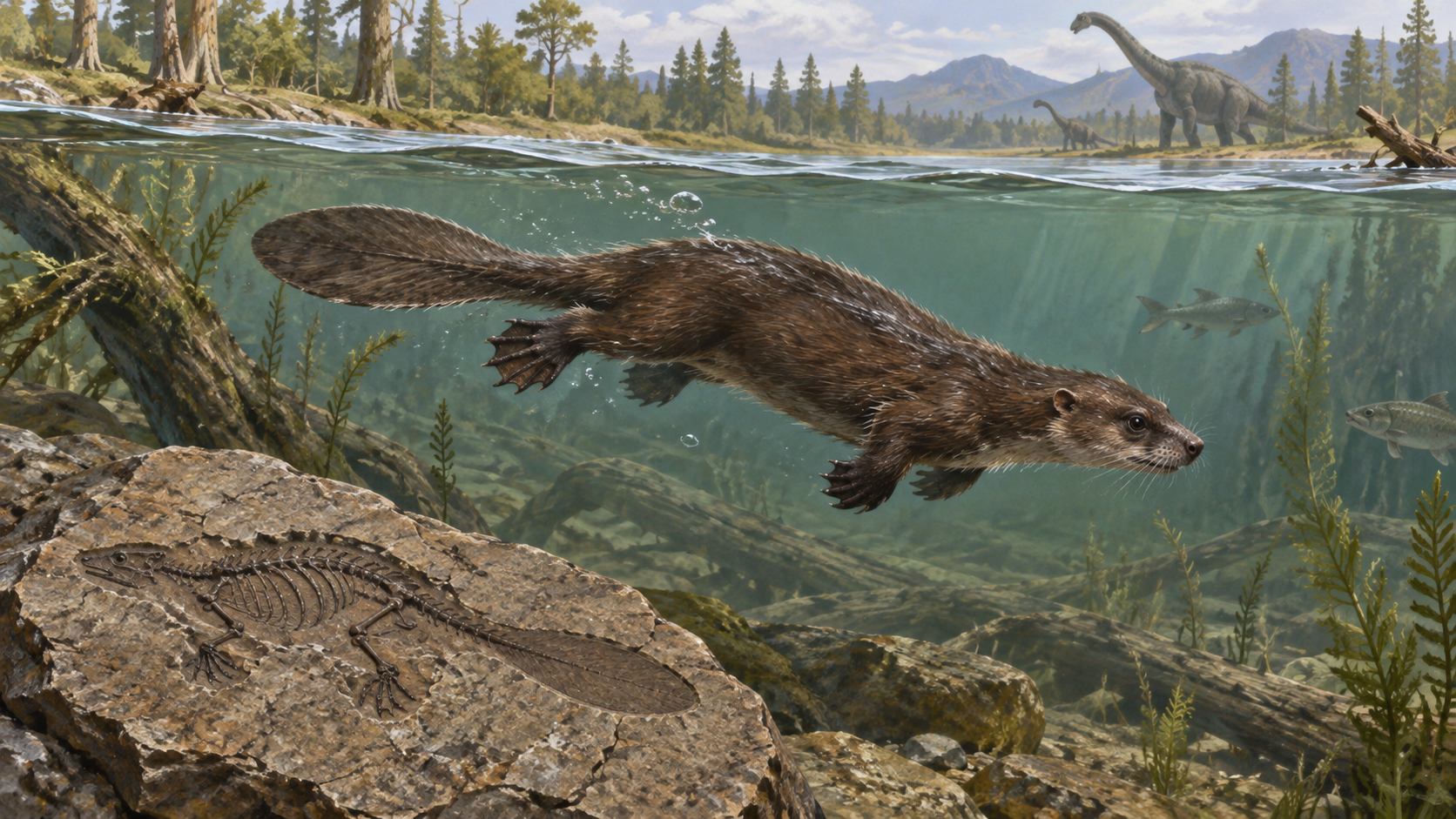
Swimming is an anatomical interpretation
The hind limbs, broad flattened tail, teeth and small vertebrate bones preserved in the stomach support foraging in water. Resemblance to an otter or platypus does not make it the same animal. Independent coverage includes assessments by scientists outside the team. The fossil adds evidence of diverse habitats used by mammal relatives in the dinosaur era, not proof that all early mammals lived this way.
Separate preserved bones from reconstructed functions
This check used the paper’s public abstract and extended figure descriptions, institutional information and matching independent reporting. The full subscription text was not directly read. Further specimens and comparisons behind the functional reconstruction remain useful next checks. The illustration is neither a specimen photograph nor an exact reconstruction. Reading the paper alongside institutional explanations helps separate observed structures from interpretations.
Primary source and independent checks
Public paper abstract and extended figure descriptions; full text requires subscription: Nature: Li et al.
Primary source and official explanation: University of Chicago
Independent reporting check: Live Science
Read in other languages
한국어 · English · Español · 日本語 · Tiếng Việt