WORLD NEWS
A basalt-treated watershed changed within weeks, but two-year export was 9.5–11% of theoretical potential
Spreading crushed basalt on soil produced measurable whole-watershed water-chemistry changes consistent with enhanced weathering.
Over two years, alkalinity exported by the stream represented 9.5–11% of theoretical removal potential, with a stronger signal in summer and autumn than winter and spring.
How large was the trial
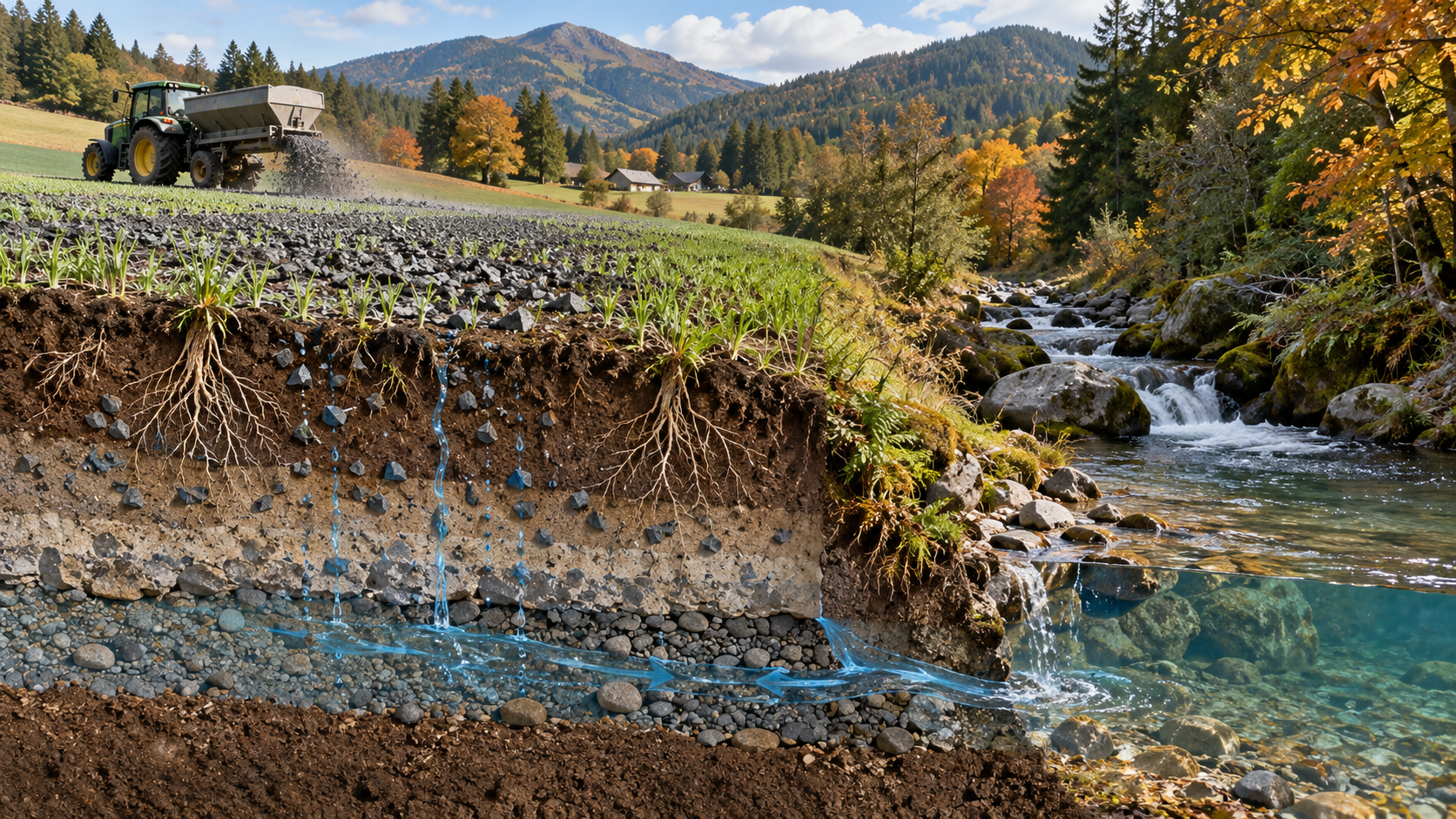
Basalt was applied at 20 tonnes per hectare to about 15% of a 59-hectare temperate headwater catchment. Researchers compared alkalinity, silica, lithium and major ions before and after treatment and against a counterfactual estimate.
What changed within weeks
Stream alkalinity rose as much as 557 microequivalents per litre above counterfactual estimates. Element ratios plus silica and lithium chemistry shifted consistently with basalt dissolution, making a purely seasonal explanation less likely.
How strong was seasonality
Enhanced weathering accounted for 7–17% of observed alkalinity in successive summers and autumns but less in winter and spring. Temperature affects dissolution, while rain, snow and groundwater control when products reach the stream.
Can this be counted directly
Average export equalled 34.7 tonnes of CO₂ per square kilometre per year. Mining, grinding and transport emissions, carbon retained in soil, downstream durability, metals and ecology still require separate accounting. The 9.5–11% is not universal efficiency.
Primary source and independent checks
Primary paper: Nature Water 원 논문
Institutional or data check: Yale 유역 규모 현장시험 설명
Independent or context check: Yale Center for Natural Carbon Capture 기술 설명
Read in other languages
한국어 · English · Español · 日本語 · Tiếng Việt