WORLD NEWS
Space just got sweeter: the first “true sugar” found between the stars
Astronomers detected erythrulose in a molecular cloud about 8.2 kiloparsecs away near the Galactic Centre.
It is the first “true sugar” identified in interstellar space, but it is not evidence of life or a lump of table sugar.
What makes it a first
Erythrulose is a four-carbon ketose with a carbonyl group and multiple hydroxyl groups, satisfying the chemical definition used by the researchers for a true sugar.
Sugar-related molecules had been found in space before, but not a sugar itself meeting these conditions in the interstellar medium.
Two radio telescopes caught the fingerprint
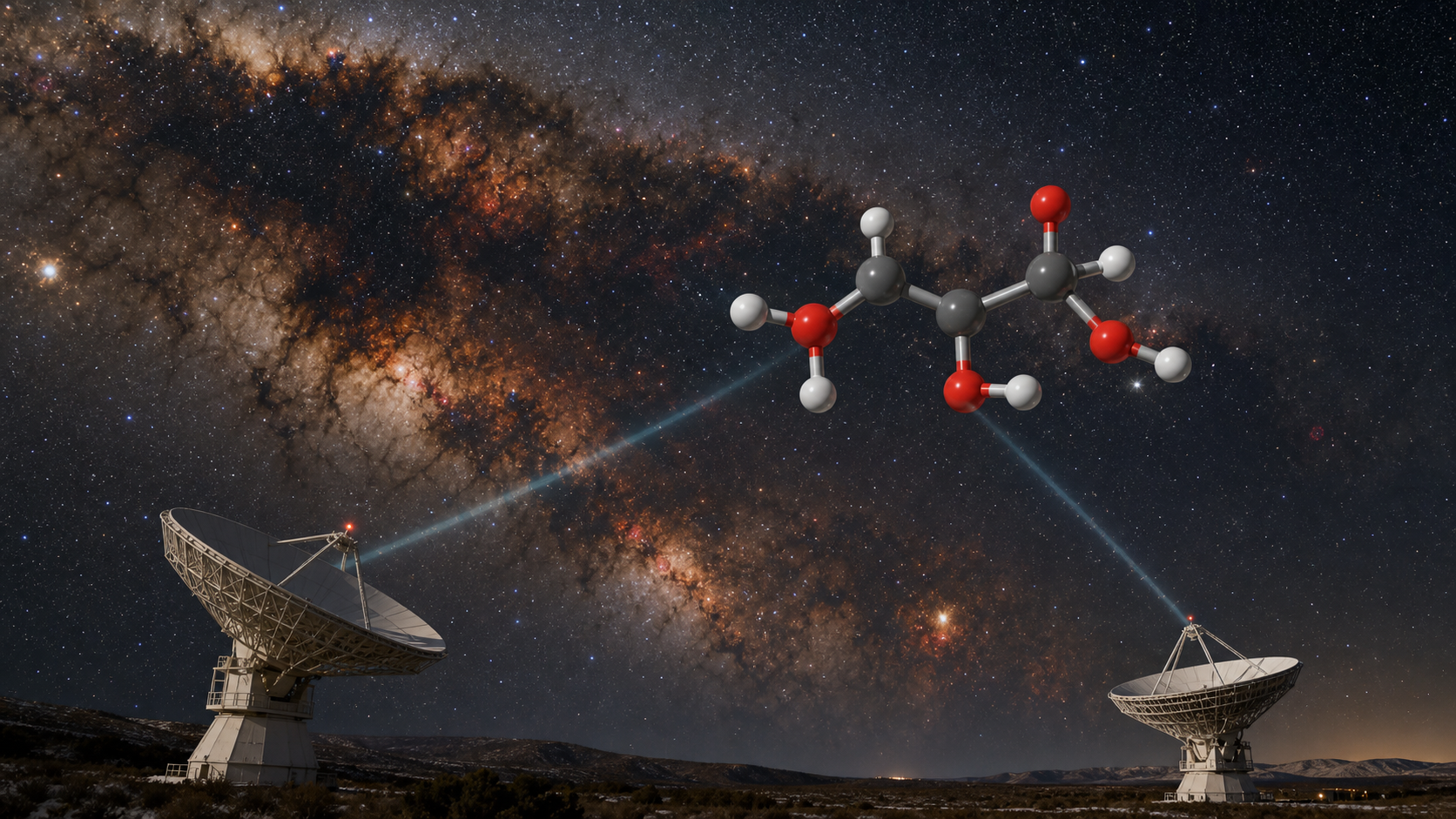
The team observed cloud G+0.693-0.027 with Spain’s Yebes 40-metre and IRAM 30-metre radio telescopes.
Multiple rotational spectral lines matched laboratory measurements, with separate instruments and frequency ranges supporting the identification.
It was more abundant than smaller sugars
Erythrulose was calculated to be at least eight times more abundant than analogous three-carbon sugars that the same search did not detect.
That complicates the simple expectation that larger molecules must always be scarcer and offers a clue for revising interstellar chemical networks.
The cosmic ingredient shelf just expanded
Sugars participate in terrestrial energy metabolism and the backbone of genetic material. Their formation in cold space broadens the chemistry available to planet-forming material.
Delivery by comets or meteorites remains a hypothesis; this observation proves neither delivery to early planets nor the emergence of life.
Neither sweet to taste nor a life signal
The abundance is tiny and the target is a distant cloud measured through radio spectra. It is not an edible deposit or a trace of extraterrestrial organisms.
Repeated detections in other clouds and experiments on its formation route are needed to establish how widespread cosmic sugar chemistry is.
Official primary sources
Primary source: Nature Astronomy paper