WORLD NEWS
An Earth-like auroral cycle operates on Mars without a global magnetic field
NASA’s MAVEN data show that small crustal magnetic-field regions in southern Mars circulate solar-wind energy through the same type of process that drives aurora on Earth.
Mars has no planet-wide magnetic field, but magnetism preserved in ancient rock creates miniature local magnetospheres.
Ion flow completed the picture
In Earth’s Dungey cycle, solar-wind and planetary fields reconnect on the dayside and particles circulate toward the nightside. Mars observations had magnetic fields and electrons but lacked the closing ion flow. Simultaneous MAG, SWEA and STATIC data supplied it and connected five elements.
Twenty times smaller and much faster
The paper estimates a spatial scale about 20 times smaller than Earth’s. Reconnection distance and solar-wind speed imply a cycle timescale near one minute, while ionospheric plasma flow of about 2 km/s was observed.
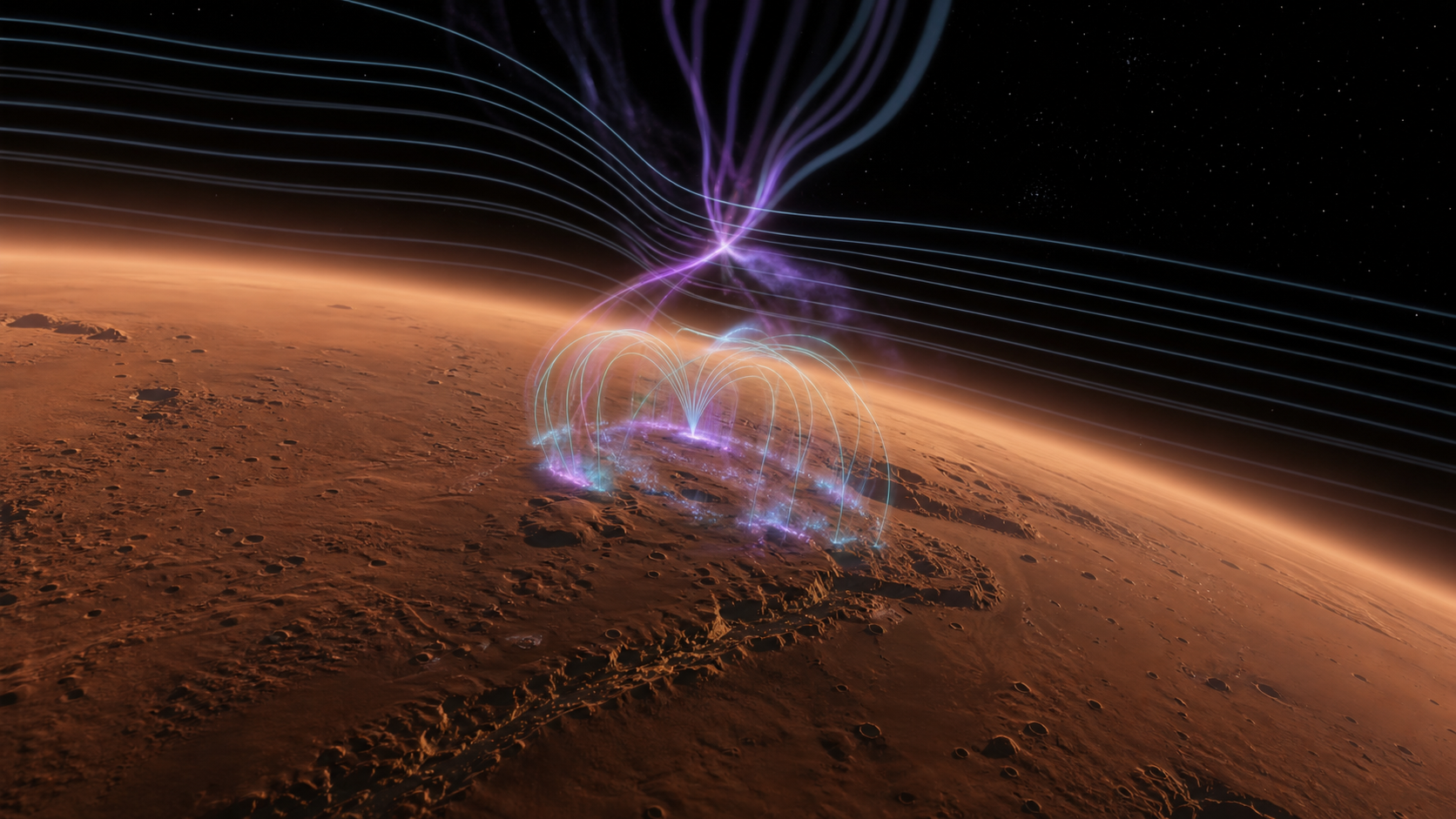
Why Martian aurora now look different
Local reconnection, particle acceleration, ionospheric flow and aurora can be interpreted as one physical circulation. It also provides a framework for comparing how the solar wind interacts with Mars’ upper atmosphere and helps remove atmospheric particles.
One minute was not directly timed
The figure is calculated from observed scale and solar-wind speed, not a stopwatch measurement of a full cycle. The study presents a main case and additional examples, but it does not establish the frequency across Mars or explain every aurora.
A local field is not Earth’s shield
The result concerns small crustal-field regions in southern Mars. They do not protect the whole planet like Earth’s global field. The next test is repetition over other crustal regions and a quantitative link to atmospheric escape.
Official Primary Sources
NASA MAVEN: instruments and significance of the Martian auroral cycle
Nature Communications: simultaneous magnetic-field, electron and ion observations