WORLD NEWS
Beta Pictoris d was found by its molecular signal through a dusty disk
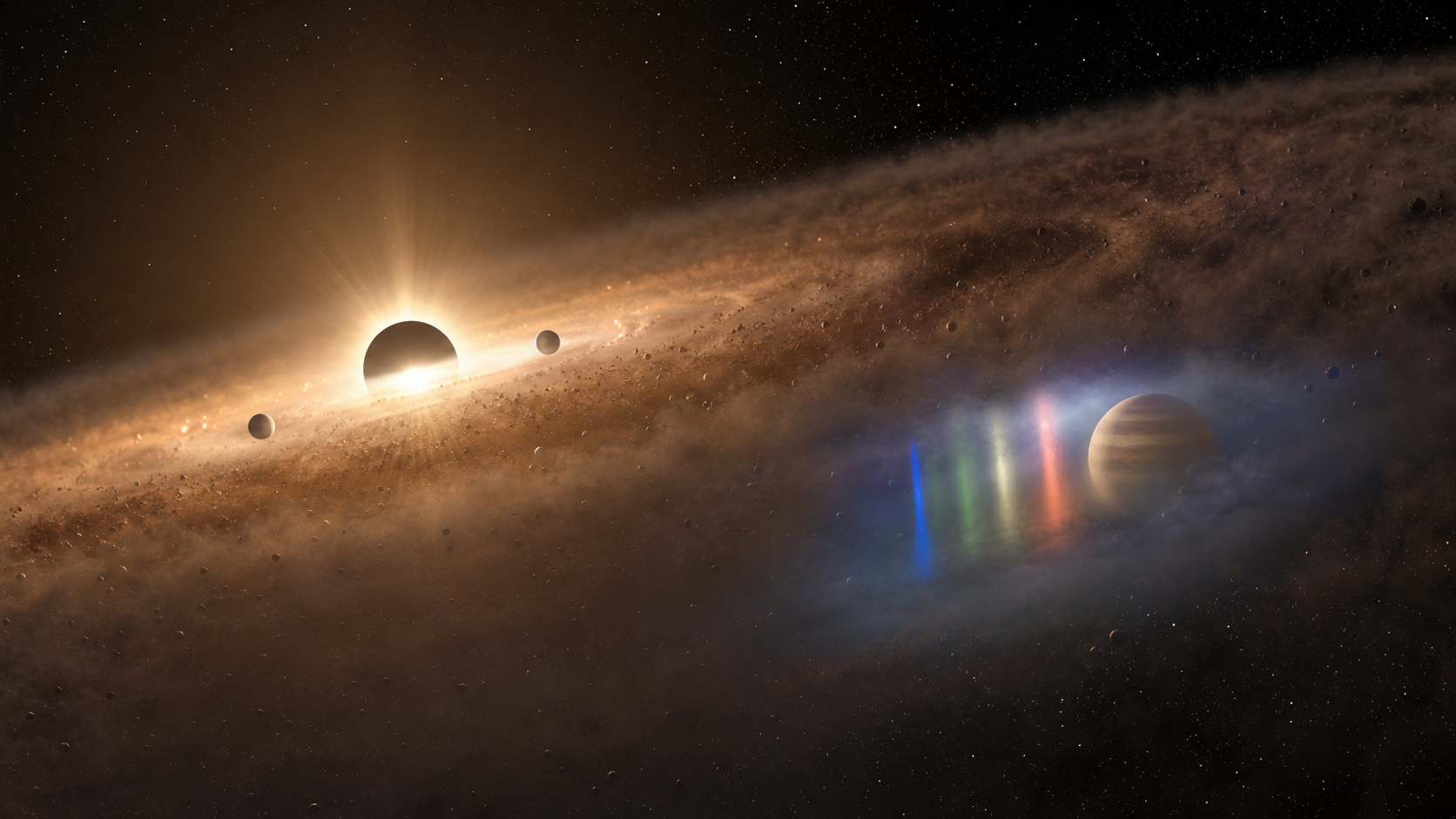
NASA and STScI said on 15 July 2026 that James Webb Space Telescope observations confirmed Beta Pictoris d, a third giant planet in the Beta Pictoris system. The important point is that the planet was first pulled out of a bright debris disk through molecular spectral signals such as methane, carbon monoxide, and water vapor, not simply spotted as a clean image point.
Related ApJ Letters papers estimate the planet at roughly 2-4 Jupiter masses, while a direct-imaging analysis gives 2.4 +/- 0.6 Jupiter masses and an orbit near 26 au. This is not an Earth-like or life-related announcement; it is a step forward in finding young giant planets hidden in difficult glare.
What Was Found
Beta Pictoris is a young star system about 63 light-years away and already famous for directly imaged planets Beta Pictoris b and c. The new object, Beta Pictoris d, is presented as a wide-orbit giant gas planet embedded in the system’s dusty environment.
NASA says the system has become a rare case with three imaged giant planets. The surprise is not that astronomers looked at a famous system again, but that a different method separated a hidden planetary signal from disk light.
How It Was Confirmed
The first clue came from Webb NIRSpec IFU moderate-resolution spectra. The team used template matching to detect narrow molecular patterns from methane, carbon monoxide, and water vapor that aligned with the position of Beta Pictoris d.
A second paper compared VLT/ERIS observations with earlier JWST and VLT data over an 11-year baseline. Different instruments and methods pointing to the same outer object make a disk feature or random noise less likely.
Why It Matters
Directly imaging exoplanets is hard because young stars and dusty disks can overwhelm faint planets. This result shows that a planet can be found first by the spectral fingerprint of its atmosphere, then checked against imaging data.
That matters for young planetary systems. Beta Pictoris d gives researchers another object for testing how giant planets form, migrate, and shape debris disks through gravity.
What Is Still Unknown
The mass, temperature, atmosphere, and orbit remain estimates. The difference between 2-4 Jupiter masses and 2.4 +/- 0.6 Jupiter masses reflects different data sets and models rather than a contradiction in the basic finding.
Beta Pictoris d is also a young giant gas planet. It does not imply a habitable world, liquid water on a surface, or evidence of life.
Next Observations And Sources
The next checks are repeat Webb spectroscopy, direct-imaging follow-up, and orbital tracking. NASA and STScI explain the discovery context, while the two papers give the spectral matching, VLT/ERIS comparison, and uncertainty range.
Official Sources
NASA Science release: Beta Pictoris d, Webb NIRSpec, and molecular spectral detection
STScI release: famous star system, hidden planet, and Webb observation context
Accepted ApJ Letters paper: moderate-resolution spectroscopy and 2-4 Jupiter-mass estimate
Direct imaging paper: VLT/ERIS, 11-year data comparison, and 2.4 +/- 0.6 Jupiter masses