WORLD NEWS
Juno measured Io’s hidden heat for the first time, rising over 20 C within metres
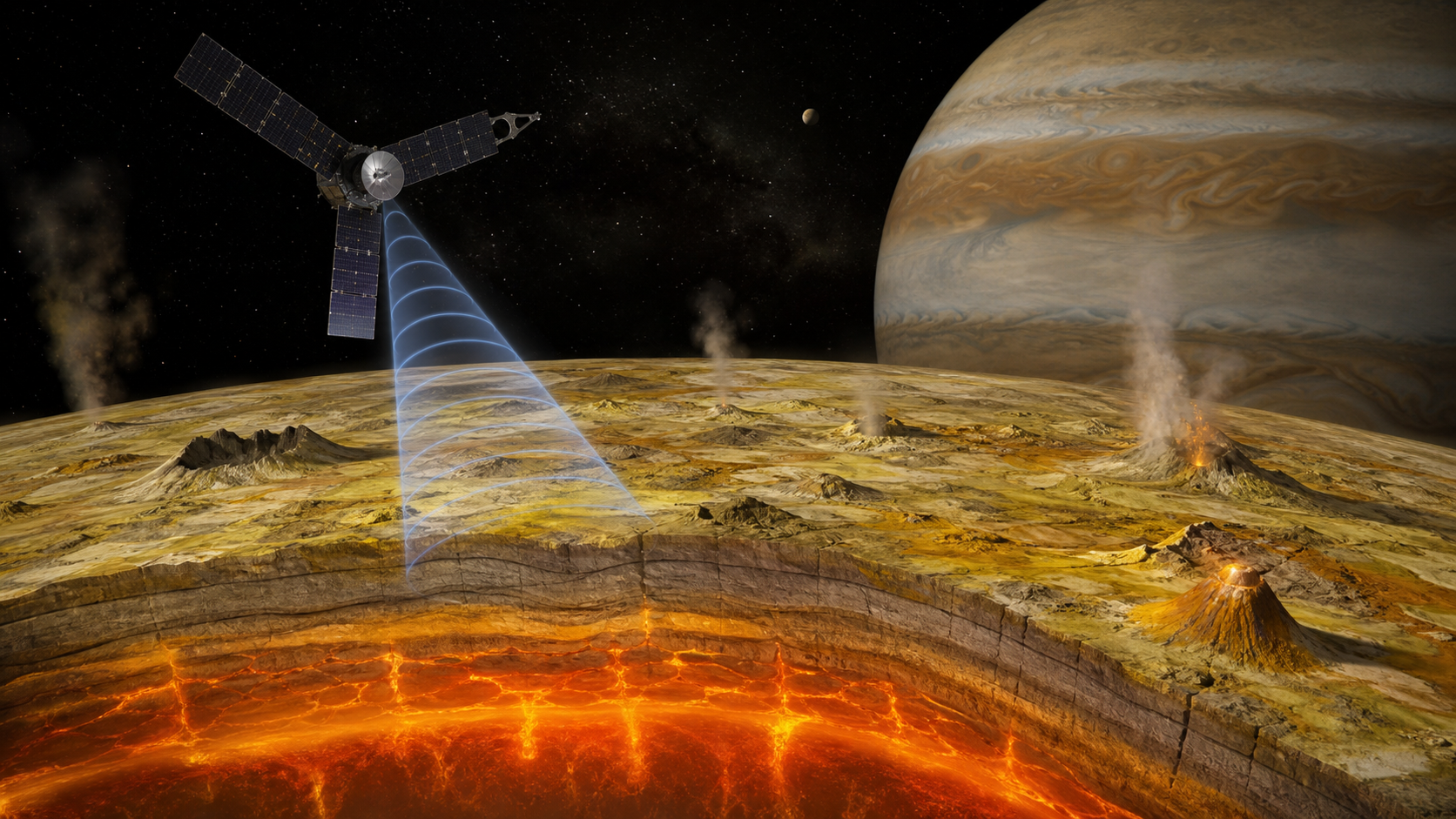
NASA’s Juno spacecraft made the first spatially resolved measurement of heat rising from roughly 2-6 metres below the surface of Jupiter’s moon Io.
Temperature increased by more than 20 C within the upper few metres, but the data still allow two explanations: broad conductive heat flow or scattered shallow lava and hot vents.
A Jupiter instrument looked under a rocky moon
Juno’s Microwave Radiometer was built to see below Jupiter’s thick clouds. During Io flybys in December 2023 and February 2024, it measured thermal emission from 0.6 to 22 GHz.
Lower frequencies probe deeper than infrared surface measurements. The lowest-frequency channels sampled roughly 2-6 metres below the surface.
A steep shallow temperature rise
Across the observed regions, the study found a temperature increase greater than 20 C within the upper few metres, a signal too steep to explain with sunlight alone.
The inferred density of the upper layer, below about 10 cm, was 0.7-1.1 g/cm3. That is consistent with a broad cover of porous volcanic material such as ash or pumice.
Two ways the heat could rise
One model has internal heat moving steadily through a conductive crust at 1-3 W/m2. The other uses relatively fresh lava under five years old, or hot vents below thin crust, scattered across about 10% of the surface.
The present observations do not choose conclusively between them.
A first measurement, not a buried thermometer
This is a remote inference from microwave brightness temperature and dielectric properties, not a lander thermometer. Two flybys did not cover every region of Io.
Applying the technique to Earth volcano monitoring is also a proposal, not demonstrated eruption forecasting.
Why it matters
The result moves beyond surface infrared views and directly constrains how heat travels inside the most volcanically active world in the Solar System. Similar observations could probe shallow layers on other rocky and icy moons.
Official Primary Sources
Journal of Geophysical Research: Planets original study