WORLD NEWS
Euclid resets the distance record: why its 31 quasars matter
ESA’s Euclid telescope has confirmed 31 quasars from the early Universe. Two surpass the previous distance record, while the known sample beyond redshift 7 has grown from nine to 23.
What was found and which record changed
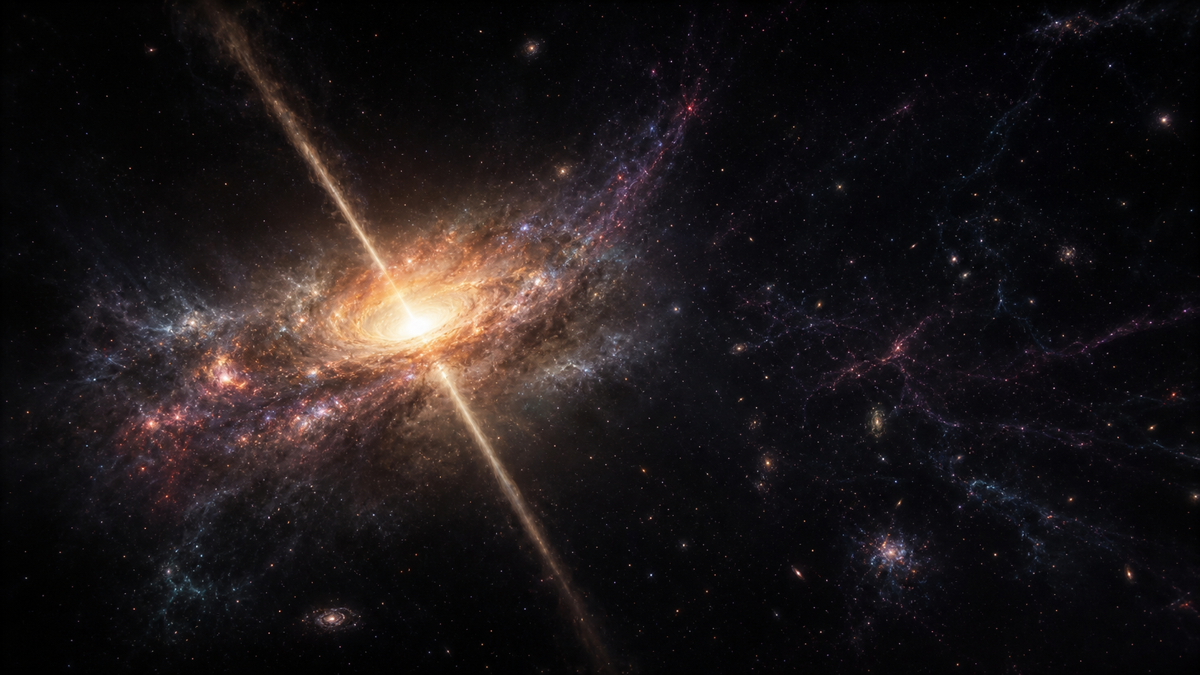
ESA and the Euclid Consortium confirmed 31 quasars at redshifts 6.6 to 7.8. The most distant, EUCL J172902.75+641018.1, is at 7.77 and the second at 7.69, both beyond the previous record of 7.64. The most distant light left when the Universe was about 670 million years old, roughly 5% of its present age. A quasar is an intensely luminous galactic centre powered by matter falling toward a supermassive black hole.
Why the sample matters more than the record
Before this study, only nine quasars had been confirmed beyond redshift 7; the total is now 23. Twelve of Euclid’s 31 additions lie in that range. Researchers can begin comparing a population rather than explaining isolated extremes, testing how billion-solar-mass black holes grew so quickly and how they relate to galaxies and neutral hydrogen during reionisation.
How Euclid found such faint quasars
Euclid surveys broad areas from space in visible and near-infrared light. Researchers selected candidates from about 3,000 square degrees collected during the first 1.5 years, using machine learning and spectral-colour signatures, then confirmed them with spectroscopy from Keck, Magellan and the Large Binocular Telescope. The Consortium reports a confirmation efficiency of about 30%, roughly ten times earlier efforts.
What changes and what remains unknown
The sample gives black-hole growth and early-galaxy models a much stronger test and provides backlights for studying reionisation. But “most ancient” refers to the earliest quasar light observed, not a direct measurement of when the black hole was born. “A trillion Suns” compares luminosity; it does not mean the object contains a trillion Sun-like stars. The masses and growth histories of all 31 black holes are not yet known.
Primary sources and the next checkpoint
The ESA release explains the two record objects and cosmic age. The Euclid Consortium release describes the sample increase, search method and DR1 data release planned for late 2026. The journal paper and open manuscript provide DOI 10.1051/0004-6361/202658883, selection criteria and methods. Forecasts of hundreds more discoveries over the full six-year survey are expectations, not completed results.