WORLD NEWS
Enceladus ice grains are not average scoops of its ocean
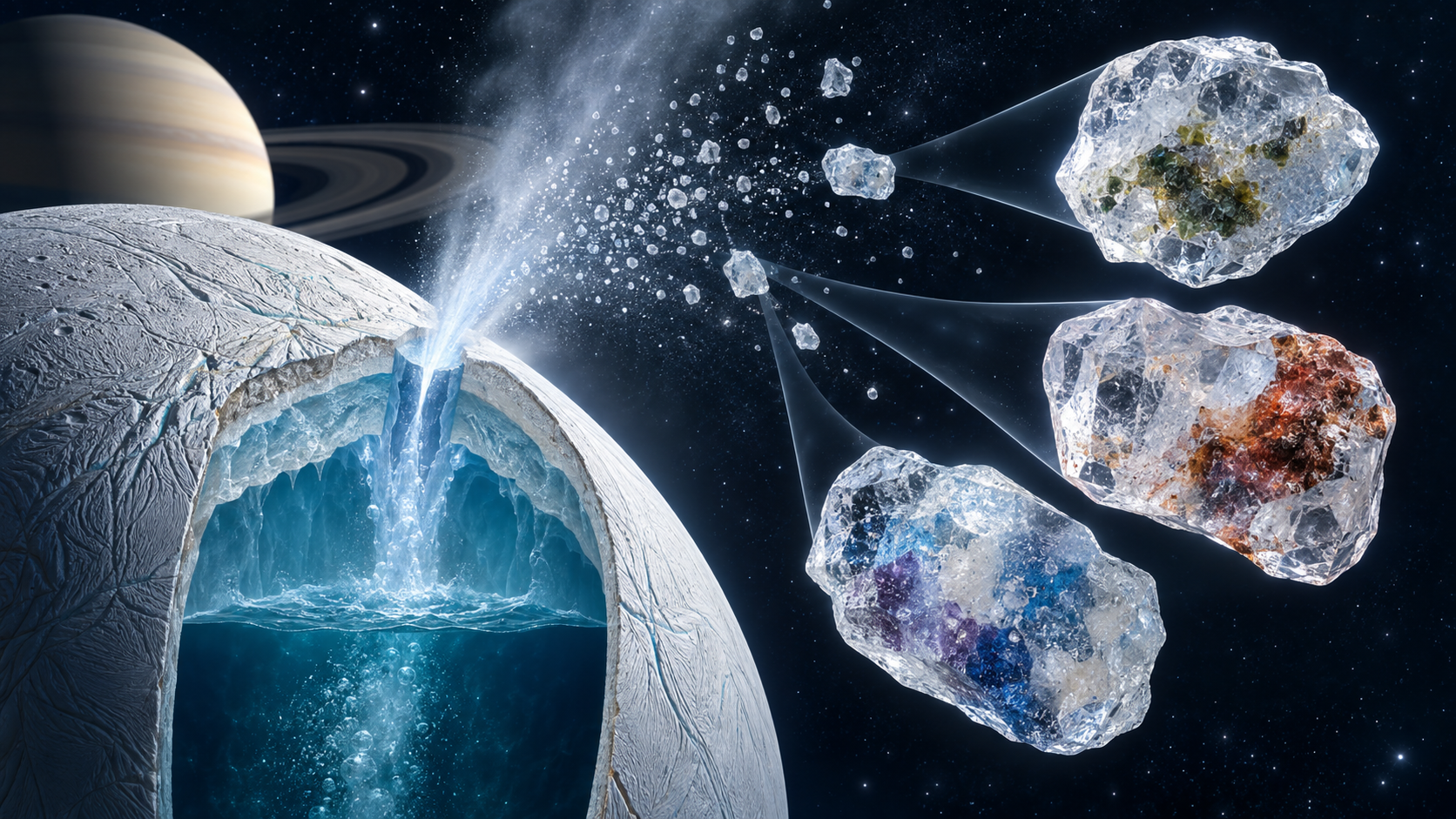
Nearly 1,000 salt-rich particles from Enceladus varied widely in sodium chloride, carbonates, phosphates and potassium-bearing salts.
The result does not detect life or a biosignature. It supports a mechanism in which ocean spray freezes slowly, separates chemically and then fragments in icy vents.
What was reanalyzed
Researchers studied individual grains recorded by Cassini’s Cosmic Dust Analyzer. They compared those data with freezing experiments using alkaline salt water designed to resemble the moon’s ocean, plus thermodynamic calculations and droplet-cooling models.
Why grains may differ
A relatively large droplet can freeze slowly enough for salts to collect in separate regions. Collisions with vent walls can then break the frozen droplet into fragments enriched in different compounds. This is a proposed mechanism, not a process directly filmed inside Enceladus.
What it changes for life searches
If rare organic molecules or biosignatures exist, they might be concentrated in only a few particles. Averaging many grains together could dilute that signal, so a future instrument would gain information by measuring as many individual grains as possible.
What remains unknown
Other processes may contribute to Cassini’s observed diversity, and organic compounds still need to be shown to sort like salts. A follow-up mission would need higher-resolution measurements of inorganic and organic chemistry in the same individual particles.
Primary source and independent checks
Primary source: Science Advances 원 논문
Institutional explanation: UC Riverside 연구 설명
Independent check: EurekAlert 서지·방법 확인
Read in other languages
한국어 · English · Español · 日本語 · Tiếng Việt