WORLD NEWS
Even the quiet black hole of our galaxy blows wind, a 3-light-year passage was a trace.
Observations have shown that hot winds from the central black hole of our galaxy, Sagittarius A*, have created a path at least 3.3 light-years long in the surrounding gas.
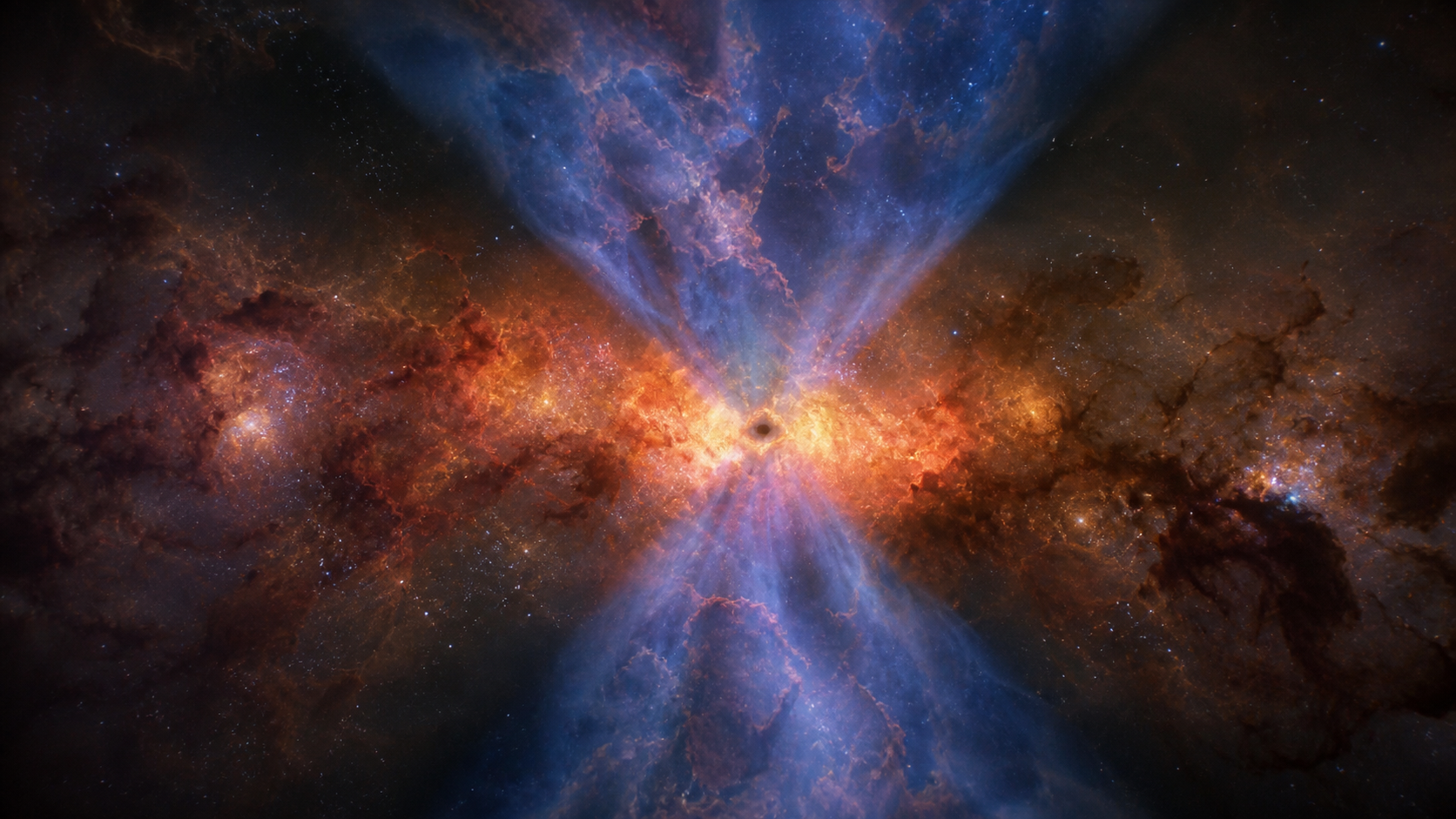
This is not an image of the wind itself from a black hole, but an interpretation that compares the shape and energy of the conical empty space left in the cold molecular gas with a wind model.
What did you observe?
Researchers observed the molecular gas at the center of the galaxy very deeply using the ALMA radio telescope in Chile. A conical void at least 1 parsec long was seen extending from Sagittarius A*, with an opening angle of about 45 degrees.
Why do I see it as a trace of the wind?
The direction of empty space points toward the center of the black hole, and the motion of the surrounding gas and the energy required fit the hot outflow model. Explosions of stars and coincidental overlapping clouds were also examined, but it was difficult to explain their overall shape together. The researchers interpreted that the gas was pushed out by weak winds that continue to this day.
How does a quiet black hole create wind?
Sagittarius A* is currently much dimmer than the active galactic nuclei, which gobble up a lot of material. Still, some of the incoming gas may not reach the event horizon and may escape as hot as possible. Even weak currents, if sustained for long periods of time, can change the path of surrounding gases.
Is it like a giant jet?
This structure is not the result of a direct search for a bright, narrow relativistic jet. It is more like a widespread hot wind, leaving uncertainty in its speed and exact mass outflow rate. It is not possible to invert all the properties of wind just from the visible empty space.
Why it’s important
This is a clue from nearby galactic centers that even when black holes are quiet, they can push out or recycle star formation fuel around them. If other molecular lines and higher resolution observations confirm the same passages and gas velocities, the interpretation becomes more robust.