WORLD NEWS
A wandering black hole gave itself away by eating a star
A supermassive black hole revealed itself by shredding a star more than 30,000 light-years from the center of a galaxy. Astronomers found an otherwise hidden object through the star’s final flare.
This is strong evidence for a black hole wandering outside a galactic core, but its origin is unresolved. It may have been ejected during a multi-galaxy merger or may still belong to a merging dwarf galaxy.
How was it caught?
The event occurred in a galaxy about 750 million light-years away. In November 2025, the Zwicky Transient Facility detected a sudden flare at the galaxy’s outer edge.
ZTF records roughly 500,000 changing lights each night. An AI system selected this one because it resembled a star being torn apart by a black hole.
What happened to the star?
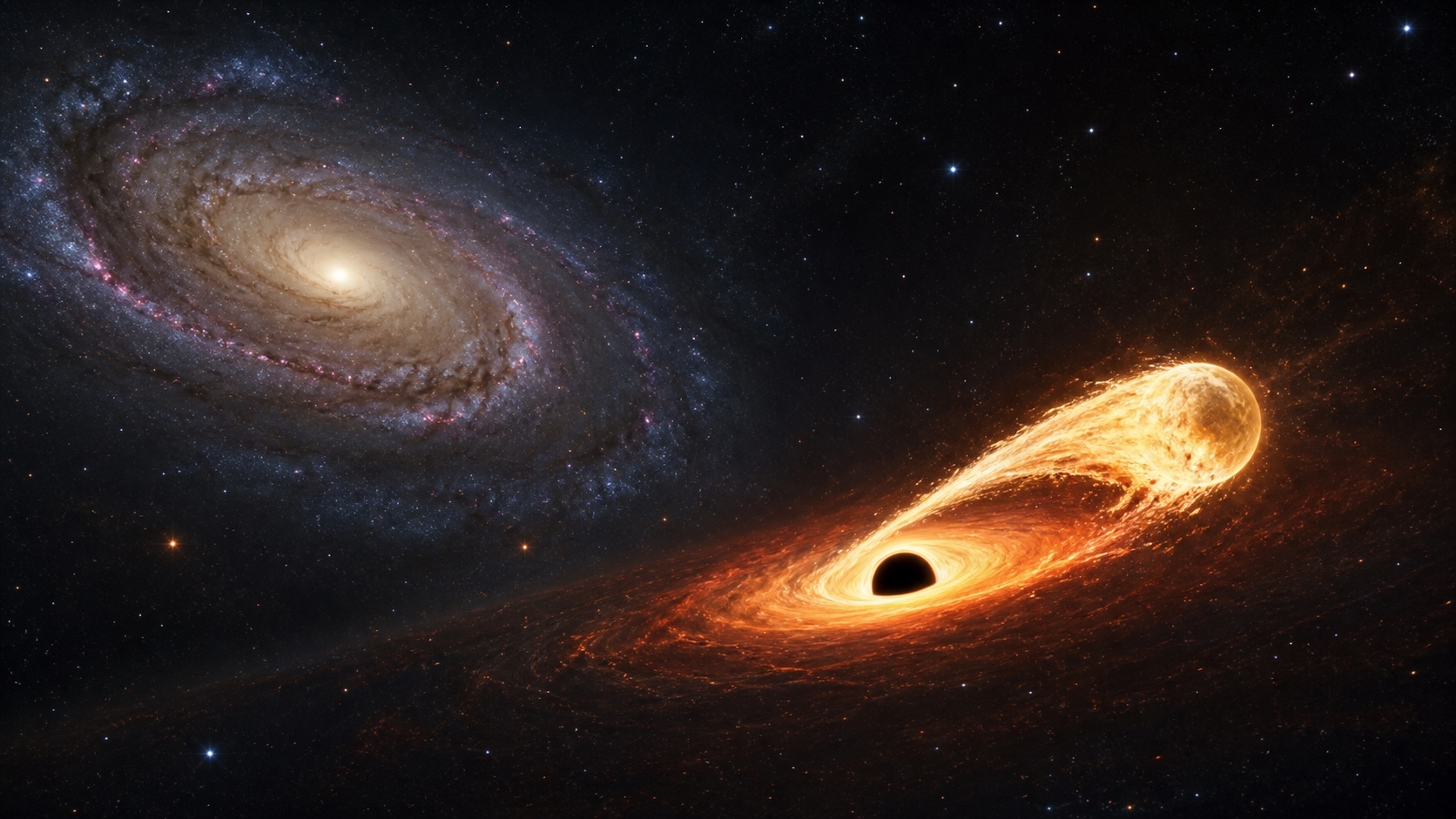
A star passing too close to a black hole feels a much stronger pull on its near side than its far side. It stretches and breaks apart, while some debris forms a hot, bright disk.
The black hole is estimated at about one million solar masses. In ultraviolet light, the flare briefly shone like about 10 billion Suns and outshone its host galaxy.
How do we know it was a black hole?
One bright point can resemble a supernova or another explosion. The team combined spectra from ground telescopes with ultraviolet and X-ray observations from NASA’s Swift.
The flare was about 30,000 degrees Celsius and evolved as expected for a shredded star. After comparing alternatives, the paper identified it as a tidal disruption event.
Why is it away from the center?
Supermassive black holes normally sit at the centers of large galaxies. This one is more than 30,000 light-years away, much farther out than the earlier confirmed example.
A merger of three or more galaxies may have produced a gravitational struggle that ejected the lightest black hole. Another possibility is a dwarf galaxy currently being absorbed by the larger one.
What remains unknown?
The observation cannot yet choose between those origin stories. Astronomers need its motion and evidence for stars left from a smaller galaxy.
The key result is a new way to find dark, quiet black holes when they shred stars. Rubin Observatory and the Roman Space Telescope could show how common these wanderers really are.
Official primary sources
Primary source: NASA Swift official science release
Primary source: University of Maryland official research release
Primary source: The Astrophysical Journal Letters original paper