WORLD NEWS
Hera reveals a stadium-sized crater on the asteroid struck by DART
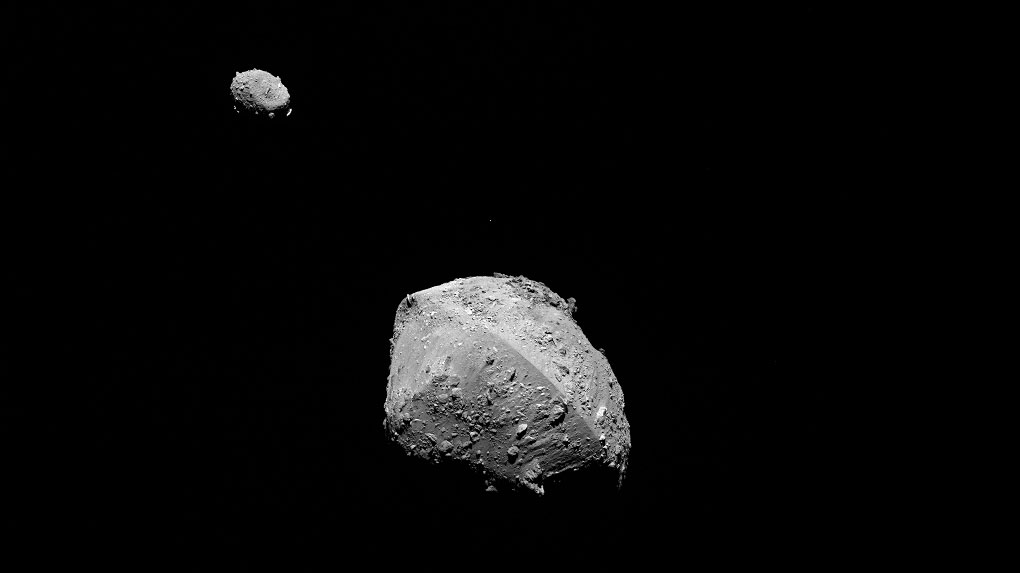
Images from ESA’s Hera spacecraft released on November 25 reveal that a large impact crater has flattened one face of the asteroid Dimorphos.
The observations examine the aftermath of NASA’s deliberate 2022 spacecraft impact; neither asteroid currently poses a danger to Earth.
One face was flattened while other regions look familiar
ESA describes a stadium-sized crater spanning the width of the impacted face. That conveys a large feature relative to the roughly 150-meter moonlet. Stadium-sized is a comparison, not a precise crater diameter established in meters.
Other boulder-covered regions show no evidence of major changes compared with DART’s earlier images, ESA says. A greatly altered face and largely familiar terrain can therefore coexist. The observations do not mean the whole asteroid was shattered or every part of its surface changed in the same way.
The 33-minute change concerns its orbit around a larger asteroid
NASA deliberately struck Dimorphos with DART on September 26, 2022. Dimorphos circles the larger asteroid Didymos, and the impact shortened the time for one such orbit by about 33 minutes. It did not lengthen an orbit around the sun by 33 minutes.
Ground-based telescopes measured the orbital change, but a close inspection of the surface required a separate observation. Hera has now arrived at the impact site and is returning images. CNN’s reporting from the briefing describes initial observations of Dimorphos tumbling irregularly as it spins. Its rotation and the time it takes to circle another body are different measurements.
Newly discovered boulders are not necessarily newly created
Hera also detected hundreds of previously unknown boulders orbiting the asteroid pair. ESA describes rocks a few meters across that must be considered as the spacecraft moves closer. This is an operating concern near the spacecraft; the discovery does not by itself establish a new danger of rocks falling to Earth.
In the briefing questions reported by CNN, planetary scientist Naomi Murdoch said their origin was not yet known: they might be DART debris or material from the larger asteroid. The possibility that DART approached too fast to see preexisting boulders was also raised. Discovering objects now is different from proving they formed recently.
Mass measurements will help assess the impact’s efficiency
As of ESA’s November 25 announcement, Hera is observing from about 25–30 kilometers away. It is scheduled to move to roughly 13 kilometers in December and deploy two small satellites in January 2027. These are future plans, not completed approaches or deployments.
A key next task is to determine Dimorphos’ mass and other physical properties more precisely. Combining its mass with the measured orbital change will help calculate DART’s effectiveness and improve predictions for other asteroids. The images begin that investigation. They do not prove that the same technique would stop asteroids of every size and composition.
Primary sources and independent checks
ESA original announcement of November 25: crater, surface and motion, nearby boulders and observing plans: ESA — 2026-11-25
CNN / Katie Hunt, officially hosted by KESQ: briefing questions, uncertain boulder origin, no Earth threat and mass-measurement purpose: CNN / Katie Hunt — 2026-11-25, via KESQ
Official DLR image page: ESA observation date November 7, approximate 29 km distance, objects and credit: DLR — Hera AFC image, ©ESA