WORLD NEWS
Atoms reach 9.7 picokelvin in orbit—but the laboratory does not
Chinese researchers report an equivalent temperature of 9.7 picokelvin for a cloud of rubidium atoms aboard Tiangong.
The value describes how slowly the atoms expand, rather than the temperature of the space station or its equipment.
What was cooled?
The Science paper published online on November 5 describes an experiment involving about 20,000 atoms. Laser light held the atoms in an optical trap.
A picokelvin is one trillionth of a kelvin. The reported value is 0.0000000000097 kelvin above absolute zero, which is −273.15 degrees Celsius.
Why measure expansion?
When the cloud is released, its atoms move apart. Slower spreading corresponds to a lower equivalent temperature associated with that motion.
This is a measurement of a small atomic ensemble. Treating it as the ambient temperature of an orbital laboratory would misrepresent the result.
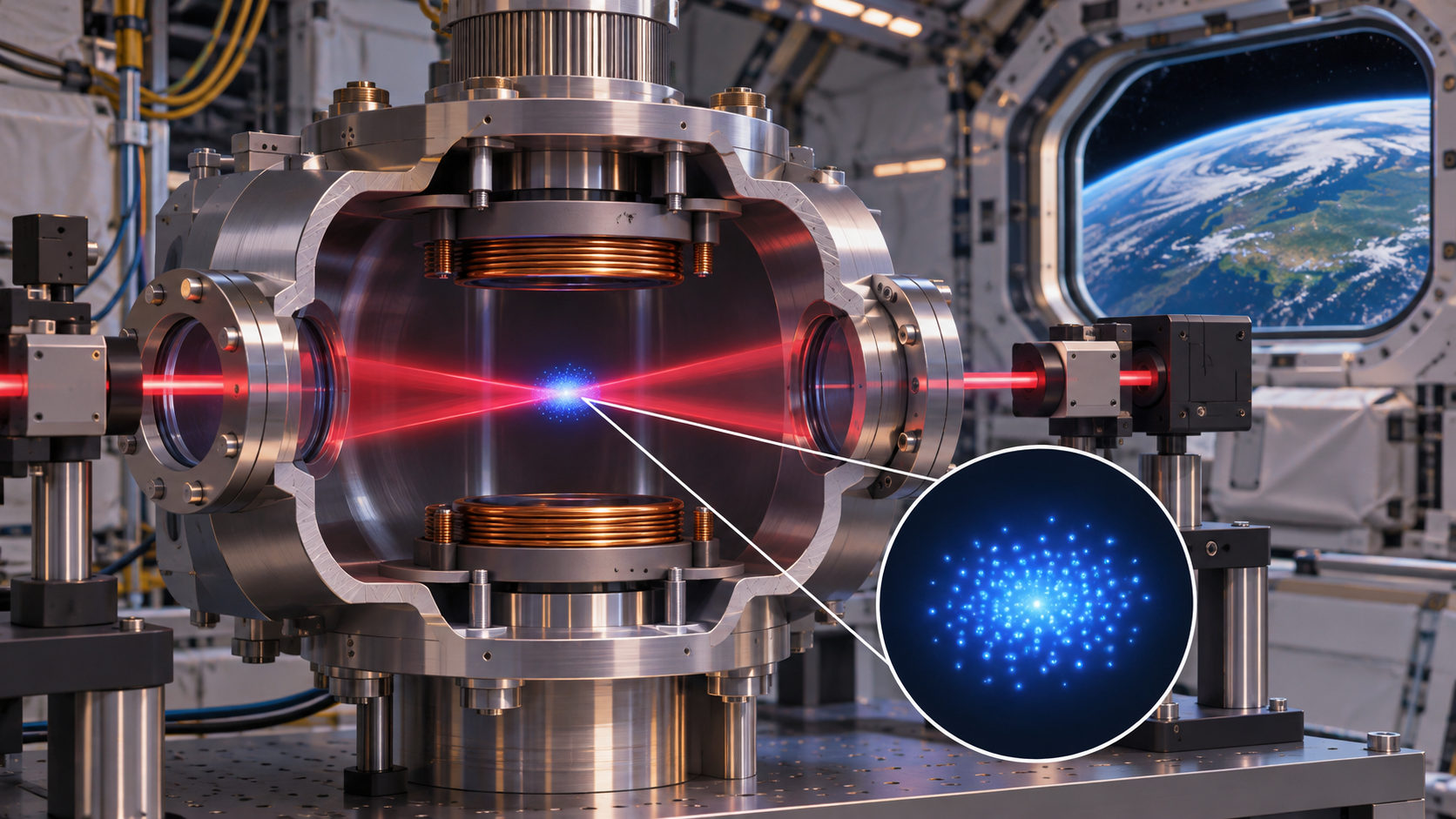
Seven seconds to watch the cloud
The paper reports seven seconds of free expansion. It compares this with an earlier result of 38 picokelvin and two seconds.
On Earth, gravity pulls atoms down and limits weak confinement and long observation. Apparent weightlessness in orbit reduces that constraint; gravity itself has not vanished.
Why observation time matters
Extremely cold atoms can form a Bose–Einstein condensate, a state in which they exhibit collective quantum behavior. Such ensembles provide a controlled way to study matter.
Longer observations could help quantum experiments and precision measurements. This paper does not establish that a practical new sensor or a new material has already been delivered.
Is this a new November 16 announcement?
No. The paper appeared on November 5 and has recently received further science coverage. The experiment should not be dated as a new result announced today.
The paper’s abstract gives the experimental scope and comparison. Science News independently explains the link between expansion and temperature. Actual performance in later precision measurements remains a question for follow-up work.
Primary sources and independent checks
Paper abstract: atom count, comparison and publication date: Science paper / PubMed
Independent explanation: expansion and effective temperature: Science News — Emily Conover
Institution-hosted explanation:9.7 pK and equipment distinction: Chinese Academy of Sciences / CGTN