WORLD NEWS
Frozen ground can slide as a whole when its base weakens
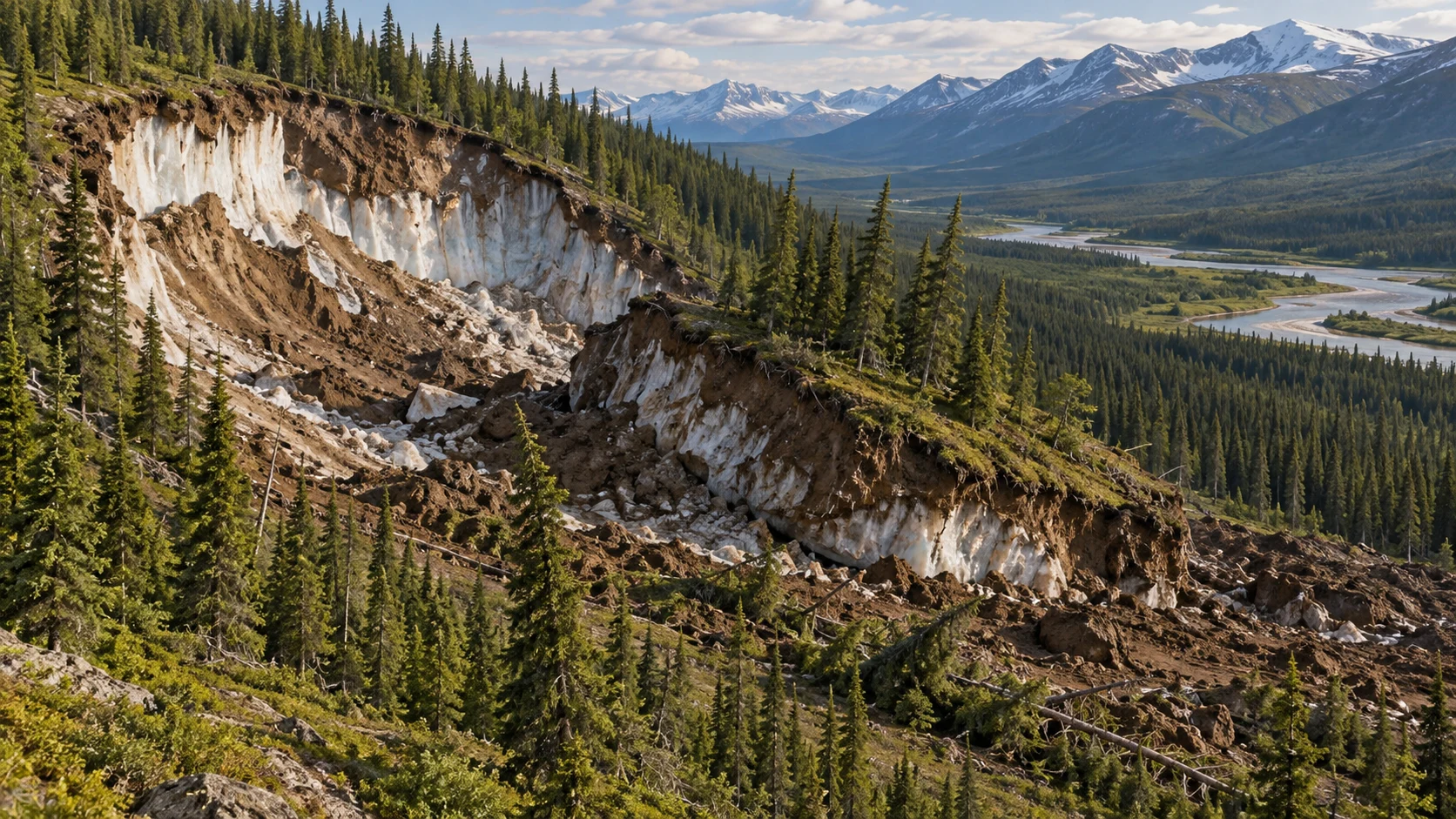
A study of two landslides in northwestern Canada describes frozen ground sliding in coherent blocks after weakening at its base.
The September research concerns events in 2017 and 2018 and was revisited on October 26; it is not a new disaster or an Arctic-wide collapse forecast.
How is this different from melting mud?
Permafrost is ground that remains frozen over years. Instead of all the surface thawing into mud, the researchers examined large frozen blocks displaced in the Johnson and Redstone river valleys of the Northwest Territories. The important distinction is loss of support at the base while material above remains frozen. They call this a permafrost detachment slide: a newly described mechanism, not a claim that landslides began this year.
How was the subsurface investigated?
The team combined satellite histories, changes in terrain elevation, field samples of sediment and ice, and electrical surveys that infer underground conditions. At the two sites, roughly 18–20m of permafrost was compared with failure depth. That is a local measurement, not a universal thickness. Frozen blocks and surface movement support the interpretation, but the entire underground sequence was not continuously filmed.
Why can a fire have effects decades later?
The authors investigated how the 1995 wildfire and climatic warming could affect subsurface heat. Thermal modelling tests whether surface changes can reach about 20m down over decades. Cracks and infiltrating water may further accelerate deeper thaw. This is a mechanism proposed from observations and modelling, not a rule that every burned slope must collapse exactly 20 years later.
What was independently checked?
The paper appeared on September 23. CBC separately interviewed researchers and an observer who had flown over the landscape; Live Science questioned the lead researcher again on October 26. Neither report independently reproduced the mechanism. Its prevalence elsewhere and the ability to predict failure timing need further investigation. Follow the paper’s linked data and regional geological observations; this briefing cannot establish the hazard at an individual location.
Primary sources and independent checks
Open paper text, methods and results read through the web tool; direct HTTP returned 403. Conflicting volume/timing details are omitted.: Young et al. — Geophysical Research Letters
October 26 interview with the lead researcher; establishes recent coverage, not independent experimental replication.: Live Science / Stephanie Pappas
October 13 interviews with researchers and an outside observer; recollections do not independently date failure or replicate its mechanism.: CBC / Julia Parrish / Eye on the Arctic
Read in other languages
한국어 · English · Español · 日本語 · Tiếng Việt