WORLD NEWS
A warmer crystal produces about 1.5 times the photocurrent, not a solar-cell efficiency record
Japanese researchers found that a light-exposed crystal produced about 1.5 times as much photocurrent at room temperature as in its low-temperature phase.
This is a current comparison within one material, not evidence that commercial solar-cell efficiency improved by 50%.
An August study highlighted again in October
The material is layered copper chromium thiophosphate, CuCrP2S6, abbreviated CCPS. The paper appeared in August and Science Tokyo introduced it in Japanese on September 16. On October 5, the university corrected a label in Figure 1; an English release and independent coverage on October 6 brought renewed attention. This is an earlier materials study being highlighted again, rather than the launch of a new solar-cell product.
How the current was compared
Researchers illuminated single crystals over 15–300K and measured current without applying an external voltage. Current appeared along a particular crystal direction. Changing silver electrodes to platinum produced similar temperature trends, providing evidence to investigate a bulk crystal response rather than attributing everything to electrode contacts. The roughly 1.5-fold figure compares photocurrent between low-temperature and room-temperature conditions. It does not compare total light-to-electricity conversion efficiencies.
What an average structure can miss
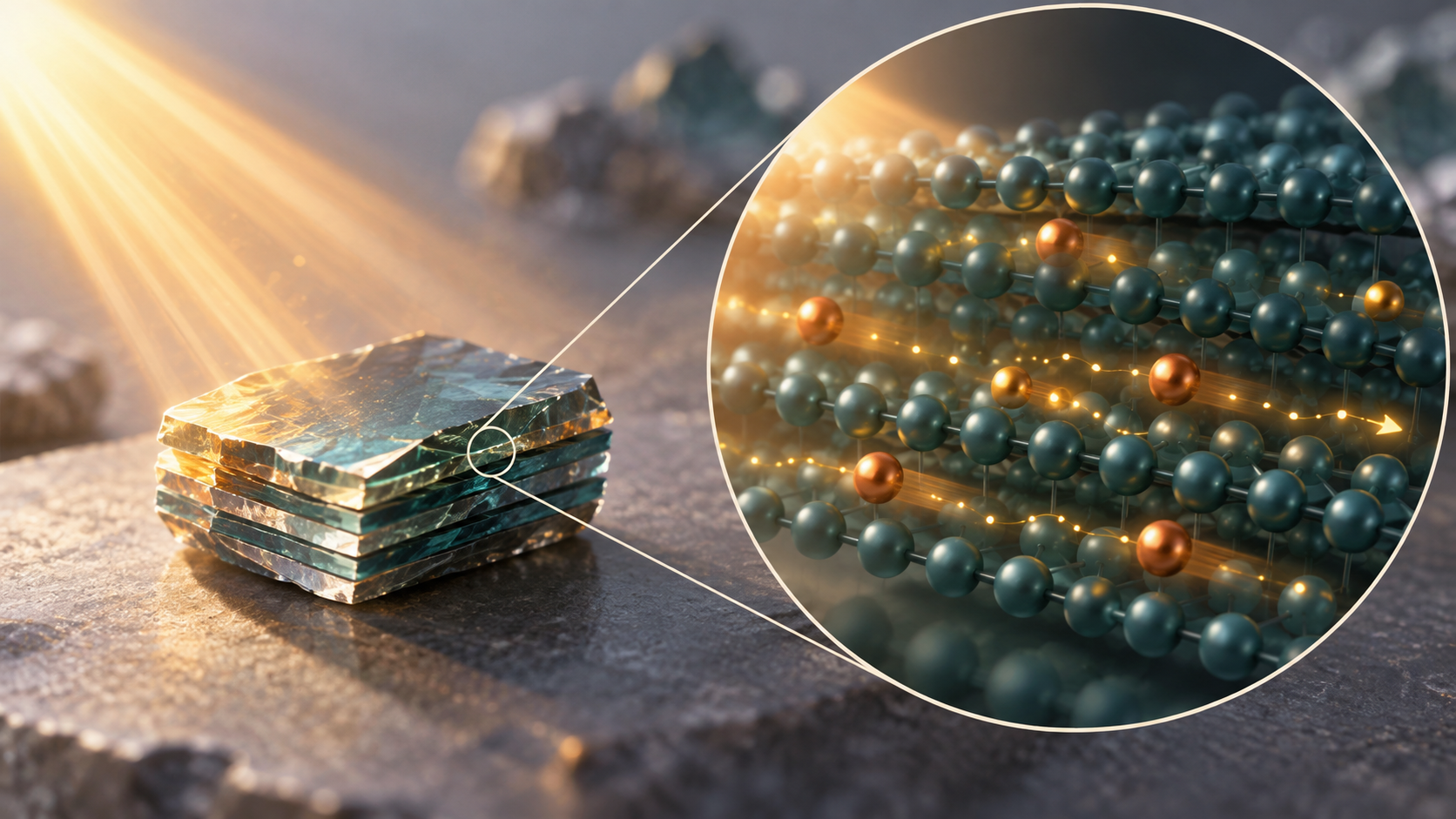
At room temperature, the average atomic arrangement appears symmetric. The researchers interpret the current in terms of moving copper atoms creating locally asymmetric configurations during the brief interval when light interacts with the material. An averaged structure and instantaneous movement can convey different information. This raises a materials-design question: thermal atomic motion may sometimes support a useful response rather than serving only as performance-reducing noise.
Better devices require further evidence
This study does not establish full sunlight conversion efficiency, large-area fabrication, lifetime or cost. Higher current with temperature is not automatically improved performance in ordinary solar cells. Follow the paper, tests of the proposed mechanism and device-level efficiency and stability experiments. We compared openly indexed paper text with the university’s explanation; direct access to the complete article was restricted during this run. scinexx’s independent coverage is not a separate replication experiment.
Primary source and independent checks
Primary source and official explanation: Science Tokyo
Primary source and official explanation: Advanced Functional Materials
Independent reporting check: scinexx
Read in other languages
한국어 · English · Español · 日本語 · Tiếng Việt