WORLD NEWS
Cable bacteria build nickel-based biological wires
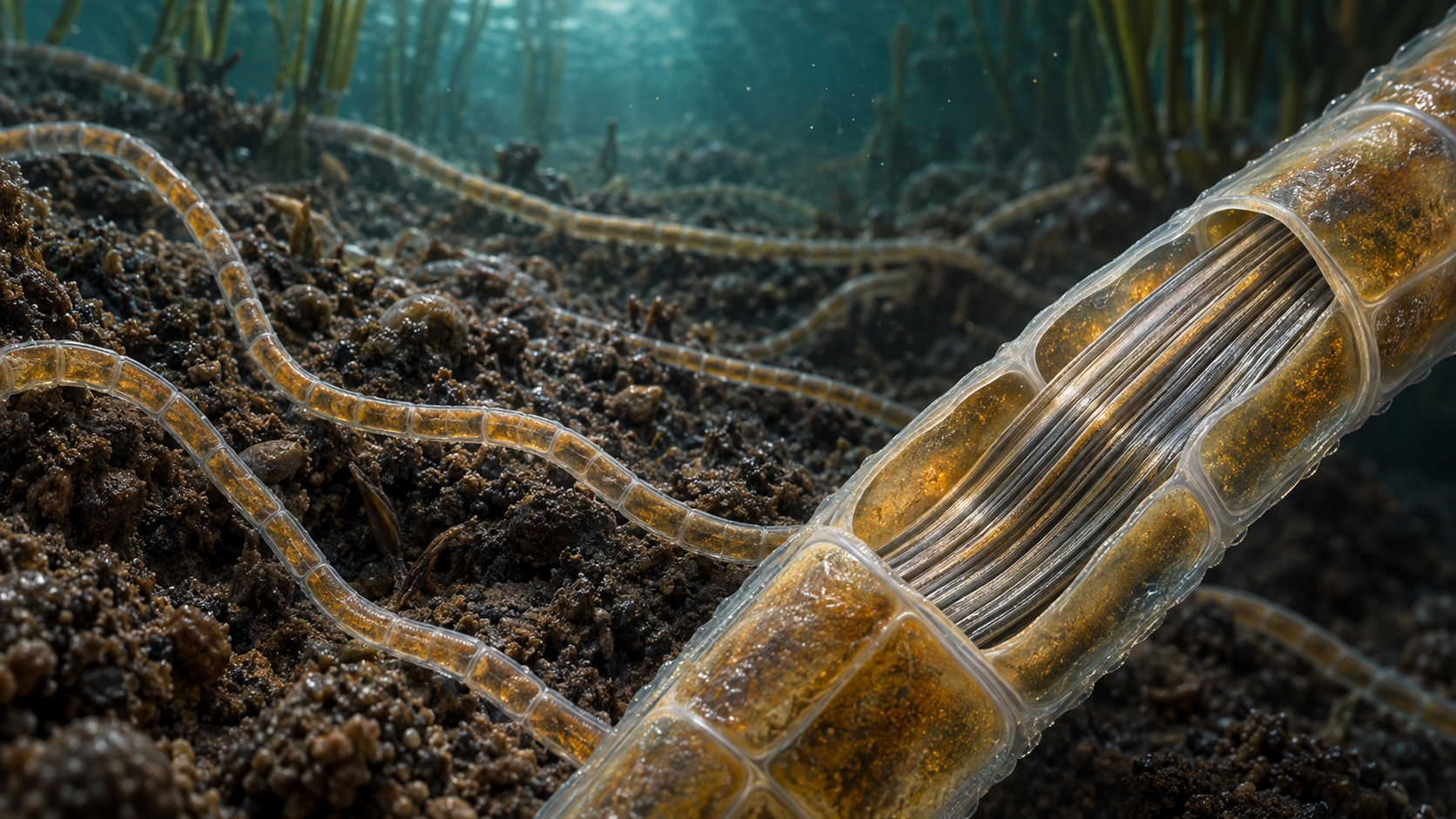
Each fibre contained about eleven intertwined ribbons roughly 1.4 nanometres wide, while nickel-rich lines continued across cell boundaries.
Cable bacteria are filaments of thousands of cells. Twenty to seventy parallel fibres along their envelope connect electron transport through the chain.
How the structure was identified
Raman spectroscopy, electron microscopy, X-ray fluorescence and absorption measurements, and modelling converged on stacked nickel-bis(dithiolene) units. The protein-wrapped bundle can stay flexible like fine conductors braided inside a cable.
What the conductivity numbers mean
Earlier whole-fibre estimates were 5–500 S/cm. Restricting the calculation to the ribbons gives 150–15,000 S/cm, but that conversion is not device performance measured under manufacturing conditions.
Why the result is unusual
Long-range biological electron transfer is usually explained with iron-bearing protein cofactors. This continuous nickel-centred route is a previously unknown biological architecture.
What remains unknown
Researchers still need the exact ligand structure, the genes that assemble it, its environmental stability and a way to reproduce it outside the bacterium before electronics claims can be tested.
Primary source and independent checks
Primary source: Nature Communications paper
Institutional measurement or explanation: ESRF measurement report
Independent check: University of Antwerp research overview
Read in other languages
한국어 · English · Español · 日本語 · Tiếng Việt