WORLD NEWS
A giant decagonal wave circles Saturn’s south pole — the north-pole hexagon is no longer alone
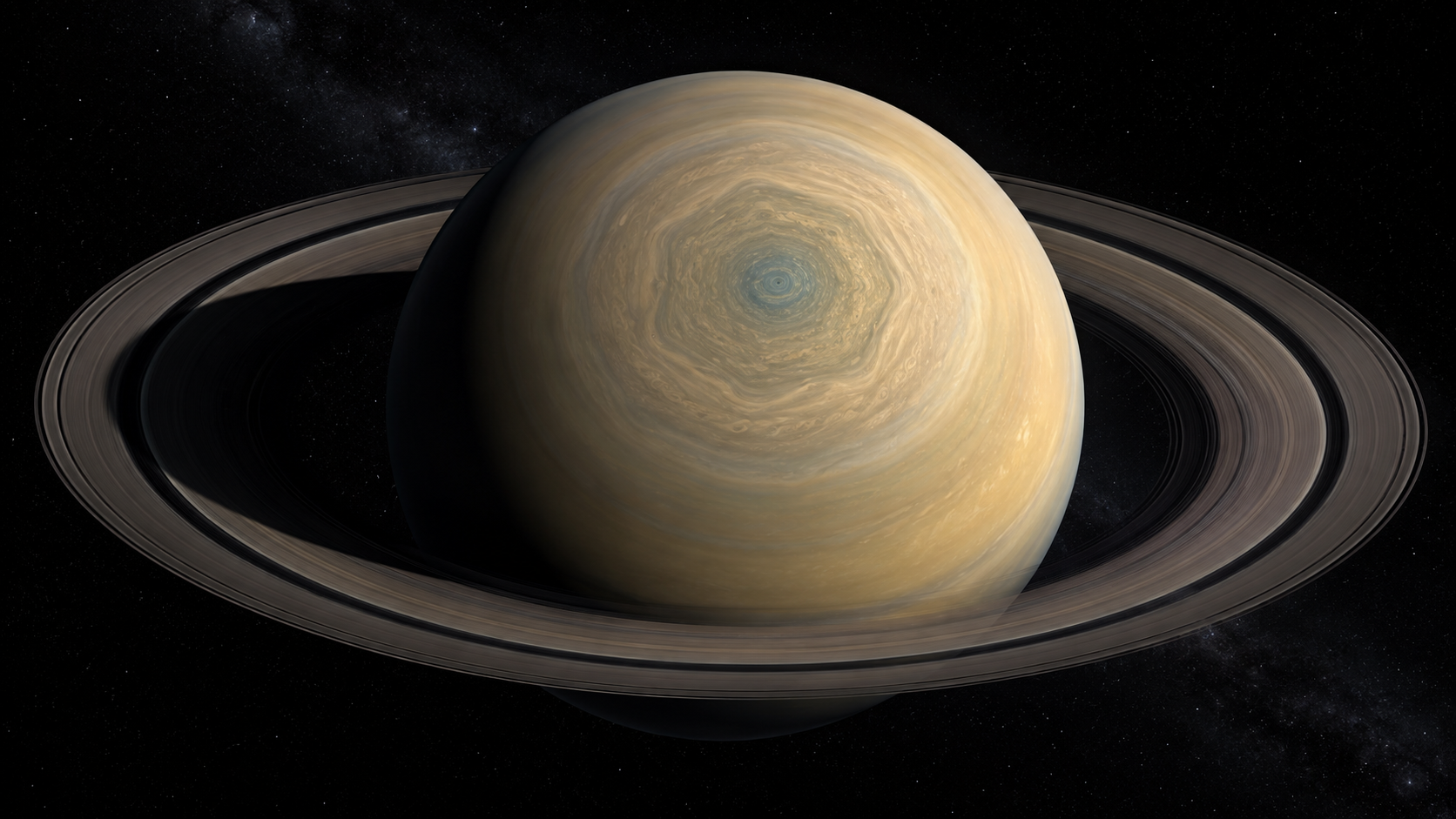
Observations from NASA and ESA’s Hubble Space Telescope revealed a huge decagon-shaped atmospheric wave surrounding Saturn’s south pole. It becomes increasingly clear in the image from 2023 to 2025, and unlike the famous hexagon at Saturn’s north pole, it moves east and has a more unstable shape.
It’s not the result of a solid decagonal wall forming on top of a cloud, or of drawing a shape just by looking at a single photo. It is an atmospheric wave analysis that combines long-term observations of multiple wavelengths and wind speed data from ground-based telescopes, and it is not yet known how long it will last.
What did the observations reveal?
By stitching together Hubble’s Outer Planet Atmospheres Legacy (OPAL) images, the researchers found a pattern of 10 curved sides in the jet stream around 60 degrees south latitude. Each side has a maximum of about 16,700 km, which is longer than the diameter of the Earth. It was faint in 2023 and became clearer in later observations.
How is it different from the North Pole Hexagon?
The North Pole hexagon has remained roughly in the same position for more than 40 years since Voyager observed it in the 1980s. The Antarctic decagon moves east at about 3 meters per second, or about 10 kilometers per hour, and its length and shape also change more. The occurrence of polygonal waves at two poles of the same planet provides an opportunity to test common principles.
Why was it discovered only now?
Because of Saturn’s rotation axis and revolution, the southern hemisphere was unfavorable for observation from Earth from 2012 to 2023. When the field of view was opened again, structures that had not been present in the previous data appeared. Researchers suggest that it may have been formed between 2017 and 2023, but the exact starting time has not been confirmed.
How polygons are created
When wave-like instability occurs in a fast jet stream, the flow can bend into a constant wave. However, it has not yet been explained why only on Saturn do these sharp polygons appear at both poles, or why waves at the South Pole extend to the same depth as those at the North Pole. It also looks different from the vortices around Jupiter’s poles.
What will the following observations answer?
Saturn’s southern hemisphere will become more visible in the future, and sunlight around 60 degrees south latitude will become stronger around 2032. In the meantime, we need to track whether the decagon is stable or broken and how its speed of movement varies with temperature and cloud height. What has now been confirmed is a new standby pipe, not a permanent structure.