WORLD NEWS
Even if concrete retakes carbon from the air, not even 10% of cement emissions can be repaid on time.
The effect of concrete slowly absorbing carbon dioxide from the air after it hardens is real, but in the new global model it would not offset even 10% of cement clinker’s annual emissions in 2030. The researchers’ central estimate is that in-service concrete absorbs about 230 million tons a year, while the cement sector emits about 3 billion tons.
This does not mean that all concrete absorbs exactly the same proportions or that natural carbonation is useless. Rates vary greatly depending on humidity, exposed area, mix, cracking and demolition method, and these results are global estimates from a simplified thermodynamic and diffusion model.
Why does concrete eat carbon?
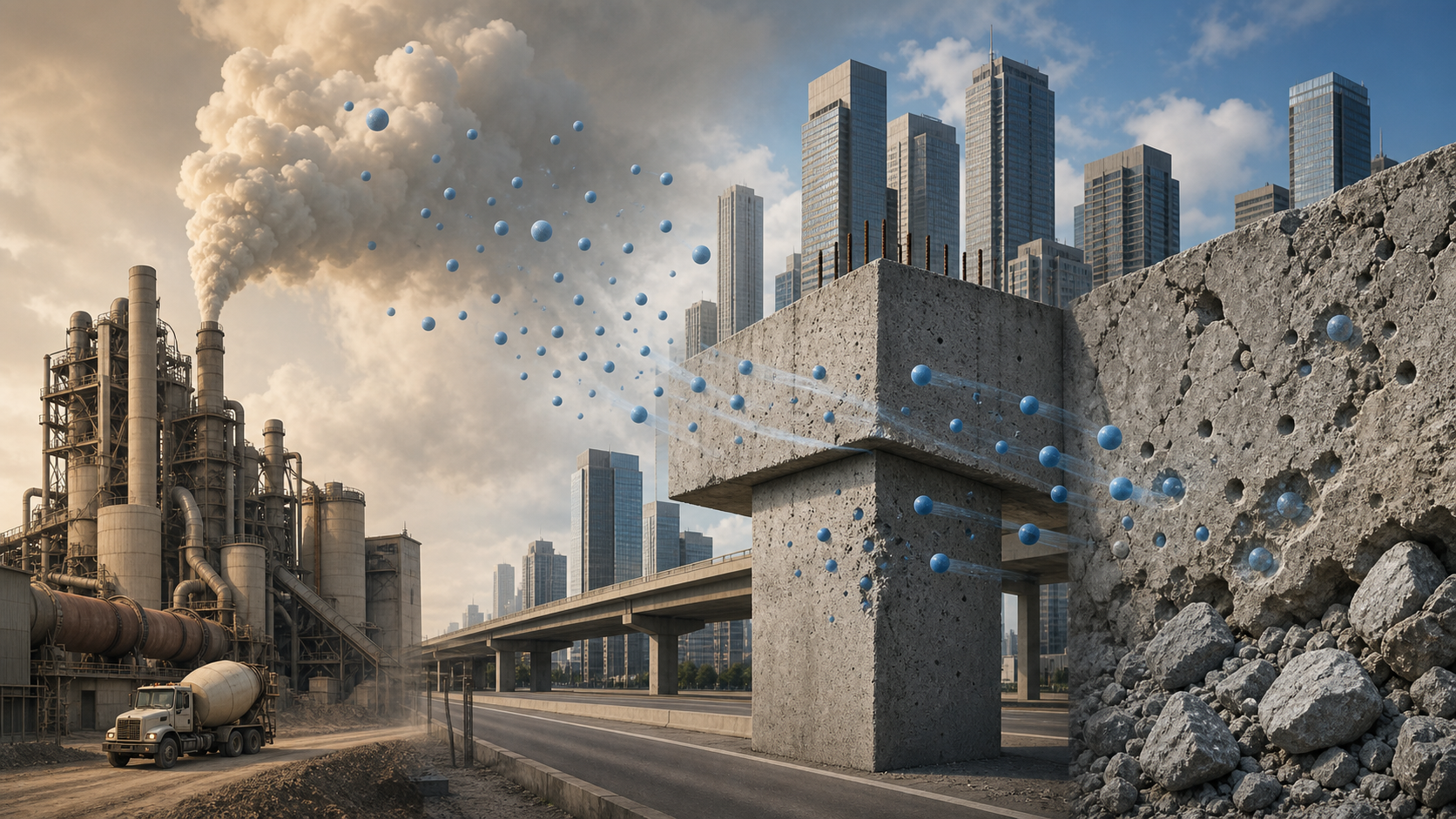
When carbon dioxide in the air dissolves in the alkaline pore water of concrete, it reacts with calcium compounds to form calcium carbonate. This natural carbonation binds carbon to solid minerals. However, this is very slow for thicker structures because the gas must spread inward from the surface.
How slow did you calculate it to be?
A typical beam, pavement or slab with a surface area to volume ratio of 10 can take up to about 1,000 years to become half carbonated under normal outdoor conditions. The study put a representative service life at 50 years. If the area in contact with the air is large, such as small broken aggregates, this can be much faster.
Can 230 million tons be considered small?
That in itself is a big absorbent amount. However, compared to the cement sector emissions of about 3 billion tons in 2030, it is less than 10% compared to the same year. Some past estimates showed that 10 to 50 percent of production emissions could be offset, and in some cases as much as 57 percent, but the new model limits both the amount that can be responded to and the diffusion time.
What can the model leave out?
The study did not track individual weather conditions, paintwork, cracking, wetting/drying, or post-demolition storage conditions around the world. Humidity of approximately 70% was used as a representative condition favorable for carbonation, and the composition and form were calculated using probability distributions. Therefore, the actual absorption of local structures requires field measurements.
What does it mean for climate action?
If natural absorption is largely taken into account and production stage reduction is delayed, the time axis does not match the 2030 goal. The researchers see measures to reduce clinker use and avoid or capture production emissions as a priority. Techniques for intentionally carbonating demolished concrete should be evaluated separately from natural leaving.
Primary sources and independent checks
Communications Sustainability original paper