WORLD NEWS
A black hole lit up while shredding a star more than 30,000 light-years from a galaxy’s center
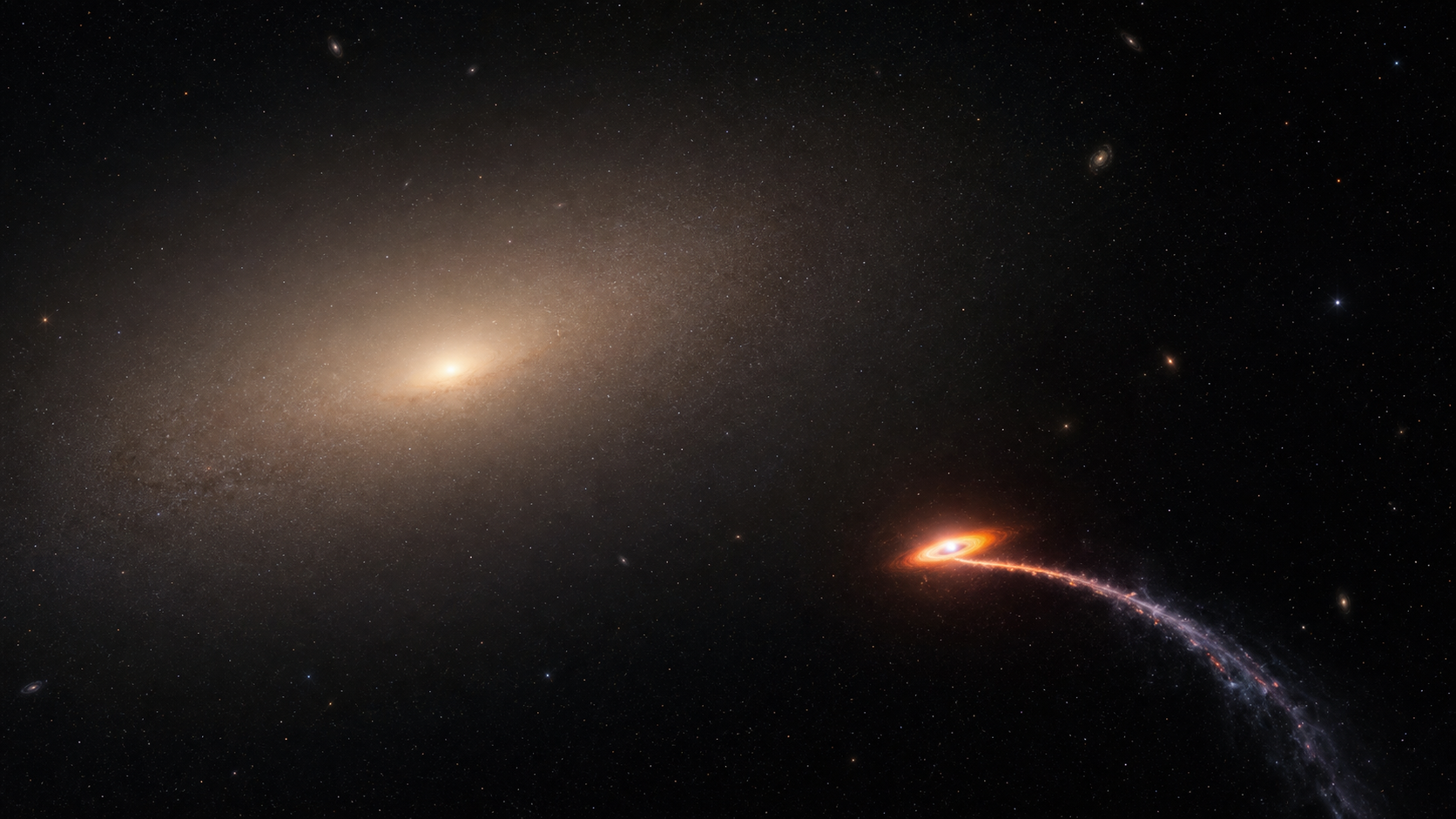
A black hole of roughly a million solar masses produced a brilliant flare while shredding a star more than 30,000 light-years from a galaxy’s center.
TDE 2025abcr is the first optically discovered tidal disruption event in a galaxy’s outskirts and validates a way to find otherwise invisible wandering massive black holes.
How far off-center was it?
The event occurred in WISEA J014656.04-152214.7, about 750 million light-years away, at a projected offset of roughly 9.3 kpc from the nucleus.
The 10.3 kpc value in an earlier abstract was a typo corrected at the end of the public manuscript. The study constrains events offset by at least 3 kpc to less than 10% of the nuclear TDE rate.
AI selected it from half a million nightly flashes
ZTF records roughly half a million transient alerts each night. The team extended its tdescore classifier beyond galaxy nuclei and selected this event in November 2025.
Hydrogen and helium spectra from SOAR, plus ultraviolet and X-ray follow-up by NASA Swift, support a tidal disruption interpretation. For a time, the flare outshone its entire host galaxy in ultraviolet light.
A destroyed star revealed an invisible object
Massive black holes emit little light when they are not feeding. A star passing too close is torn apart, and the heated debris briefly marks the black hole’s position.
The disrupting black hole is estimated at 10^6.09 solar masses. A much larger black hole is likely still located at the host galaxy’s center.
Its origin remains a two-way question
A merger among three or more galaxies may have ejected the lighter black hole toward the edge. Alternatively, a faint dwarf galaxy may still be merging with the larger host, carrying its central black hole in the outskirts.
The mass is inferred from peak-luminosity scaling rather than measured directly. Deep imaging and late X-ray observations after the flare fades are needed to identify a residual star cluster and refine the origin.
The next step is counting the hidden population
The discovery shows that off-nuclear machine-learning selection followed by spectroscopy and ultraviolet observations can work. The paper projects that the Vera C. Rubin Observatory could resolve many dozens of similar events each year.
A larger sample can test how often mergers leave black holes wandering in galaxy halos and how long they take to sink back toward the center.
Official Primary Sources
Astrophysical Journal Letters: TDE 2025abcr original paper
NASA Swift: observations, distance, brightness and origin hypotheses