WORLD NEWS
At the dinosaur extinction, Earth may have been an oven before it became a freezer
The asteroid dust linked to the dinosaur extinction about 66 million years ago might have acted as a heat-trapping lid before it cooled the planet.
A new radiation model raises estimated surface heating by about 3.5 times, but worldwide wildfire has not been directly confirmed in the geological record.
An oven, then a freezer
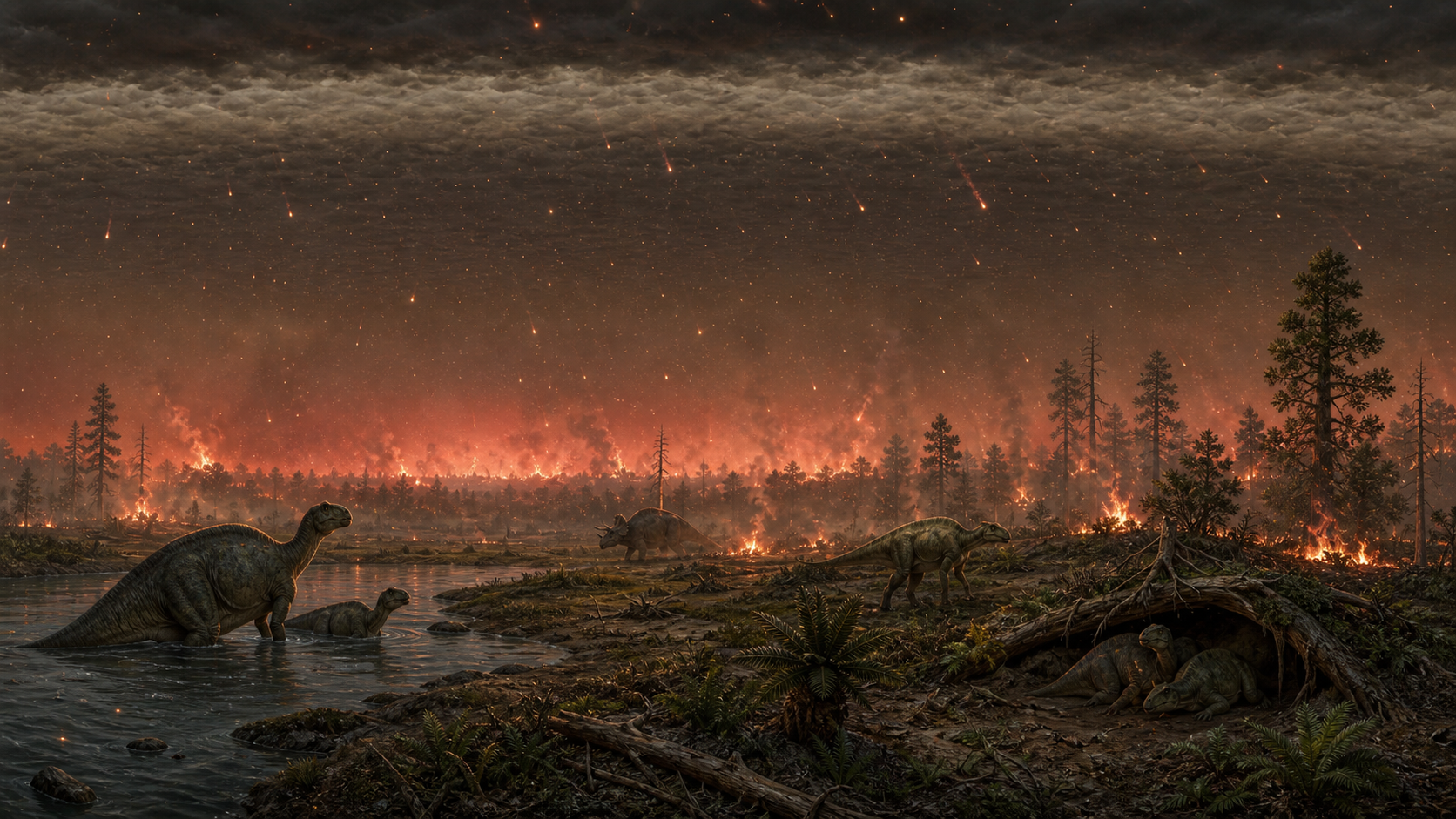
Some vaporized rock condensed into spherules that fell worldwide. Fine dust may have blocked the heat from those re-entering particles from escaping to space.
After the hot particles settled, the same dust could block sunlight for years to decades, contributing to impact winter and food-web collapse.
Dust multiplied the heat by 3.5
Researchers combined impact simulations with fine-dust evidence from the Cretaceous-Paleogene boundary. Adding the dust made modeled surface heating about 3.5 times stronger than spherules alone.
Particles around 2.5 micrometres across formed an upper-atmosphere lid that redirected thermal radiation downward.
The first one or two hours may have mattered most
In the model, the early heat was intense enough to ignite vegetation and kill exposed animals. Survival by species able to shelter in water, underground or in protected gaps is consistent with that scenario.
It was not a blast wave circling Earth. Impact material was carried globally and generated heat as it re-entered.
This does not prove every dinosaur burned
The strongest direct wildfire evidence comes from North America, and equivalent records remain limited elsewhere. Temperatures are modeled from dust properties and energy flow, not measured directly.
Impact winter, photosynthesis failure, starvation and volcanism remain possible contributors, and their relative role differed among species.
Why the explanation changed
Earlier calculations emphasized spherules shielding one another, which reduced surface heating. Evidence reported in 2023 for abundant very fine impact dust supplied the missing insulating layer for the new calculation.
Charcoal, heat-altered material and dust distributions from more boundary sites are needed to test whether the oven-like pulse was truly global.
Official primary sources
Primary source: JGR: Biogeosciences original paper