WORLD NEWS
MMX launches toward Phobos, beginning a sample-return attempt
Japan’s MMX spacecraft launched from Tanegashima on an H3 rocket at 4:41 a.m. on October 20 in Japan and Korea.
The successful step is departure; landing on Phobos, collecting material and returning it to Earth in 2031 remain future objectives.
Material from a moon, rather than Mars itself
MMX will investigate how Mars’s two small moons, Phobos and Deimos, formed. Its central sample-return objective concerns Phobos. Laboratory analysis could help distinguish captured asteroids from moons formed out of debris after a large impact on Mars. Deimos will also be observed, but the plan should not be described as collecting samples from both moons.
Why reports give two calendar dates
DLR dates liftoff to October 19 at 9:41 p.m. Central European Summer Time. That equals 19:41 UTC on October 19 and 4:41 a.m. on October 20 in Japan and Korea. Space.com’s analysis of the launch webcast describes stage separations and spacecraft release roughly 71 minutes after liftoff. The different calendar dates refer to the same launch.
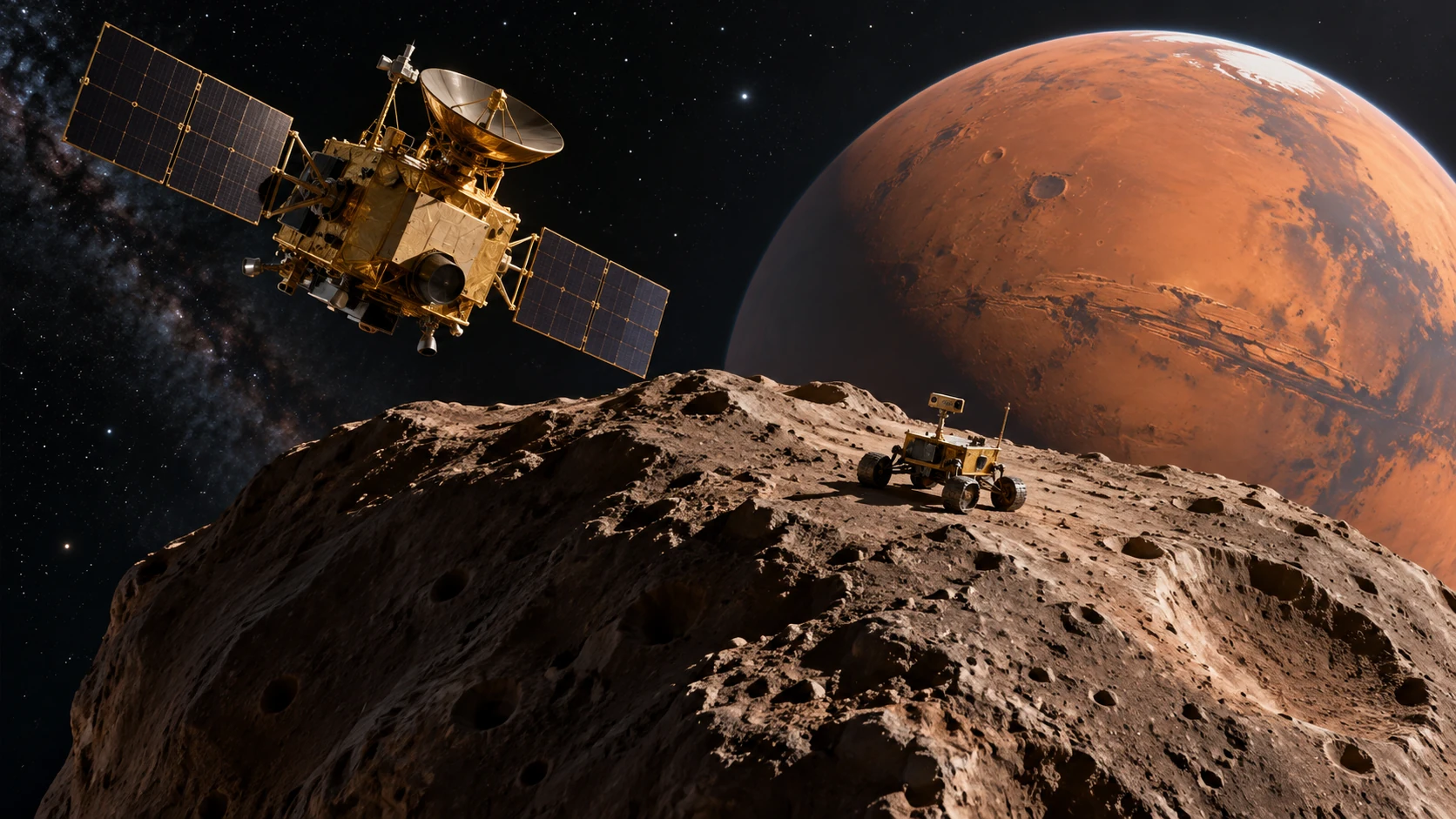
A small rover will investigate the surface
Idefix, developed by Germany’s DLR and France’s CNES, is scheduled to reach the surface around late 2028 or early 2029. Its approximately 100-day exploration should supply surface information to help prepare the mothercraft’s landing and sampling. Righting itself after landing and moving in extremely weak gravity create challenges unlike driving a vehicle on Earth.
What still has to succeed?
Cruise, arrival in the Mars system, rover deployment, mothercraft landing, sample storage and return all remain ahead. The year 2031 is the planned return year, not the arrival date of material already secured. The launch begins an opportunity to test moon-origin hypotheses using physical material. Actual laboratory results and conclusions depend on the later mission stages succeeding.
Primary sources and independent checks
Primary: mission participant’s launch result and rover schedule. Late 2028/early 2029, 100 days and 2031 remain planned milestones.: DLR · MMX launch and Idefix
Independent check: analyzes stages and spacecraft release seen in the launch webcast; it is not just a reproduced release.: Space.com · launch webcast analysis
Additional primary: a participant’s prelaunch mission description establishes the sampling target, remote observations and origin questions, not launch success.: ESA · MMX mission objectives
Read in other languages
한국어 · English · Español · 日本語 · Tiếng Việt