WORLD NEWS
Could solar shade cool farmworkers? A model lowers perceived heat by about 4°C
A computer-model study suggesting solar panels over crops could also lower workers’ perceived heat was revisited in reporting on 18 October.
The August study models a particular tomato-farm and weather scenario; it is not an experiment showing fewer illnesses or higher harvests among real farmworkers.
Modelling farming and electricity on the same land
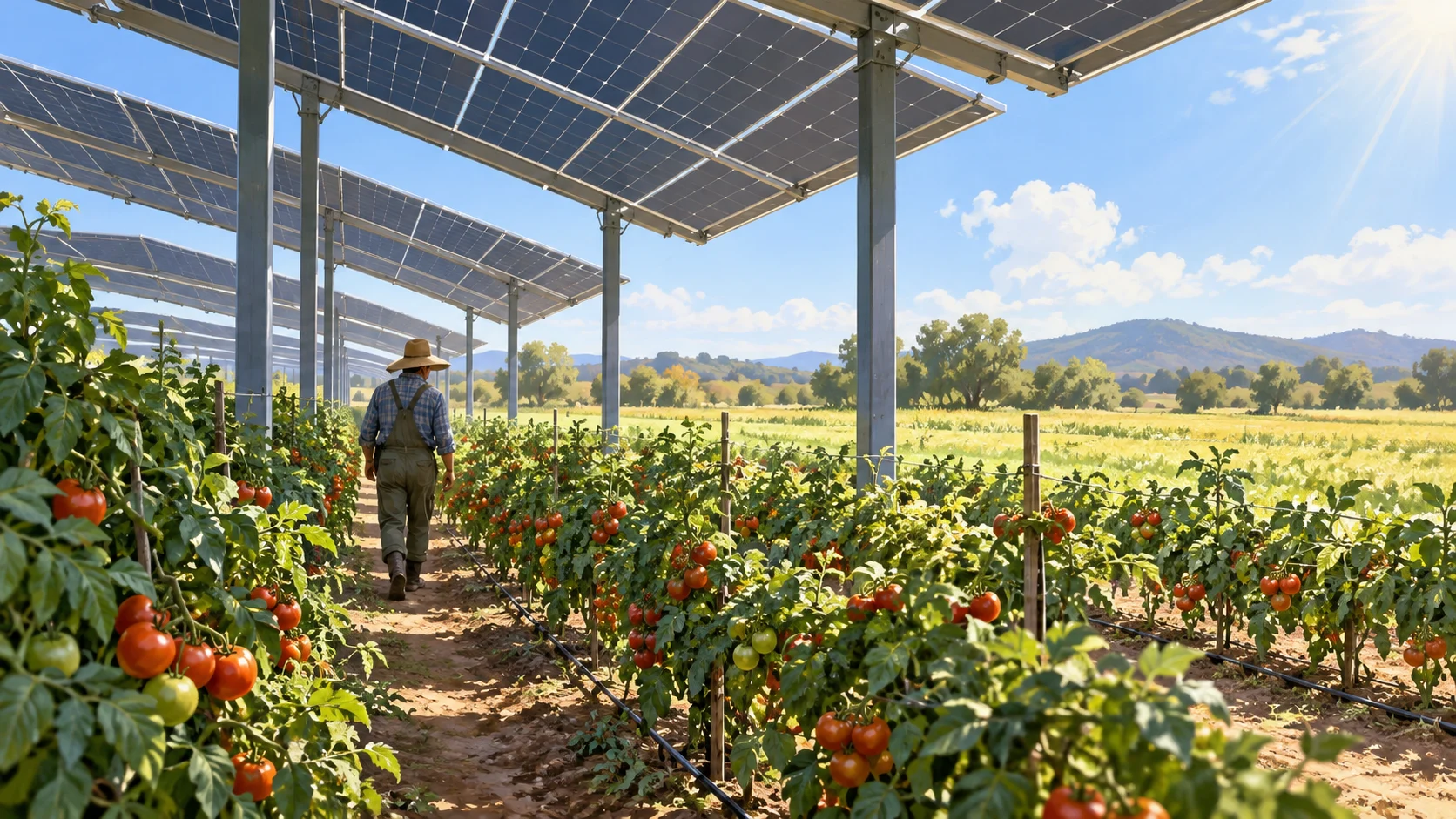
Agrivoltaics combines cultivation and solar generation on one site. The paper, published on 17 August in Journal of Advances in Modeling Earth Systems, models heat, water and carbon exchanges among panels, crops, soil and air. The framework was checked against field data from California and Minnesota; its illustrative application used a hypothetical tomato farm and hot, humid central New Jersey weather. Validation locations and the application scenario are different.
39°C to 35°C is not a thermometer reading
The paper’s plain-language summary gives mean perceived temperatures during working hours of about 39°C and 35°C. This roughly 4°C difference describes thermal burden incorporating humidity, wind and radiant heat, not an equal drop in air temperature. The abstract gives a more precise reduction of about 4.46°C. Subtracting rounded temperatures need not reproduce the precise calculated difference. Movement between shaded and sunlit areas also affects exposure.
Cooling did not remove the loss of light
In the scenario, daytime leaf temperature fell by an average 1.84°C and transpiration losses by 22.4%. However, light fell 47% and net carbon assimilation fell 31%. Cooling partly offset losses; it did not demonstrate increased photosynthesis or harvests. Average daytime panel temperature was 5.6°C lower than a conventional solar installation, not 5.6%. We use the paper and university abstract to correct the percentage wording in Xataka’s 18 October account.
Would the same happen on every farm?
Climate, crop and panel height or spacing can change outcomes. Xataka discusses potential relevance to Spain; that is not Spanish field evidence. Independent reporting is also not replication of the model by another team. The next evidence to seek is measurements of real workers’ heat exposure alongside harvest and electricity output across seasons. The results suggest a tool for comparing designs, without replacing safe-working standards during extreme heat.
Primary sources and independent checks
Original paper: 17 August publication, model, abstract and plain-language figures and scope; search-provided text used when direct HTTP was restricted: Journal of Advances in Modeling Earth Systems
University abstract: cross-checks light, carbon uptake and 4.46°C; used alongside the paper, not instead of it: Princeton University
Independent editorial analysis: 18 October renewed coverage and Spanish context; its 5.6% wording corrected to the paper’s 5.6°C; not replication: Xataka
Read in other languages
한국어 · English · Español · 日本語 · Tiếng Việt