WORLD NEWS
A nuclear reference now corrects a clock’s laser; the best atomic clocks remain ahead
European researchers have operated a nuclear clock that uses the nucleus’s response to correct drift in its laser automatically.
The laboratory prototype was reported on 7 October; it has not surpassed the best atomic clocks or discovered dark matter.
Read the response and steer the laser
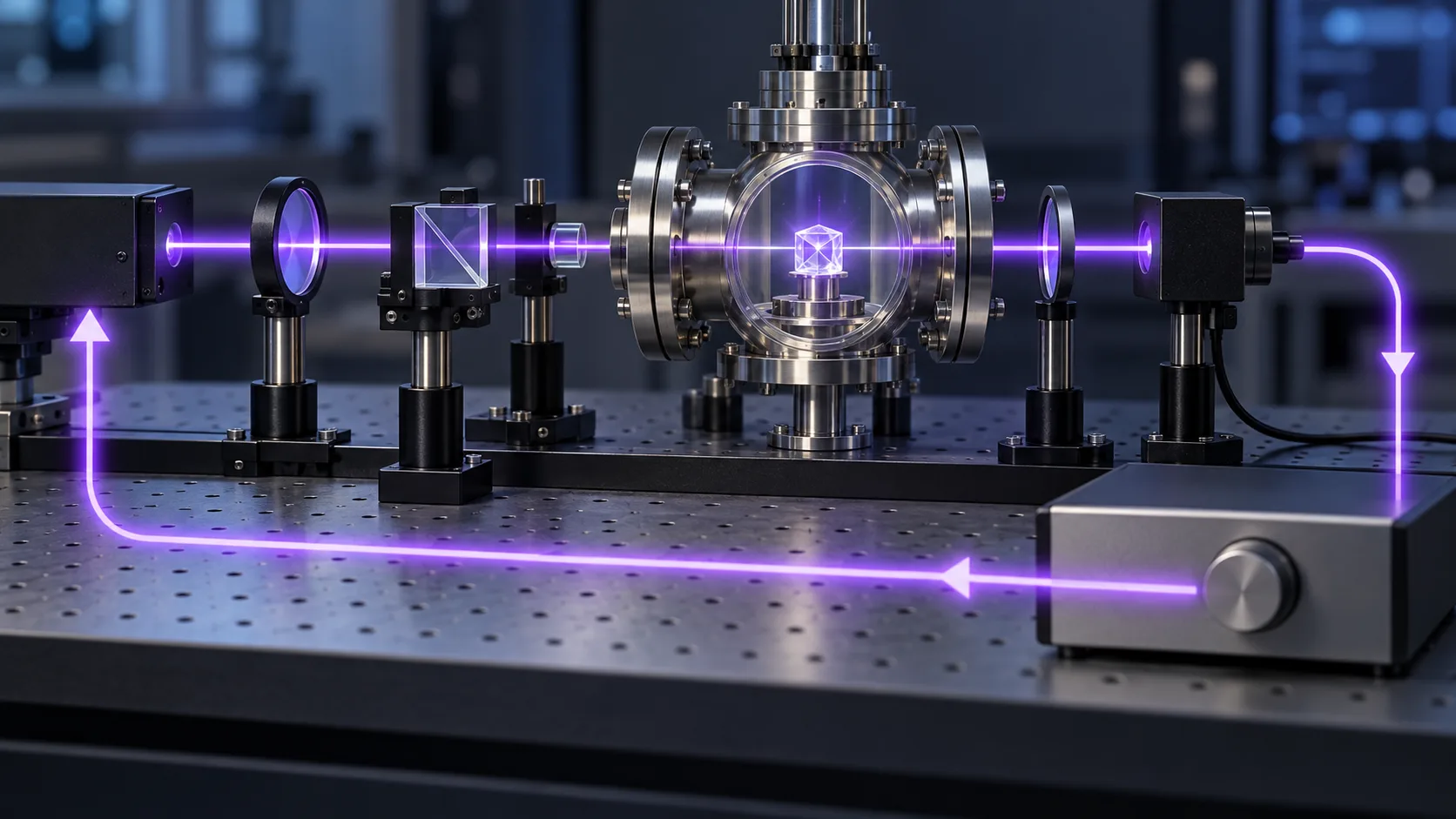
The step is from observing a promising nuclear transition to using it for active clock control. Researchers illuminated a small thorium-229-containing crystal with a specific ultraviolet laser. Absorption changes when the frequency moves away from resonance. Reading that change and adjusting the laser creates a feedback loop. A nucleus is not moving like a visible second hand.
A small crystal operated at room temperature
The Nature paper describes a millimetre-scale calcium fluoride crystal at room temperature and light near 148 nanometres. TU Wien reports stable operation for more than 24 hours without intervention. Run time demonstrates sustained function. Frequency stability and accuracy are separate comparison measures, so a day-long run alone cannot establish a precision record.
How it differs from an atomic clock
Conventional precision clocks use changes in electronic states around an atom. A nuclear clock uses changes in the nucleus. Lower sensitivity to some external disturbances is a reason to investigate this reference. APS’s independent expert account explicitly says present performance still trails the best atomic clocks. A Chinese team reported another design at the same time; its conditions and performance must not be combined with the European device’s results.
Further comparisons will test its scientific value
The European team compared its device with an external atomic clock to look for changes predicted by dark-matter models. It did not report finding those changes. Self-regulation also does not eliminate all supporting laboratory equipment. Next checks include comparisons between devices, systematic influences, longer operation and improvements. Recent renewed coverage prompted this explanation; the original experimental publication date remains 7 October.
Primary source and independent checks
Primary source: date, results and method: Nature
Primary source: date, results and method: TU Wien
Independent check: announcement, measurements and scope: American Physical Society
Independent check: announcement, measurements and scope: ABC Science
Read in other languages
한국어 · English · Español · 日本語 · Tiếng Việt