WORLD NEWS
Broccoli beneath magenta solar panels: 4.5-fold light-use efficiency, but 25 extra days
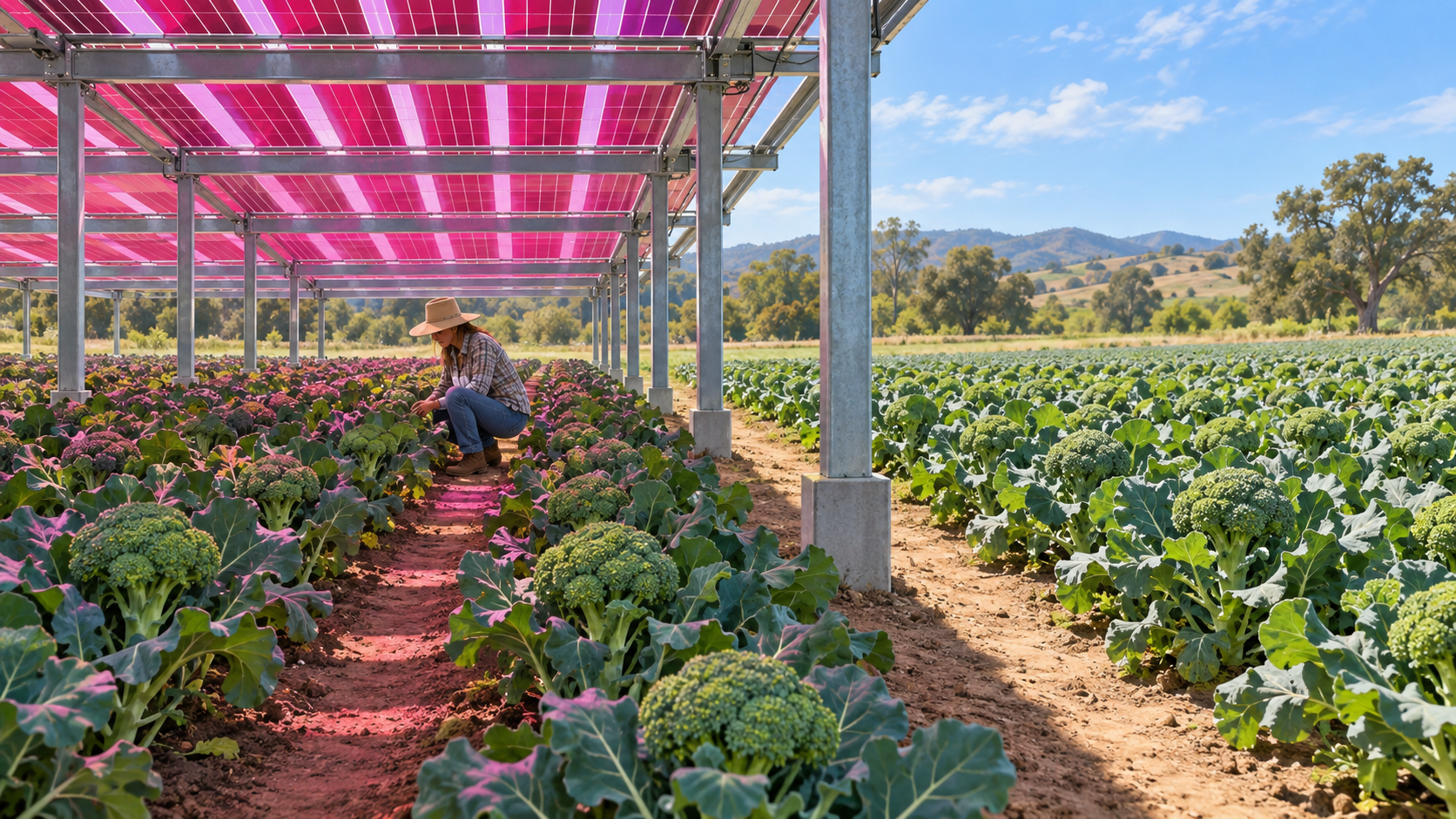
In a Swedish experiment, broccoli under semi-transparent magenta solar panels used sunlight 4.5 times as efficiently as an open-sun comparison and reached a similar final size.
This was not a 4.5-fold increase in crop yield: the plants needed 25 extra days to mature in a single growing-season trial.
Testing crops and electricity on the same land
The research announced by Cell Press on October 2 compared the 2024 growing season at a Swedish farm. Two panel systems, each 20 by 20 metres, had different transparency levels; another plot received full sunlight. Instead of blocking light with opaque panels, the design uses part of the spectrum for power while allowing light usable by plants to pass below.
What is in the denominator of 4.5-fold?
The reported comparison concerns how efficiently plants use the sunlight available to them. Efficiently using reduced light is different from producing more crop in the same time. Broccoli under the panels ultimately reached a size comparable to conventional cultivation, but needed 25 extra days. A practical farm comparison therefore has to consider the time land remains occupied and the next planting schedule, as well as final crop size.
A panel colour is only part of the choice
The aim is to explore whether crops and solar generation can share space. Similar broccoli performance beneath the two transparency levels offers a clue for comparing panel designs. It does not predict every crop’s response from colour alone. Temperature, humidity and soil moisture also shape growing conditions. These results do not establish that installing the system immediately improves farm income, and this article offers no purchase recommendation.
What prototypes still need to demonstrate
The panels were research prototypes, rather than a technology already available for straightforward commercial installation. Repeated tests across seasons, climates, crops and larger areas must be combined with comparisons of installation costs, electricity output and growing time. Our check is limited to agreement between the Cell Press announcement and independent reporting; access restrictions prevented reading the linked full paper. The independent article is not an experimental replication. Follow-up tests of colour and transparency should examine the crop–power balance.
Primary source and independent checks
Primary source or announcement: Cell Press
Institutional or data check: Cell Reports Physical Science
Additional primary source or independent check: The Times of India
Read in other languages
한국어 · English · Español · 日本語 · Tiếng Việt