WORLD NEWS
An mRNA carrier lasted a year at room temperature—but only in mouse tests
MIT researchers found a formulation that preserved dried mRNA lipid nanoparticles for up to one year at room temperature and two months at 37°C.
Those storage results do not establish the shelf life of a licensed vaccine. The COVID-19 antigen formulation was tested for immune response in mice, not people.
What changed
The team changed the mixture and ratios of sugars, salts and polymers around the lipid nanoparticles rather than the mRNA payload itself. It screened about 50 approved excipients, selected five candidates and repeatedly used a data-efficient algorithm to choose the next combinations to test.
What the time claims mean
After vacuum drying and storage, the particles carrying a SARS-CoV-2 antigen produced mouse immune responses comparable to a Moderna-like control formulation. That does not yet show equivalent performance for every antigen, at manufacturing scale or under the shocks of real distribution.
Why it matters
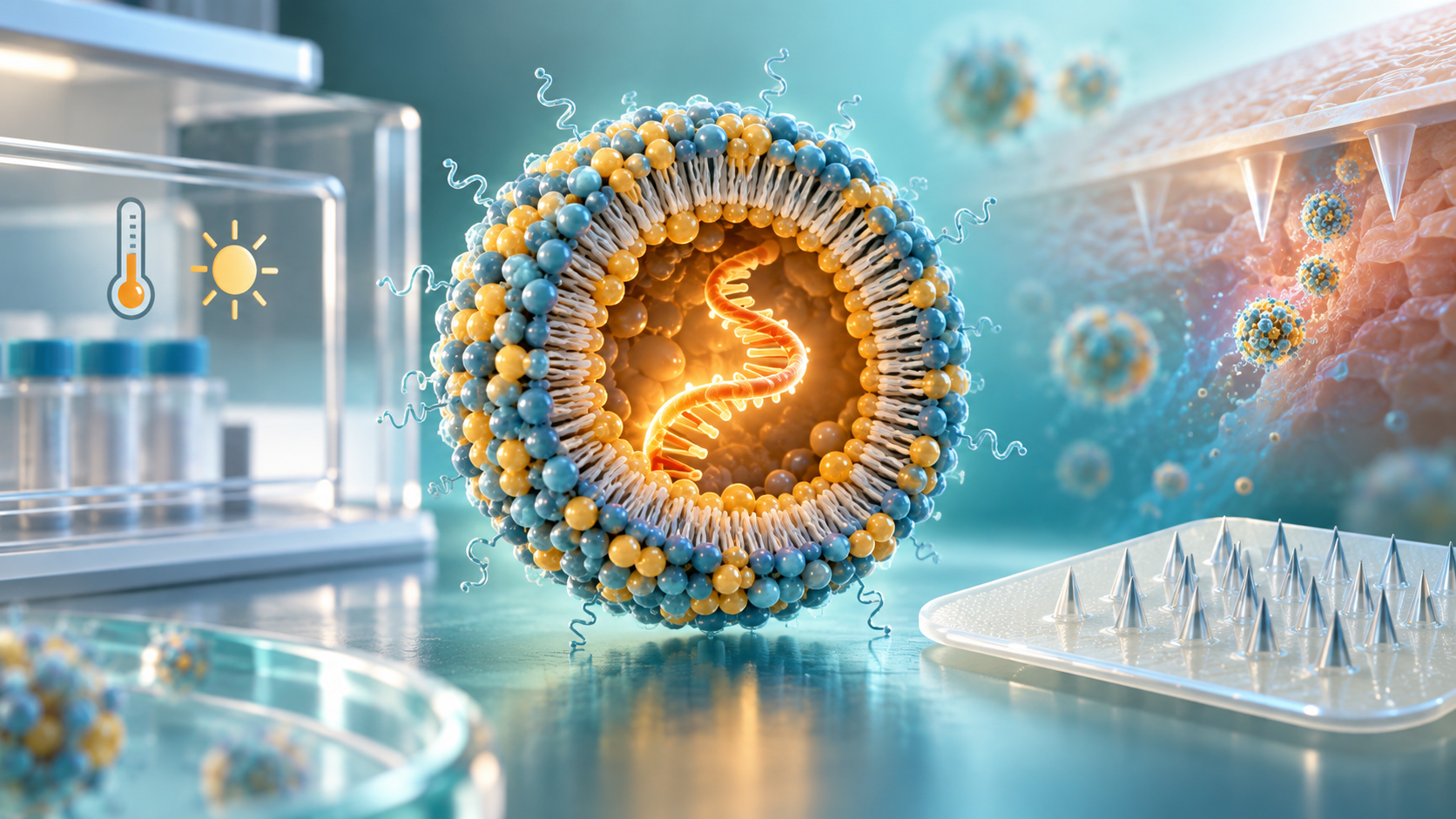
RNA degrades easily, so many current products depend on refrigerated or frozen supply chains. Reproducible dry-state heat tolerance could widen distribution and support formats such as dissolving microneedle patches, but cost, production and regulation remain separate hurdles.
What must come next
Researchers need human safety and efficacy studies, tests with multiple RNA cargos, scale-up data and measurements of particle properties after long storage. The paper also discloses patent, consulting and company relationships, making independent replication especially valuable.
Primary source and independent checks
Primary source: Nature Biotechnology 원 논문
Institutional explanation: MIT News 연구 설명
Independent check: Nature 논문 서지·동료심사 정보
Read in other languages
한국어 · English · Español · 日本語 · Tiếng Việt