WORLD NEWS
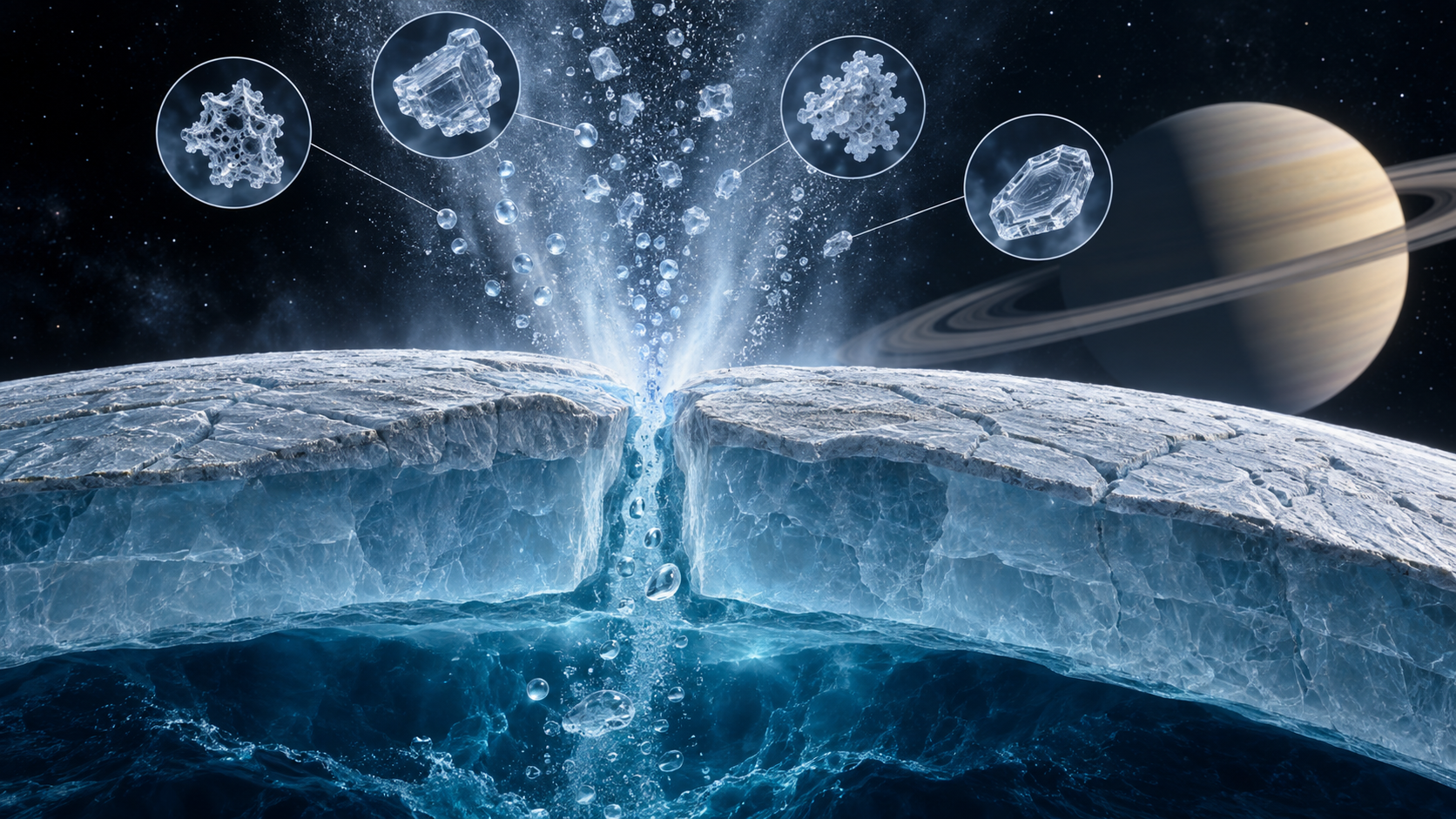
Enceladus ice grains may sort ocean ingredients into separate samples
Researchers distinguished at least five basic groups dominated by different chloride, carbonate, phosphate, hydroxide and potassium salts. One grain therefore need not represent the ocean’s average composition.
Solutes can separate within a freezing droplet, which may then strike an ice-vent wall and break into micrometer fragments. Individual fragments can become enriched in one component.
Why the sample sorts itself
Bubbles bursting at the subsurface ocean can create spray carried upward by vapor. During gradual freezing, dissolved compounds migrate into different regions instead of being locked uniformly.
What Cassini measured
The Cosmic Dust Analyzer recorded ions produced when grains struck the detector in Saturn’s E ring. Observations, laboratory work and modelling were combined to reconstruct the process.
It is not evidence of life
Segregation means microbial material, if present, might be concentrated in a minority of grains. No life or biosignature was detected, and conditions throughout the vents were not directly watched.
What a future mission must do
A probe should measure many individual grains rather than rely on a small average. Experiments must narrow the effects of decompression, cooling and wall impacts and test instrumental selection bias.
Primary source and independent checks
Primary source: Science Advances paper
Institutional explanation: Freie Universität Berlin explanation
Independent check: Life Science Network bibliographic and abstract check
Read in other languages
한국어 · English · Español · 日本語 · Tiếng Việt