WORLD NEWS
A small Neptune-like planet was confirmed orbiting red dwarf GJ 3090 backwards
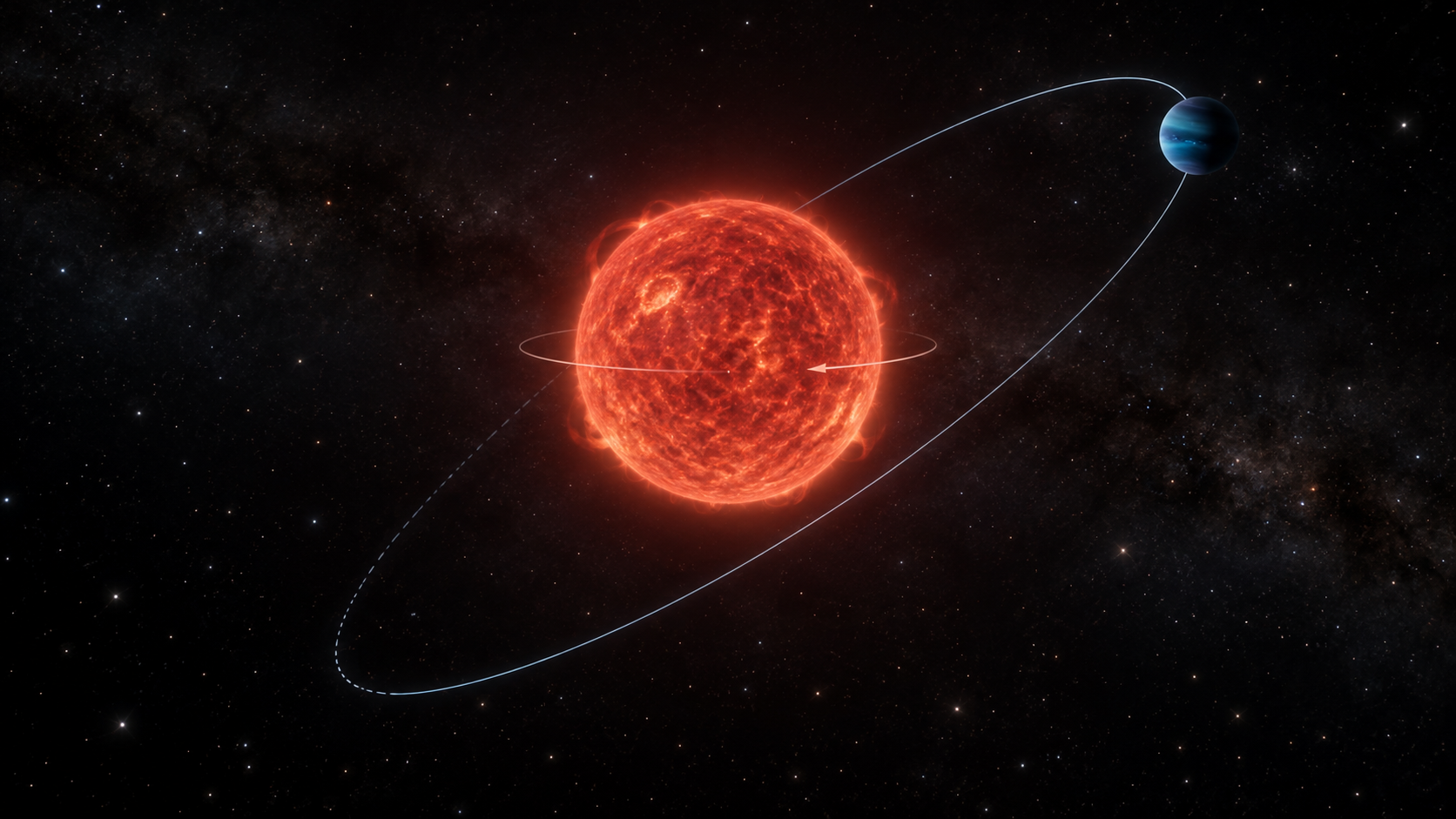
The planet is about 2.2 Earth radii and 4.5 Earth masses and circles every 2.85 days. NIRPS transit spectroscopy and stellar rotation information yielded the three-dimensional angle.
Stars and planets normally inherit a shared disk direction. An angle beyond 90° places the planet’s orbital angular momentum in the opposite hemisphere from the stellar spin.
The expected perturber is missing
Extreme tilts often involve a massive outer planet or companion star. Imaging and velocity data found none capable of easily producing this configuration within current detection limits.
Formation remains a hypothesis
The star may have acquired a second, misaligned gas disk in youth. The present orbit and absent massive companion are observations; the second disk is an unobserved historical explanation.
What “smallest” means
The planet is a low-density sub-Neptune, not an Earth-like rocky world. It is the smallest M-dwarf planet with a measured 3D obliquity, not necessarily the smallest retrograde planet of every kind.
Why more data matter
Longer velocity monitoring can reveal distant companions or tighten limits. Spin-orbit measurements in other red-dwarf systems can separate rare scattering from formation-environment pathways.
Primary source and independent checks
Primary source: Astronomy & Astrophysics paper
Institutional explanation: University of Geneva explanation
Independent check: Queen Mary University independent check
Read in other languages
한국어 · English · Español · 日本語 · Tiếng Việt