WORLD NEWS
A 560-million-year-old organism survived in 3D beneath a Norwegian sheep field
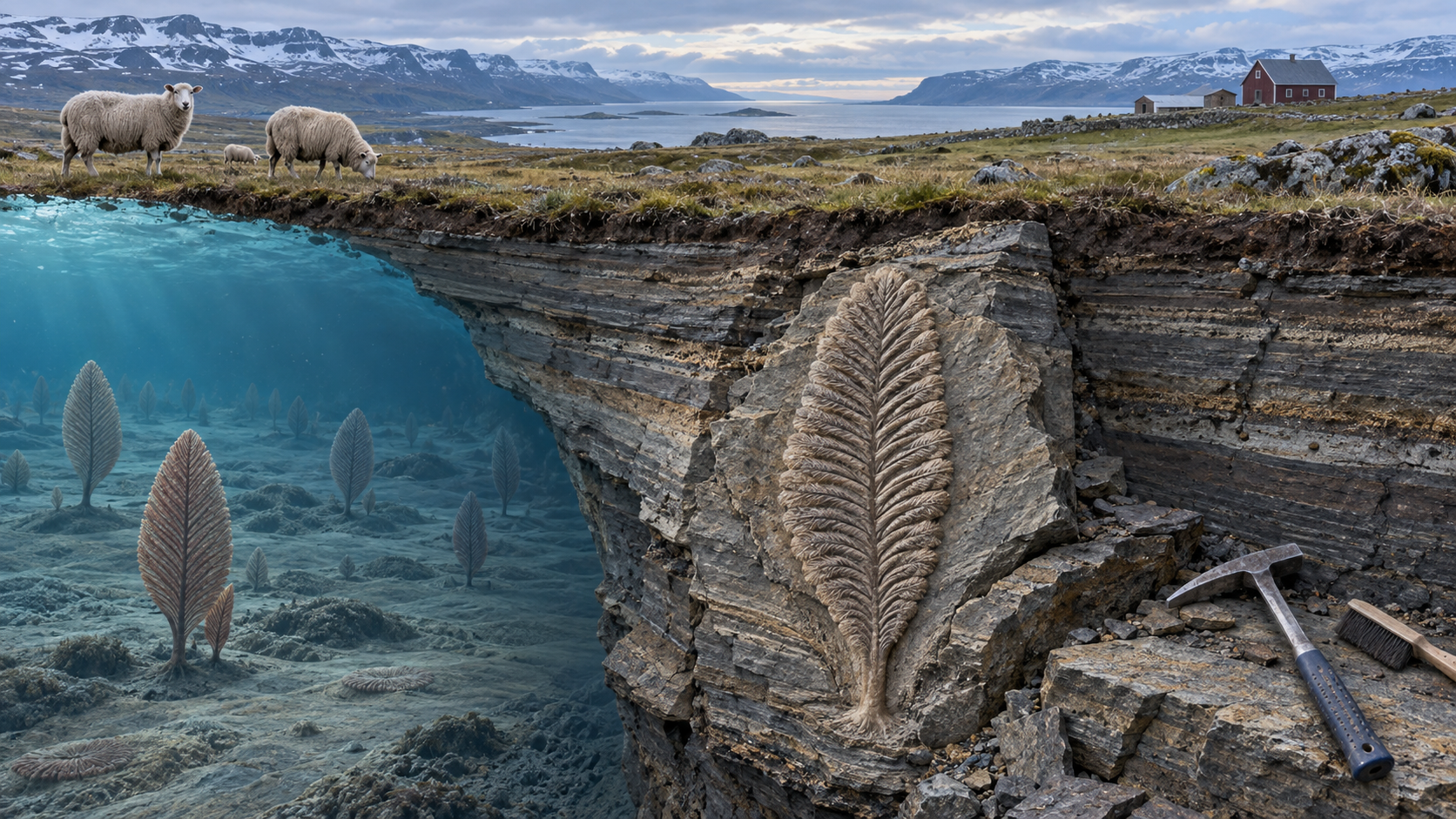
Rock in an Arctic Norwegian sheep field has yielded a frond-shaped Charnia from roughly 560 million years ago with rare three-dimensional relief intact. Most soft-bodied specimens survive only as flattened impressions, so this one exposes more structure.
Charnia cannot be assigned confidently to one modern animal group. It is widely treated as complex Ediacaran multicellular life, but its exact evolutionary position and feeding mode remain unresolved.
Where was it found?
The specimen came from an outcrop of the Indreelva Member in Finnmark, near earlier structures interpreted as anchors of organisms attached to the ancient seabed.
Why is 3D preservation rare?
Soft bodies are normally compressed flat. Turbidity-current deposits retained depth and curvature here, allowing the branching form to be compared in relief.
Was it alone?
Researchers identified other macrofossils and ecosystem traces. The value lies in a major new European Ediacaran locality as well as one exceptional fossil.
What changes?
The first confirmed Scandinavian Charnia expands its known reach and suggests early large organisms were widespread. One site cannot establish global abundance.
What comes next?
More excavation, dating and three-dimensional analysis should refine species identification and burial history; nearby outcrops may hold more specimens.
Primary source and independent checks
Read in other languages
한국어 · English · Español · 日本語 · Tiếng Việt