WORLD NEWS
A genetic code was automatically prototyped in a test tube before modifying a living organism
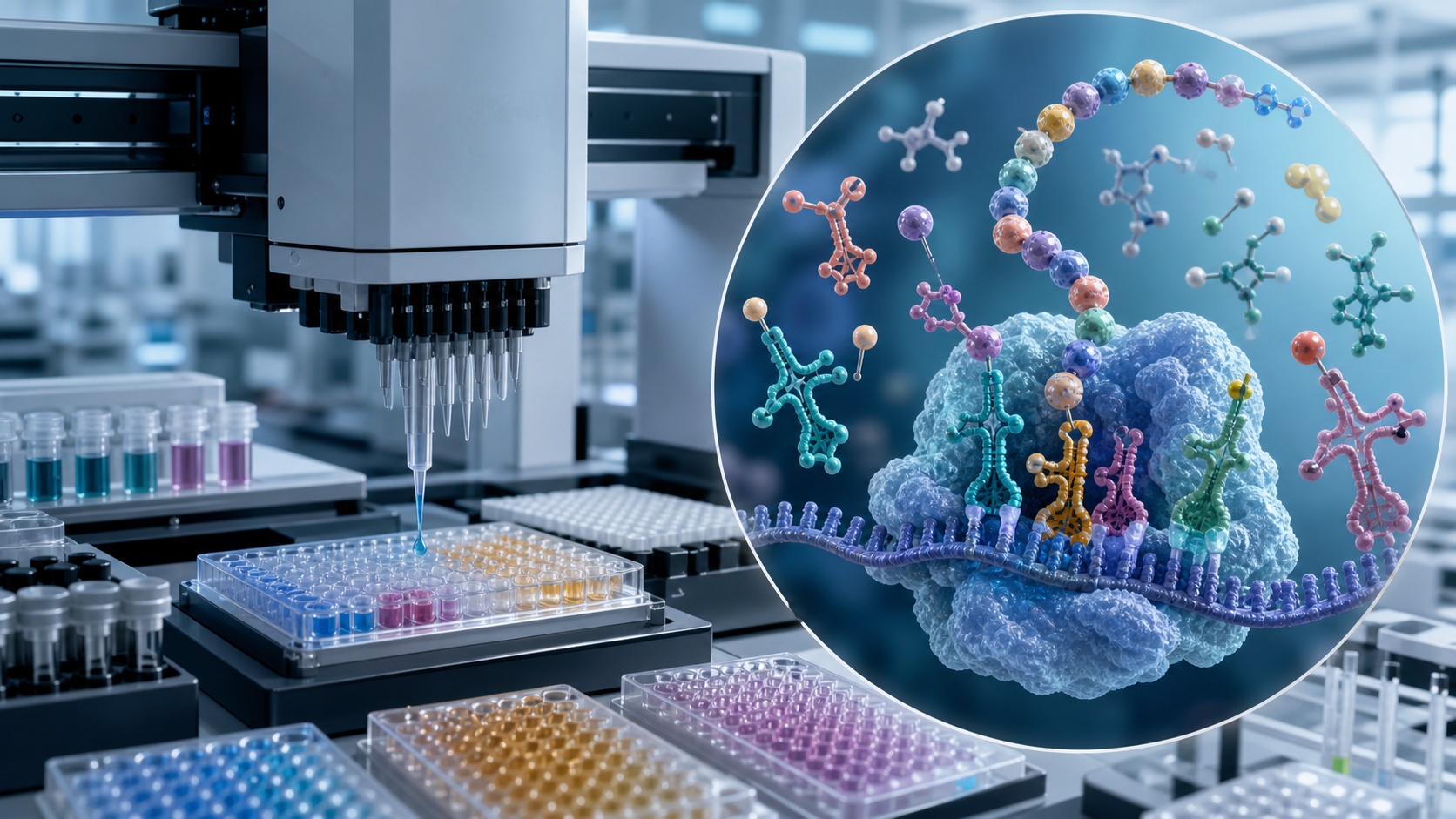
Harvard researchers have unveiled AGENTEX, a robot that creates and compares new genetic codes in an in-vitro translation device without first changing the genome of a living cell. We tested a compact code that specifies 20 standard amino acids with 22 tRNAs, theoretically making room for 14 codons to be reassigned to new material.
This does not mean that a new life form was created or that 34 non-standard amino acids were added to proteins at once. The study actually tested one non-standard amino acid and up to three reassignment codons in cell-free extracts; whether they would work in the metabolism and chromosomes of living cells is a separate challenge.
Why compress the genetic code?
Normally, living organisms express 20 standard amino acids and start/stop signals using 64 codons. Since several codons refer to the same amino acid, leaving some of them empty creates the possibility of introducing chemical materials that do not exist in nature into the protein chain. However, modifying the entire genome to test a design takes a long time.
What does AGENTEX automate?
The researchers created a tRNA with a changed end and a modified ribosome that selects and receives it. The robot synthesizes and purifies tRNA bundles and messenger RNA and compares protein translation results in cell extracts. It is also key to separate the natural translation system and the new translation system so that they are rarely mixed in the same test tube.
What are the numbers 22 and 34?
The actual compression design used a total of 22 tRNAs, 21 tRNAs for sense codons and 1 tRNA for stop codons. This configuration retains the standard 20 amino acids while theoretically allowing 14 codons to be opened to other materials, which the paper calls the ’34-codon code’. This number does not mean that 34 new materials were created at once.
Where are the safety and limits?
Since it is a cell-free device, it has the advantage that it is difficult to operate even if the components are transferred to living organisms in the environment. Inside the cell, on the other hand, chromosome structure, metabolism, growth rate, and error correction are intertwined. A code that works well in a test tube cannot be considered stable in a live strain.
What are the next steps?
The researchers plan to automatically compare translation speed and accuracy with more non-standard materials and codon combinations. Only then can the risk and cost of transferring the chosen design to a real genome be reduced. It is necessary to check the number of reassignments and cell-free conditions that have actually been verified in official papers and data.