WORLD NEWS
A supersonic vortex that separates gas and vacuum without solids created a pressure ratio of 200 in a 15 mm open hole.
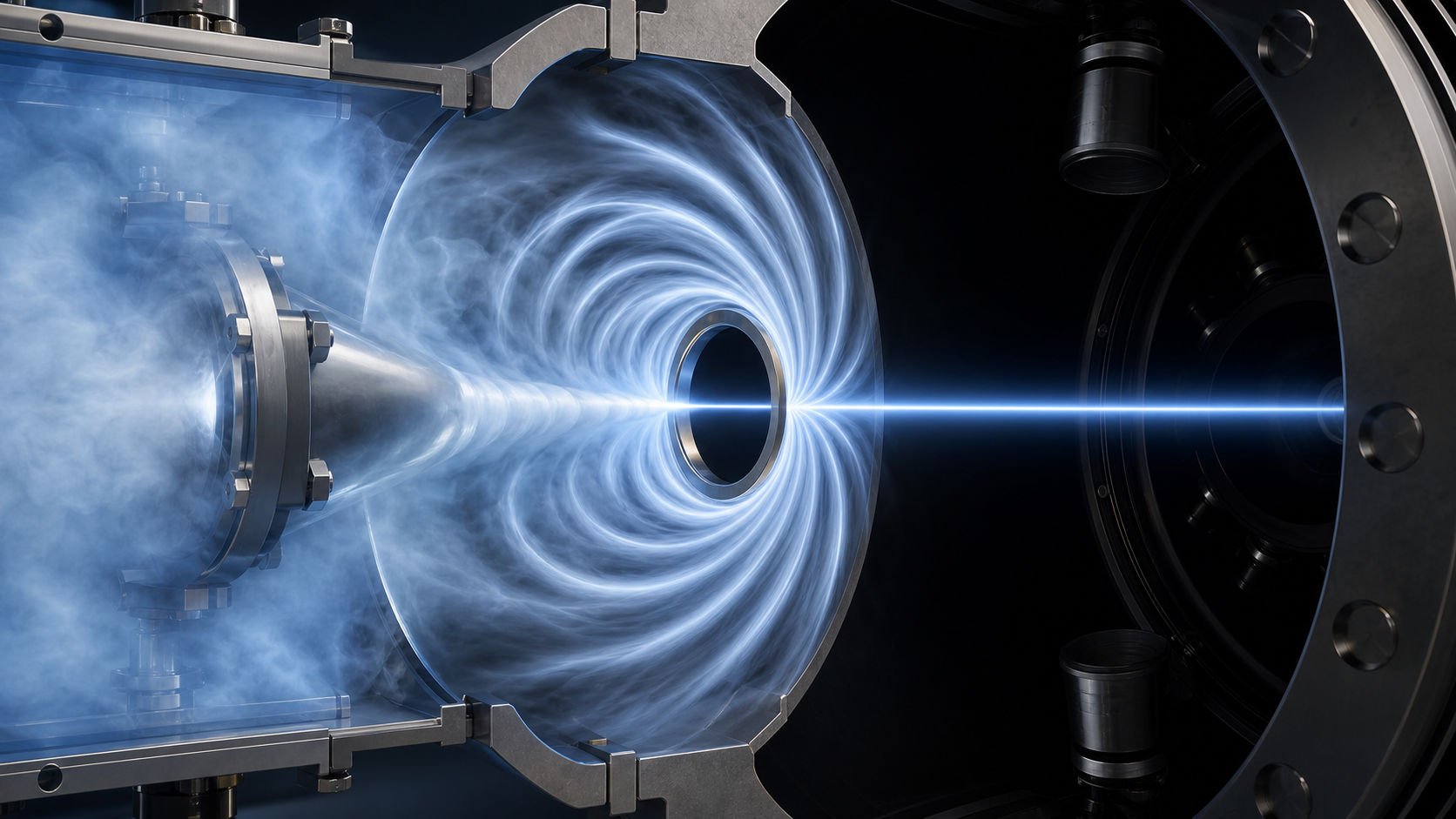
Researchers at Riken and Nagaoka University of Technology in Japan increased the pressure ratio of the ‘vortex window’, which divides two spaces with only a supersonic gas vortex without a solid membrane, to a maximum of about 200. The 15 mm diameter hole is left open, allowing light or particle beams to pass through.
This does not mean that there is a direct connection between the atmosphere on one side and a complete vacuum like space. Approximately 200 is the experimental value of a low-pressure/low-flow single device, and when two devices are connected in series, the value of approximately 4,550 is not an experiment, but an estimate calculated from the performance of a single device.
How gas acts as a window
In a free vortex, the closer you are to the center, the faster the flow and the lower the pressure. The researchers swirled a supersonic gas jet to create a pressure gradient between the high and low pressure sides. The absence of solids avoids the problem of strong lasers or particle beams heating or shattering the window.
What did you drive differently?
In the existing method, the ambient pressure difference was calculated to be equal to the pressure difference of the ideal vortex, and the pressure ratio was about 5. The new method intentionally made a big difference by pressing more on the high pressure side and pulling more on the low pressure side. The gas flow then adapted its own path and width, sustaining a pressure ratio of about 70 and reaching about 200 under low-pressure conditions.
How to distinguish between 200 and 4,550
Approximately 200 is the maximum pressure ratio measured by a single device in practice. The value of approximately 4,550 possible when two devices are placed in series is a theoretical estimate based on these measurements. It must be confirmed in the next experiment whether the flow remains stable when multiple stages are connected.
Where can I use it?
For now, it is the foundation technology for making the gas stripper smaller for use in Riken’s next-generation heavy ion accelerator. Researchers also cited particle blocking around semiconductor EUV light sources, vacuum analysis equipment, and space experiment devices as possibilities. However, neither application has been proven on commercial equipment.
What is the next confirmation
Improvements in pressure ratio were confirmed not only in air but also in argon and helium, but long-term operation, gas recovery, beam quality, and multi-stage connection stability remained. The actual stage pressure ratio and holding time should be confirmed in the paper and subsequent Ricken tests. The key is that the flow itself became the boundary rather than building a wall.
Primary sources and independent checks
Review of Scientific Instruments original paper