WORLD NEWS
What would happen if only half a photon was reflected? The answer was the overlap of several photons.
A theory has shown that if the mirror is suddenly removed while one photon is being reflected by the mirror, the remaining light becomes a quantum state in which multiple photons can occur simultaneously.
This is not an experiment in which a particle called a photon is cut in half with a knife, but a prediction that calculates how the quantum field changes when only the front part of the light is reflected to create a waveform.
Why can’t a single photon explain it?
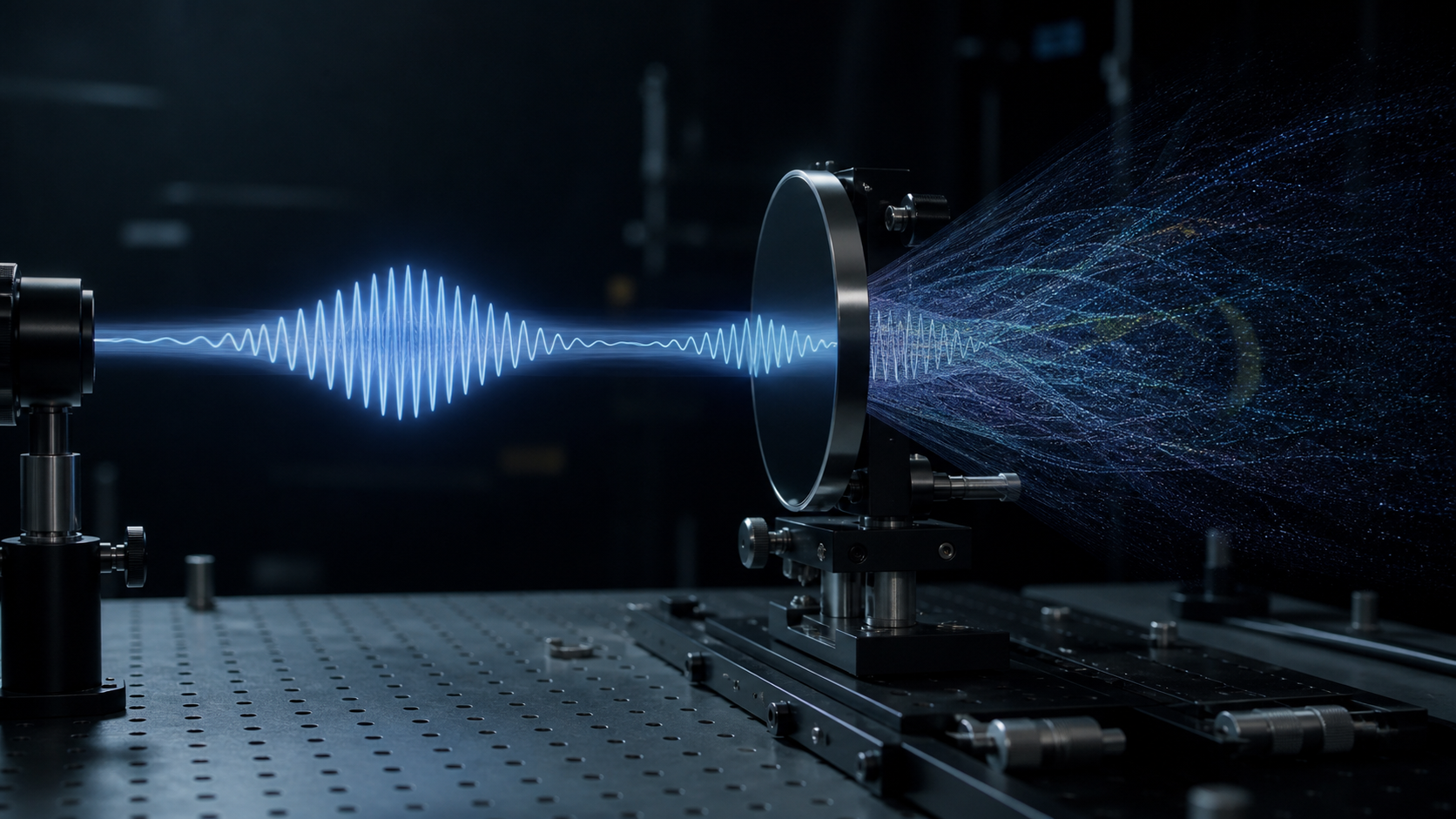
Photons, bundles of waves, are spread out over time and space. If the mirror is all the way up, the entire thing is reflected, but if you remove the mirror after the front part has been reflected, there will be an abrupt end to the waveform. The researchers calculated that this sharp boundary does not correspond to exactly one photon state.
So what comes out?
The result is a quantum overlap, with the possibility of zero, one, two or more photons. The steeper the boundary, the larger the range of photon counts required. Infinitely fast mirrors are impossible, so there are limits to the number of photons and the sharpness of the waveforms in real devices.
Where does energy come from
The extra photons don’t come for free. A device that quickly moves or removes a mirror does work on the quantum field and supplies energy to it. Although moving boundaries resemble the dynamic Casimir effect that creates particles, the study focused on situations where the ongoing reflection of a single photon is interrupted.
Can you see it right away in the experiment?
The paper is a theoretical calculation and does not yet have experimental results that directly detect multiple photon states using this method. The switching speed and loss of the mirror and the time resolution of the detector must be addressed together. The researchers believe that superconducting circuits or rapidly controlled optical boundaries could be candidates for testing.
Why it’s important
The simple manipulation of leaving only part of the light creates a state in which the number of photons itself is not set, suggesting a new control method for quantum information. However, the difference between the ideal computational boundary and the actual device is large, so its usability must be confirmed through follow-up experiments.
official source material
Physical Review Letters original paper