WORLD NEWS
Euclid confirms a quasar 630 million years after the Big Bang
Quasar J1504+6252, identified in Euclid observations, has been confirmed at an epoch about 630 million years after the Big Bang.
This is a record for luminous quasars, rather than a claim to the earliest black hole of every kind.
Several telescopes checked a tiny red point
A quasar is an exceptionally bright galactic nucleus. Gas heats up and shines as it approaches the massive black hole at its centre. This observation does not photograph the black hole’s interior.
The team selected the candidate in Euclid data and analysed its light with Keck, Hubble, the Large Binocular Telescope and James Webb. The paper appeared in Astronomy & Astrophysics on November 24. The source is nicknamed Dún Aonghasa.
630 million years describes the universe’s age
The measured redshift is about 8.13: this expresses how much cosmic expansion stretched the light. In the cosmological model used in the paper, the light was emitted about 630 million years after the universe began. We see the source at that early epoch.
The paper calculates an advance of about 39 million years over the previous quasar record, rounded to about 40 million in the announcements. The 630-million-year figure is neither the black hole’s lifetime nor its distance in light-years. Other kinds of black hole candidates at earlier epochs belong to a different comparison.
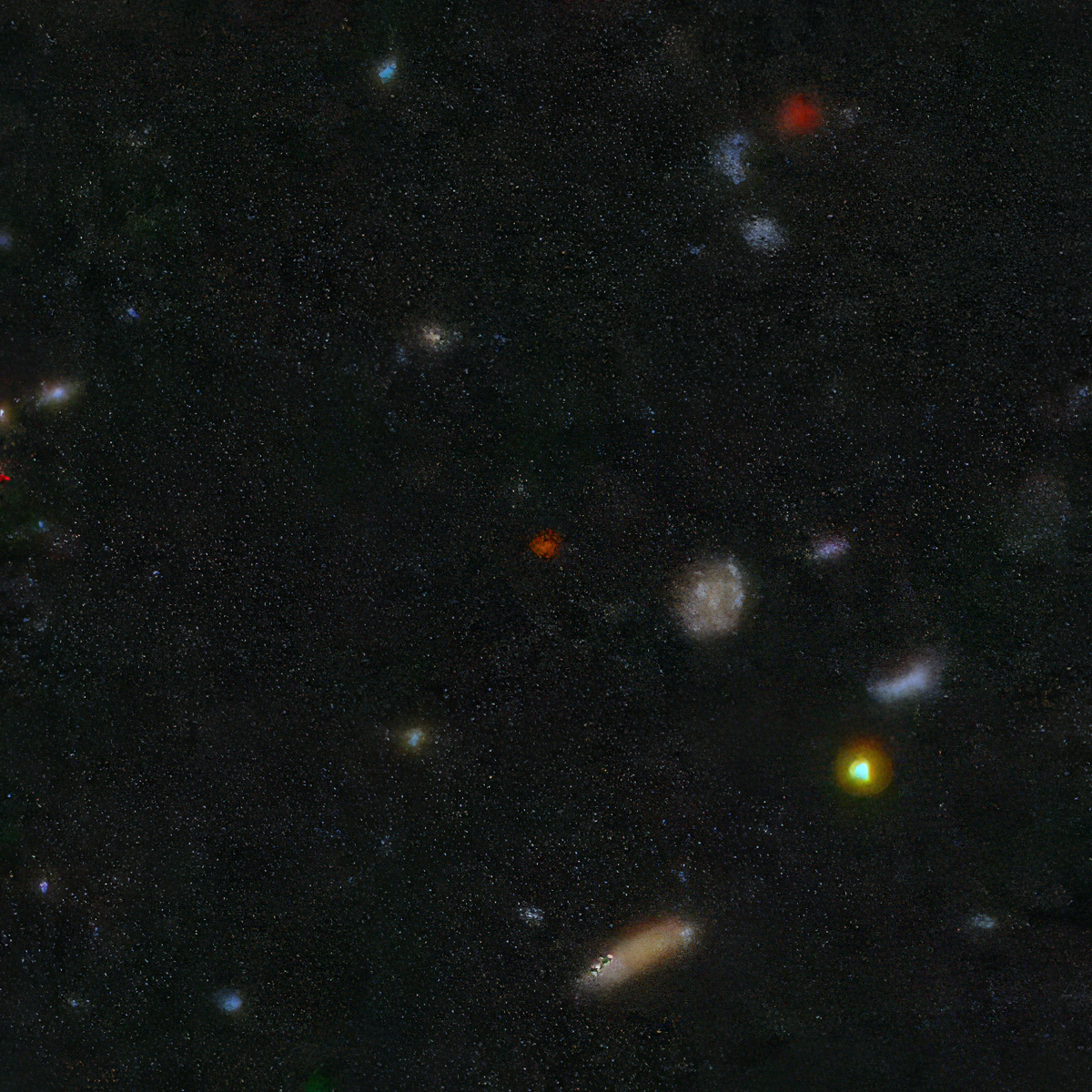
360 million Suns is a reference mass estimate
The team inferred mass from the width and brightness of hydrogen and magnesium emission features produced by nearby gas. The reference value is about 360 million times the Sun’s mass. Different calibrations give central estimates of roughly 200 million to 800 million solar masses, with uncertainty around each estimate as well.
Comparing luminosity with mass gives an accretion state of about 12–44% of the Eddington benchmark. This is a theoretical luminosity scale associated with the competition between gravity and radiation pushing on infalling gas. It should not be confused with the mass comparison or treated as a constant growth rate throughout the object’s life.
Its growth history is still unresolved
Finding such a massive black hole so early leaves growth models less time to assemble it. A large initial seed or highly efficient earlier feeding could help. Direct collapse of a large gas cloud is one possible route, but this observation cannot establish which formation pathway occurred.
AP separately questioned the lead researcher about the mass and the record. That is independent reporting, not an independent replication of the measurements. Further surveys can test whether equally massive but brighter quasars exist and how varied their feeding states are. There is no fixed date for the next record.
Primary sources and independent checks
Full original paper: observations, mass-calibration uncertainties, luminous-quasar scope and formation limits: Wolf et al. — arXiv:2611.31385 / A&A 715 A356
ESA November 24 announcement and observational image with licence: ESA — Euclid / 2026-11-24
AP reporting with a separate email interview; not independent replication: Associated Press — Marcia Dunn / 2026-11-24
Original observation image, authorship and reuse licence: ESA — image / CC BY-SA 3.0 IGO