WORLD NEWS
Could part of the Milky Way’s Norma arm be a star-forming shock front?
A study published in Nature Astronomy on November 20 suggests that stellar nurseries mapped as part of the Milky Way’s Norma arm may instead follow a shock front driven by the galaxy’s central bar.
The finding reinterprets a stretch near the galactic centre; it does not show that the entire Norma arm is absent.
What lies where a spiral arm was mapped?
The Milky Way has a long concentration of stars across its centre, called a bar. As the bar turns, its gravity redirects the surrounding gas. A shock front is a boundary where the gas abruptly changes speed and is squeezed together.
The researchers asked whether stellar nurseries previously mapped as part of Norma line up along this boundary. The nurseries were already known; the question was which structure they belong to.
How do you map a galaxy from the inside?
We cannot look down on the Milky Way from outside it. Dust blocks part of the view, and gas clouds in the same direction can lie at very different distances. The team used masers, naturally amplified microwave signals near newly forming massive stars, as markers.
The researchers compared the markers’ positions and their velocities along our line of sight with a computer model. On both measures, the pattern of signals previously assigned to Norma lined up well with the modelled shock front along the edge of the bar.
Why is star formation at a shock front surprising?
Compression can gather gas that might form stars. But turbulence stirred up by strong shocks can keep that gas from collapsing under its own gravity. In other nearby barred galaxies, star formation is often weak in these lanes even when plenty of gas is present.
If this interpretation is right, shocks do not shut off star formation in the stretch of the Milky Way examined. That does not make our galaxy unique or mean that stars are forming everywhere along its bar.
What does the figure of 14,000 light-years measure?
If the markers do trace the shock front, the resulting model puts one end of the bar about 14,000 light-years from the galaxy’s centre along its long axis. That is neither the full length of the bar nor its distance from Earth. It is an estimate obtained by fitting the size and orientation of a model to observations, not a direct measurement.
Other gas structures can produce similar velocity signatures, so a good fit does not settle the identification. More measurements of the distances to stellar nurseries and of gas motions can test whether the same explanation holds. The study does not establish how structures farther out that have also been called Norma connect to one another.
Primary sources and independent checks
Research paper: comparison of observations and simulations, and the estimate of the bar’s half-length: Nature Astronomy
Independent account: what the gas velocities show and what else could explain them: scinexx · Robert Klatt
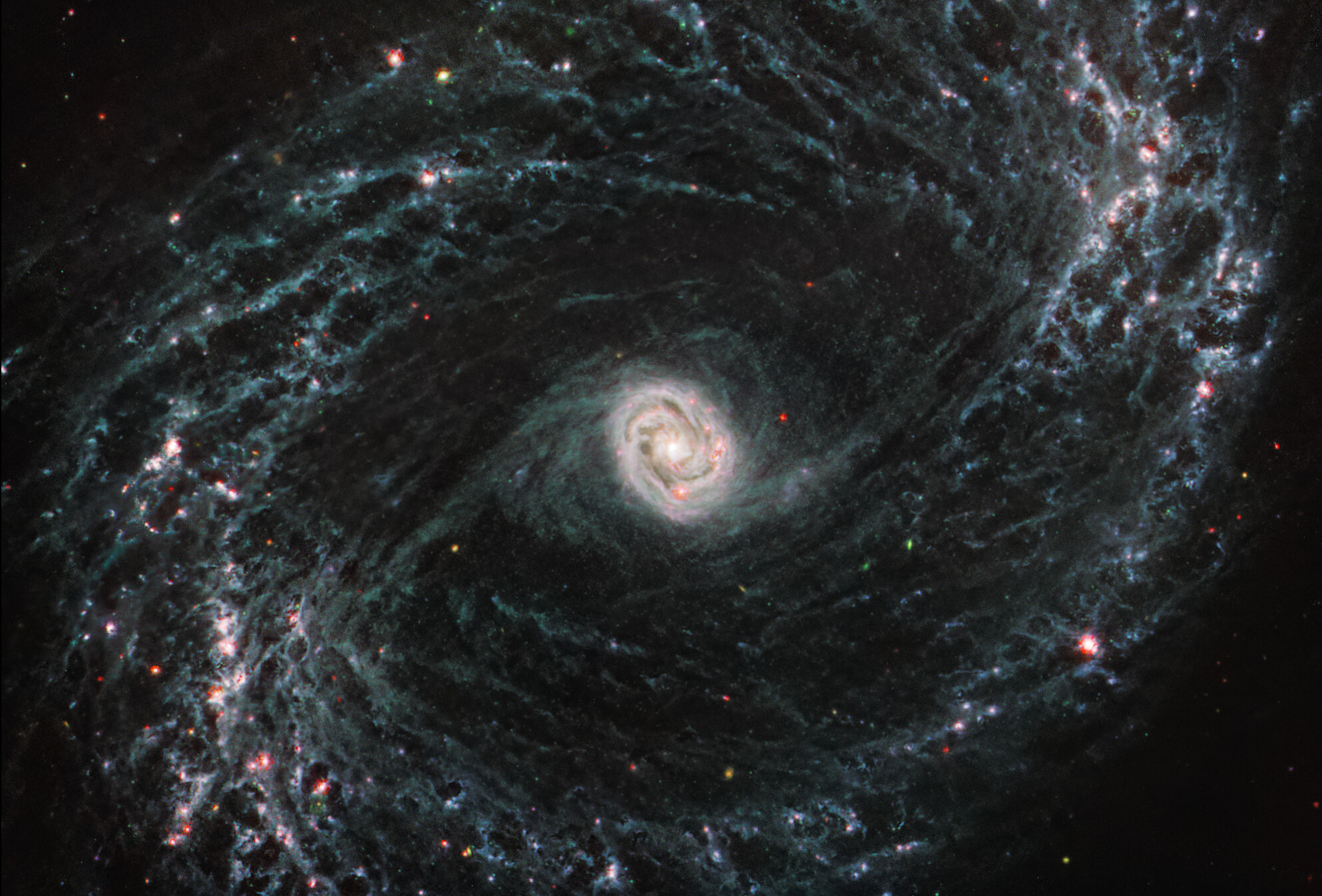
Comparison image, original credit and CC BY 4.0 usage terms: ESA/Webb · NGC 1433