WORLD NEWS
Did Andromeda’s two stars become one? Observations trace a possible merger
Astronomers have reconstructed a process in Andromeda in which a giant star appears to have engulfed its smaller companion.
The study announced on November 18, 2026 compares light before and after a 2025 eruption; further observations must clarify the final outcome.
Was this a new explosion?
The team began tracking an unusually brightening star in 2023. An eruption was detected on October 17, 2025, prompting follow-up work with several telescopes.
James Webb collected data 47 days after peak brightness. The news is the reconstruction from observations surrounding the eruption, rather than an explosion happening this week.
How different were the stars?
NASA’s account describes a model with a giant about seven times the Sun’s mass and 350 times its radius. The smaller companion was estimated at about 0.7 solar masses. Mass and radius measure different properties.
The companion was not separately photographed and weighed. Infrared emission from surrounding dust, combined with other observations and modeling, helped infer its properties.
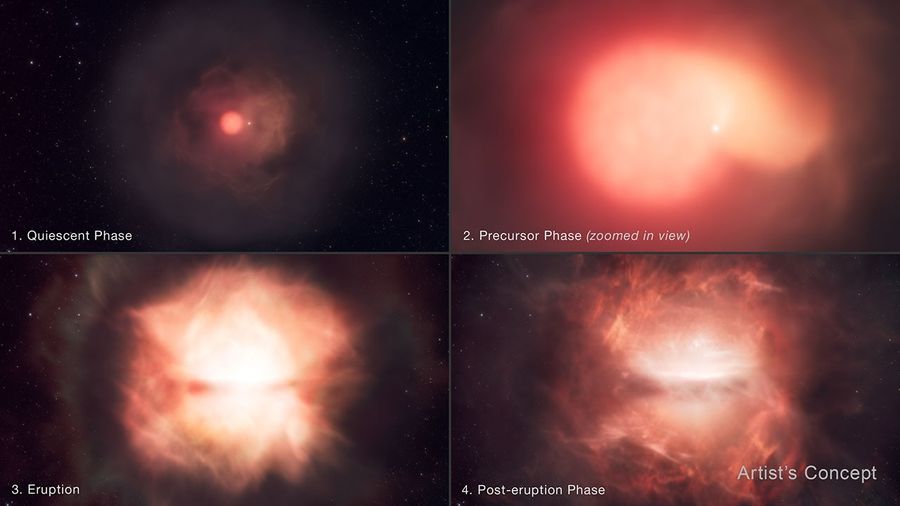
What happens inside the gas?
The proposed explanation puts the small star inside the giant’s outer gas layers. Drag can remove orbital energy and send the companion spiraling inward.
When both stars share an outer gas layer, astronomers call it a common envelope. Comparing observations across this phase helps test ideas about how close pairs of stars evolve.
Is the merger fully settled?
NASA presents the event as a merger. In a separate Space.com interview, however, the lead author also described the possibility that both stars survived in a tighter orbit.
The smaller star’s complete destruction should therefore not be treated as certain. Continued monitoring after the eruption settles is needed to distinguish the remaining possibilities.
What should readers follow next?
NASA provides the observation timeline and modeling account. Space.com adds the researcher’s explanation of the alternative outcome and the need for follow-up. The illustration is not a direct view inside a star.
Future results should clarify how many stars remain and their condition. This one system does not establish that every binary follows the same path.
Primary sources and independent checks
Observation timeline and merger model: NASA Webb
Independent interview: survival alternative and follow-up: Space.com / Charles Q. Choi