WORLD NEWS
The lightest known neutron-star pair offers another test of gravity
Analysis using China’s FAST telescope reports PSR J1856–0039 as the lowest-total-mass known double neutron-star system.
An October 21 author interview revisits research published in a September journal issue; this is neither a discovery made today nor a final proof of gravity.
How the pair becomes a natural clock
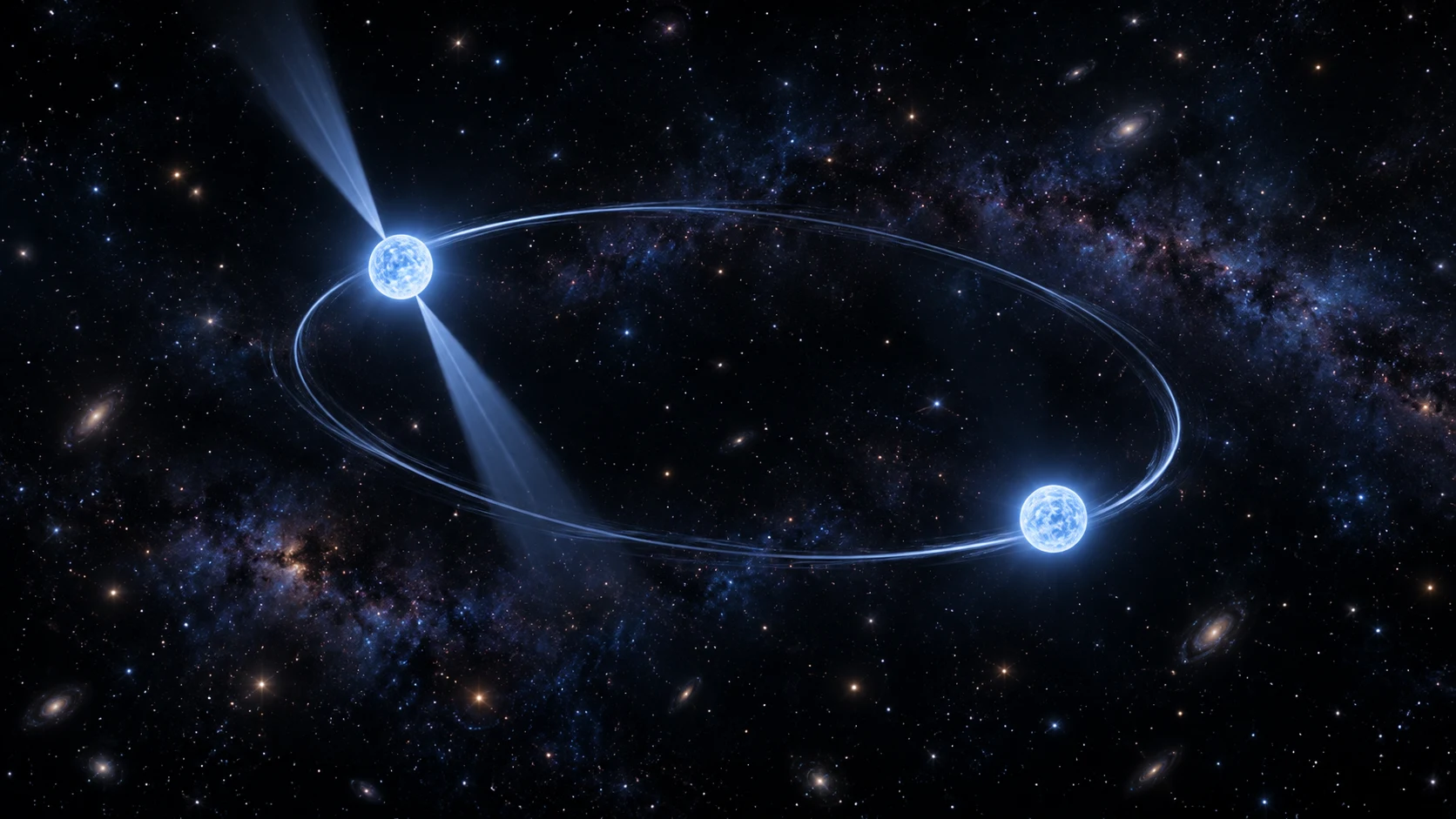
Neutron stars are extremely dense remnants of exploded massive stars. One member sends regular radio pulses, allowing it to act as a clock. Researchers compared pulse arrival times from 17 FAST observations in 2020–2025 with orbital models. The stars orbit in about 2.36 hours. Their masses were not obtained by simply photographing two points of light.
The record concerns the combined mass
The paper reports a total of 2.48841±0.00015 solar masses. Individual estimates are about 1.304 and 1.185 solar masses, each with uncertainty ±0.022. Total and individual masses have different precision because different orbital effects constrain them. “Lightest” applies to the total among known double neutron-star systems, not all stars or the least massive individual neutron star.
What agreement at roughly one percent means
The analysis combines orbital decay, rotation of the orbit’s orientation and delays in pulse timing. The ratio of observed gravitational-wave-related decay to the theoretical prediction is 1.009±0.014, reported at 68% confidence. Consistency with one supports the theory; it does not prove it permanently. An already known double pulsar provides a more precise test, so this is not a new precision record.
The eventual remnant remains uncertain
Models predict a merger in about 82 million years, not an observed collision. Whether it leaves a stable neutron star or collapses into a black hole after slowing its spin depends on dense matter. Long-term monitoring may also reveal how spinning mass drags space-time. We compared the authors’ preprint with the recent interview; that interview is not a replication by a separate observing team.
Primary sources and independent checks
Authors’ full preprint: masses, orbit, models and uncertainty; not a claim to have opened the full September PRL version: Yang et al. · author preprint · arXiv:2607.27333v1
Independent reporting: Han email and comparison with a more precise existing test; not a new discovery date or another team’s replication: Live Science · 2026-10-21
Read in other languages
한국어 · English · Español · 日本語 · Tiếng Việt