WORLD NEWS
Euclid finds its first previously unknown comet while mapping galaxies
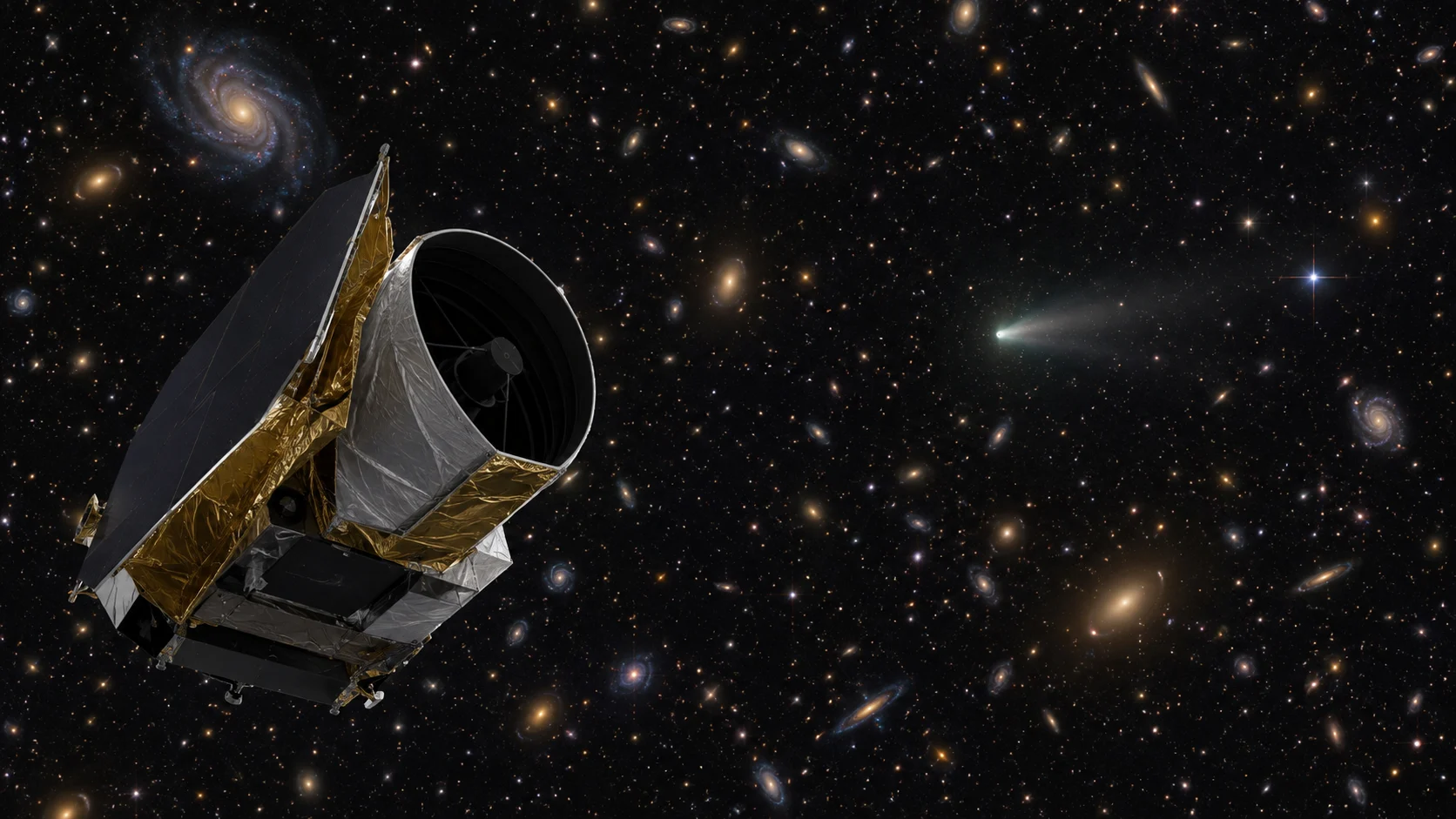
ESA announced on 19 October that Euclid had discovered its first previously unknown comet, C/2026 S1.
This is the mission’s first discovery of an uncatalogued comet, rather than its first image of any comet.
From a streak to a confirmed comet
Software searching for moving objects flagged images taken on 16–24 September. Five fields, containing 16 exposures altogether, supplied the evidence. A diffuse cloud around the object indicated activity. After finding no catalogue match, the team reported it to the Minor Planet Center; ground-based follow-up preceded confirmation on 8 October. Imaging, confirmation and announcement therefore happened on different dates.
What does 1.3 billion kilometres measure?
ESA places the comet about 1.3 billion kilometres from Earth. An independently maintained astronomical calculation page gives an Earth distance of about 8.909 astronomical units on 19 October. Multiplying by roughly 149.6 million kilometres per unit gives about 1.333 billion kilometres, consistent with that rounded scale. This is distinct from the comet’s distance from the Sun. Discovering a distant comet does not imply it is bright enough for unaided viewing.
An incidental find in a galaxy survey
Euclid primarily photographs distant galaxies to investigate dark matter and dark energy. It avoids the dusty Solar System plane and generally photographs one area before moving on. Catching a moving object repeatedly is consequently unusual. Identifying such objects also helps separate their trails from the galaxy measurements the mission was designed to make.
Will another spacecraft visit this comet?
ESA says this particular comet is unsuitable for Comet Interceptor. The discovery instead provided a real test of the process for alerting other observers. Its orbit will be refined as observations accumulate. The separate calculation page uses shared observation records, so it is an independent numerical cross-check, not another discovery or observation campaign. Follow ESA and Minor Planet Center updates for revised orbital information.
Primary sources and independent checks
Space-agency primary account: dates, first new comet and exclusion as a visit target: ESA
Independent distance calculation using shared MPC/COBS records; not a separate discovery or observation. Period differs from ESA’s broad wording and is not quoted: Gideon van Buitenen comet calculations
Read in other languages
한국어 · English · Español · 日本語 · Tiếng Việt