WORLD NEWS
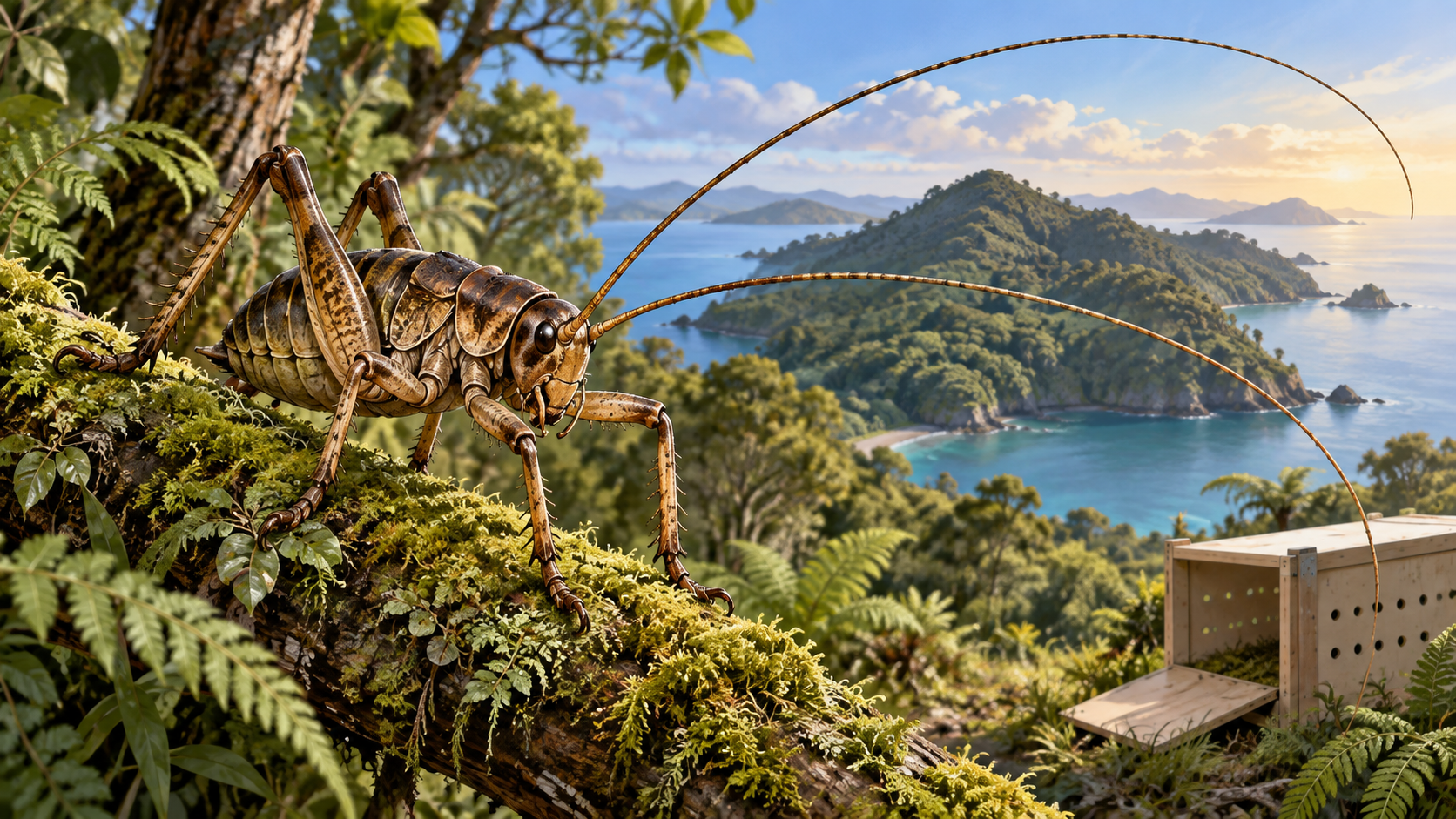
New Zealand’s giant wētāpunga gains sites through 45 translocations
New Zealand’s Department of Conservation says the wētāpunga recovery programme moved about 11,000 insects in 45 translocations to 10 new sites.
These are cumulative transfers across several years, rather than today’s surviving population or proof that recovery is complete at every site.
Habitat management matters as much as breeding
On October 2, DOC introduced research reviewing roughly 15 years of captive breeding and translocations. Wētāpunga is a native New Zealand giant wētā species. Raising many insects is only part of recovery: suitable food and space are needed after release, alongside control of introduced predators. The Guardian separately covered the programme on October 5.
Ten sites and 45 transfers count different things
The new destinations comprise eight predator-free islands and two fenced mainland sites. A destination can receive several releases, so 45 translocations do not mean 45 habitats. About 11,000 counts insects transferred over time. It differs from all insects bred, the population alive today and the fraction surviving; this total alone cannot produce a survival rate.
Wild-born generations provide stronger evidence
The official announcement describes at least four wild-born generations following the early releases on Motuora and Tiritiri Matangi. Reproduction is stronger evidence of establishment than simply finding released individuals still present. The conservation classification changed in 2022 to a threatened species whose numbers are increasing. It still includes threatened status, and these outcomes cannot automatically be extended to every new site.
The next checks are local breeding and predator control
This is a newly public research review, rather than evidence of a sudden population increase within one week. Continued wild reproduction at each destination and sustained exclusion of predators are the next questions. DOC’s programme announcement and species information provide routes to updates. We did not read the entire research paper directly during this check and have not inferred site-specific survival rates or a long-term population forecast.
Primary source and independent checks
Primary source and official explanation: Department of Conservation
Primary source and official explanation: Department of Conservation
Independent reporting check: The Guardian
Read in other languages
한국어 · English · Español · 日本語 · Tiếng Việt