WORLD NEWS
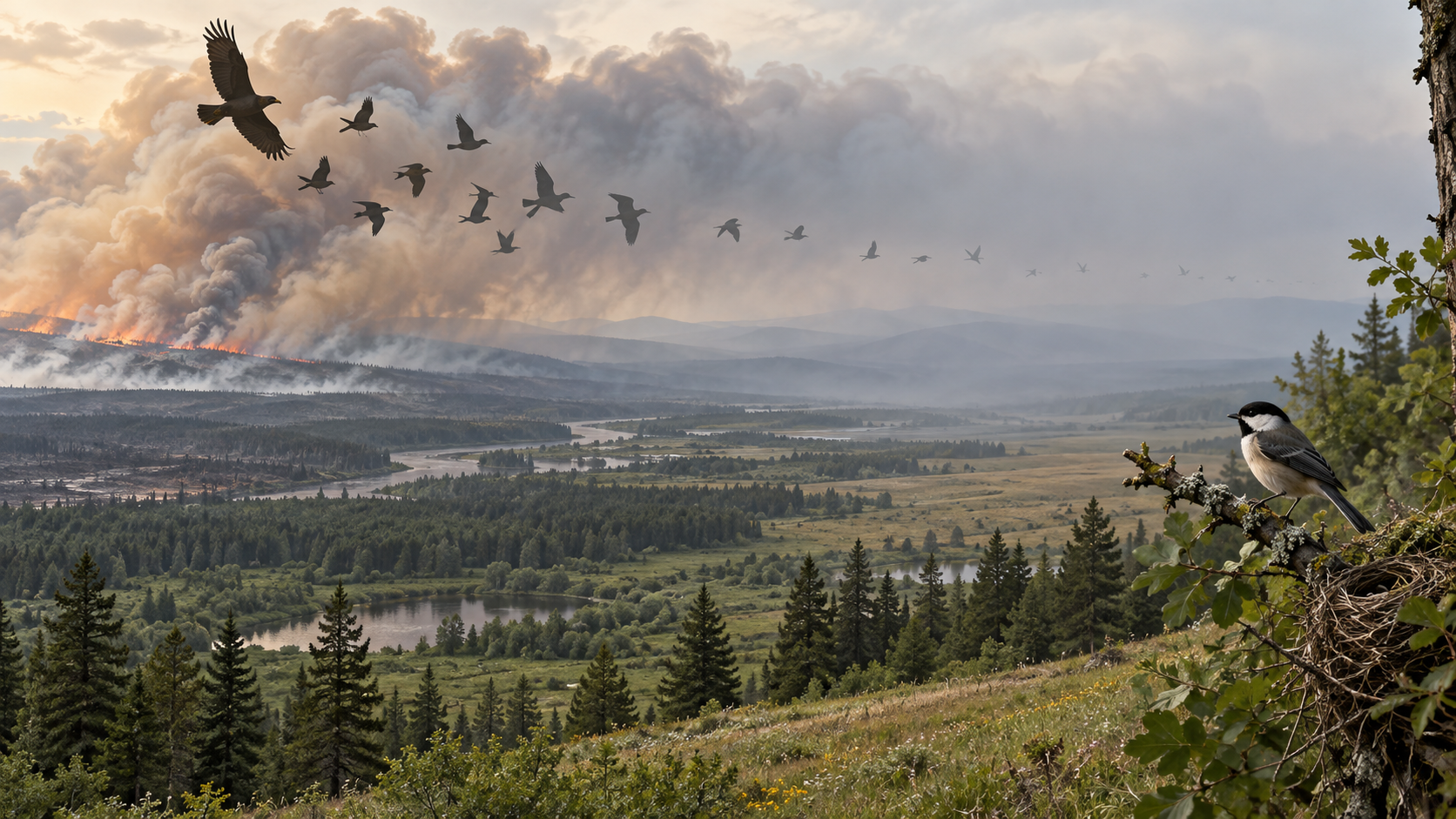
Places with heavier wildfire smoke had about 3% fewer bird species next season
Researchers combined 2008–2022 Breeding Bird Survey records with maps of wildfire-specific fine-particle pollution. Species richness, abundance and evolutionary diversity all tended to be lower one season after heavier smoke.
An average route held about 55 species, so 3% equals roughly one or two species. It does not mean 3% of all US bird species vanished.
Separating burned habitat
The association persisted on routes with no burned land within five kilometres. Models also accounted for weather, land use, survey practice and nearby movement.
Why the lag matters
The change appeared in the following breeding season. Smoke might affect breathing, body mass or behaviour, but the study did not directly establish the biological mechanism.
Measures
The team assessed species count, evenness across species and evolutionary distance. Their shared direction strengthens the signal.
Limits
Statistical controls cannot turn observation into a randomized experiment. Species-level pathways and effects outside the contiguous US remain unknown.
Next check
Species tracking, nesting success, health measures and replication elsewhere are needed. The finding supports counting smoke impacts beyond the burn perimeter.
Primary source and independent checks
Read in other languages
한국어 · English · Español · 日本語 · Tiếng Việt