WORLD NEWS
Photon-induced superconducting vortices observed directly, opening a new way to count photons
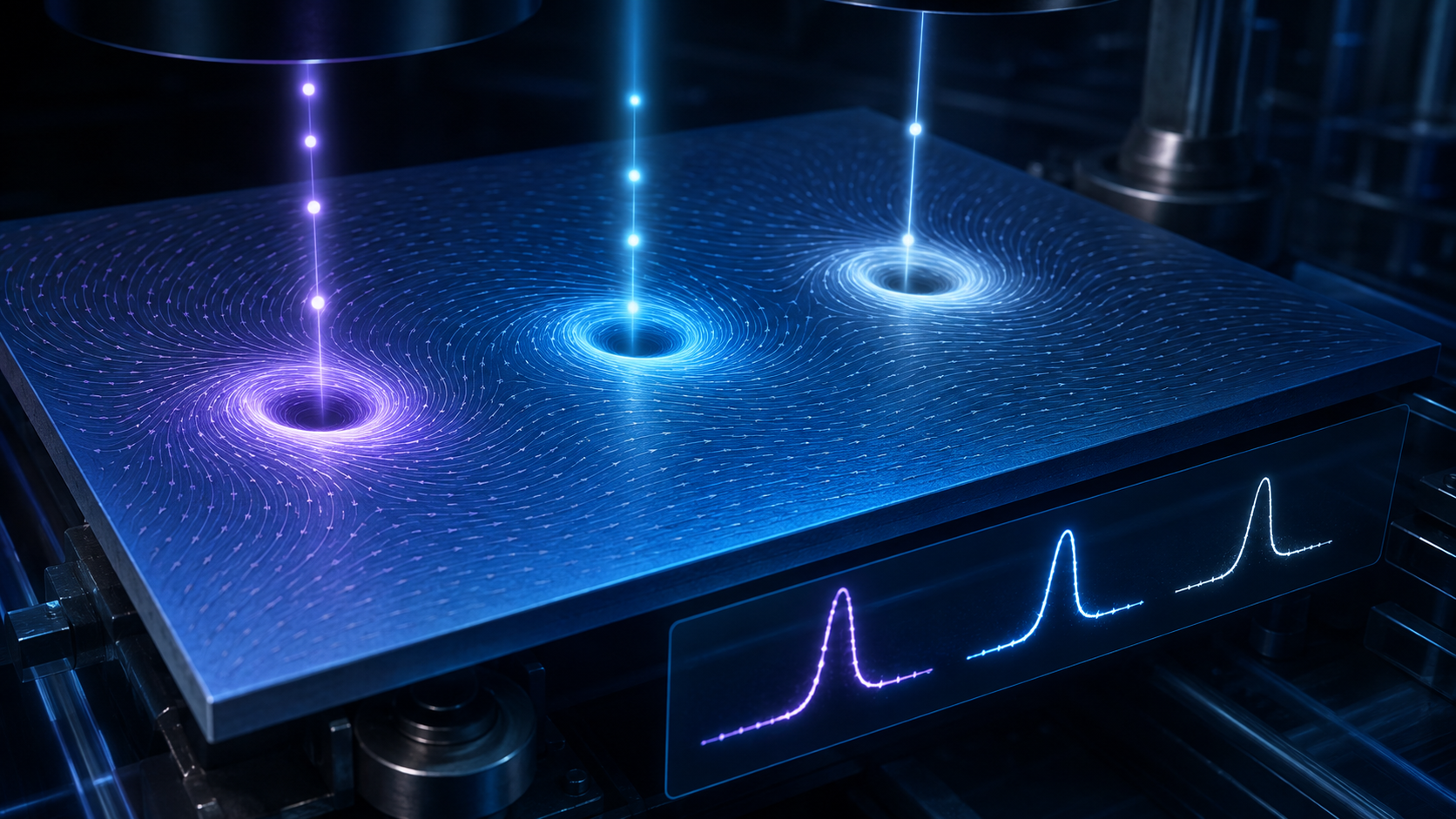
Researchers at Japan’s National Institute of Advanced Industrial Science and Technology directly observed the movement of vortices and antivortices that occur when photons are absorbed by a current-flowing superconducting film using quantized voltage signals. An experiment showed a new detection principle that can distinguish the number of photons by reading the number of events that occur for each photon.
This does not mean that commercial photon detectors or error-tolerant quantum computers have been completed. The Physical Review Applied paper reported direct evidence and demonstration of the vortex-based detection principle, and efficiency, noise, and repetition rates must be compared to verify whether a real device is faster and more accurate.
What did you directly observe?
In a superconductor, electrons move in pairs without resistance. An explanation has long been proposed: when photons energize a thin film, order can be locally disrupted and vortex-anti-vortex pairs can form. The researchers confirmed the time integral of the voltage pulse corresponding to the phase change and magnetic flux quantum that occurs when each vortex crosses the membrane.
How do you classify the number of photons?
As the number of photons absorbed at a time increased, the vortex events produced and the quantization voltage response also changed step by step. Instead of measuring the height of a continuous thermal signal, individual phase slip events are counted. The researchers proposed this as a new principle for photon-number-resolving detection.
How is it different from existing thermal methods?
Many superconducting photon count detectors read the temperature changes as the device warms and cools following absorption. Waiting for thermal equilibrium is accurate, but may limit repetition rate. The new method is likely to be faster because it uses the superconducting phase motion immediately after absorption, but this paper alone does not confirm its actual superiority.
Why are you interested in quantum computers?
Error correction in photonic quantum computers may depend on the ability to distinguish exactly how many photons are in a mode. Reliable operation of fast photon-count detectors allows error signals to be read more frequently in large-scale computations. However, issues of system integration, cooling costs, detection efficiency and dark coefficient must be addressed separately.
What will the next experiment answer?
We need to ensure that the step response is maintained at different wavelengths and photon numbers, that the eddies do not overlap when increasing the repetition rate, and that the efficiency and time resolution are better than conventional detectors. The current results are an important starting point for a direct look at the physical mechanism and are not a product performance table.