WORLD NEWS
Floating plant rafts in wastewater ponds reduced greenhouse gases by 22-31%, in one two-year trial.
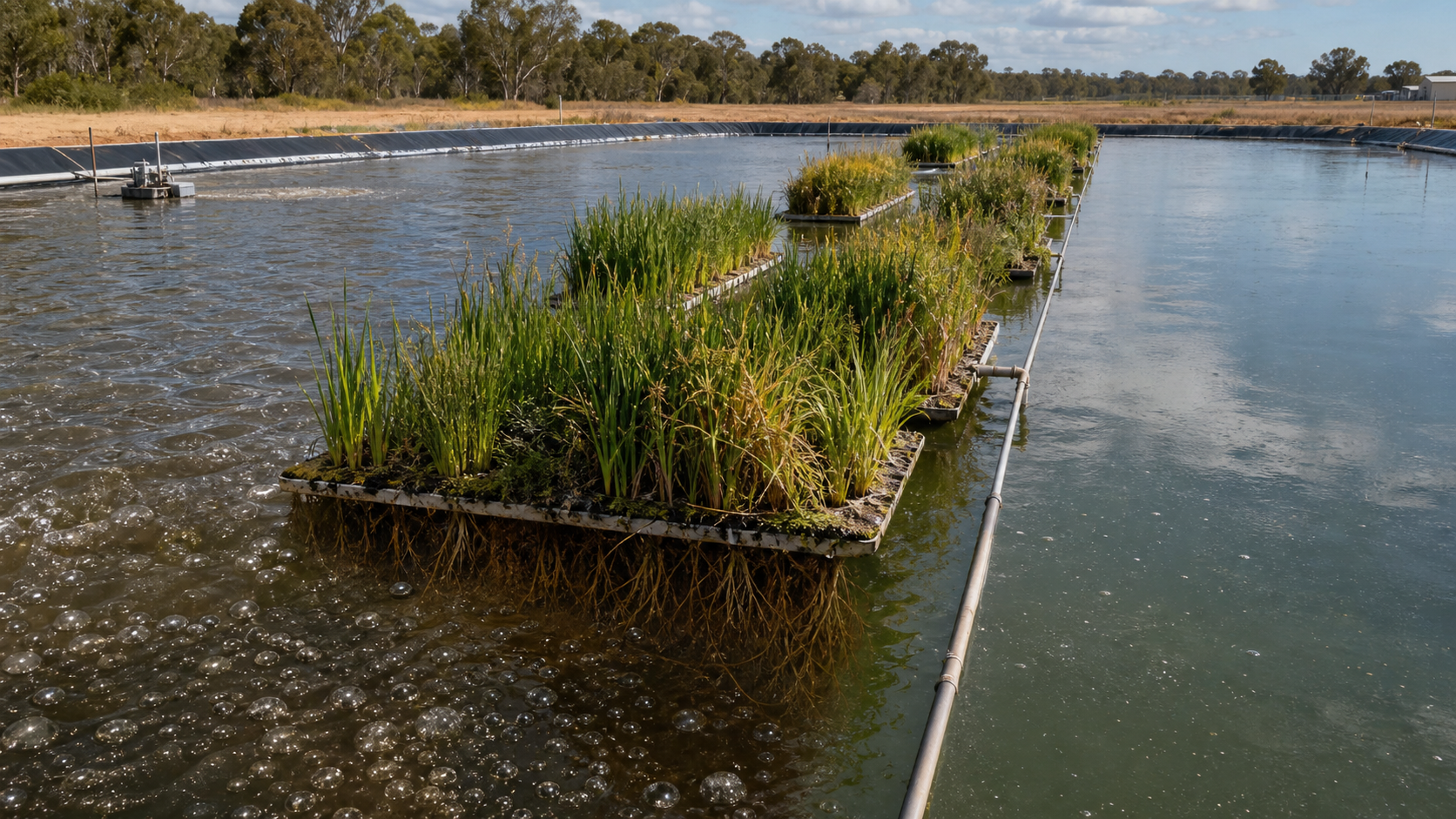
When a 330㎡ floating wetland planted with native reeds and sedges was placed in a wastewater storage pond in Phillip Island, Australia, carbon dioxide-equivalent greenhouse gas emissions were on average 22-31% lower than in a control waterway for two years. Methane reduction accounted for the lion’s share.
These figures do not apply to all wastewater treatment plants. This was a field test conducted in a pond in a temperate region, and further verification is needed to see if the effect is repeatable in other water quality, climate, design, and maintenance costs.
How did they compare?
The researchers divided one storage pond into two channels with a barrier. A floating wetland was installed on only one side and the same amount of treated water flowed on both sides. From 2023 to 2025, carbon dioxide, methane, and nitrous oxide were continuously measured, and water quality was checked every month. Comparing treatment and control channels at the same site reduced weather-related differences.
How different was each gas?
Overall CO2-equivalent emissions were 22-31% lower on average. Methane was 32-66% lower, carbon dioxide was 24-36% lower, and nitrous oxide was 18% lower. The reason for the range is that the results differed depending on the measurement period and calculation conditions. It would be an exaggeration to say that overall greenhouse gases have decreased by 66%, just by taking the largest number.
What did plant roots do?
The roots hanging down in the water provide a surface for microorganisms to exploit nutrients and pollutants. The researchers suggested that this microbial community may have influenced the process of producing and consuming gases, including methane. A decrease in emissions occurred 4 to 7 months after installation, and a decrease in organic nitrogen was confirmed approximately 12 months later. The exact microbial pathway requires further investigation.
Has the water quality improved?
Total Kjeldahl nitrogen was on average 12% lower and dissolved oxygen was about 9% higher. However, nitrate and phosphorus did not decrease significantly. This means that a floating wetland is not a device that removes all pollutants or directly turns wastewater into drinking water. It should be evaluated as an adjunct to existing treatment processes.
What to check next
You should check to see if the same decline is repeated at different temperatures, water quality, pond depths, and plant combinations. Installation costs, weed and bird management, plant replacement, and long-term durability must also be calculated. Researchers and water operators are continuing testing in additional ponds and agricultural reservoirs.