WORLD NEWS
A vacuum makes superconductivity stronger, but it is not a room temperature superconductor.
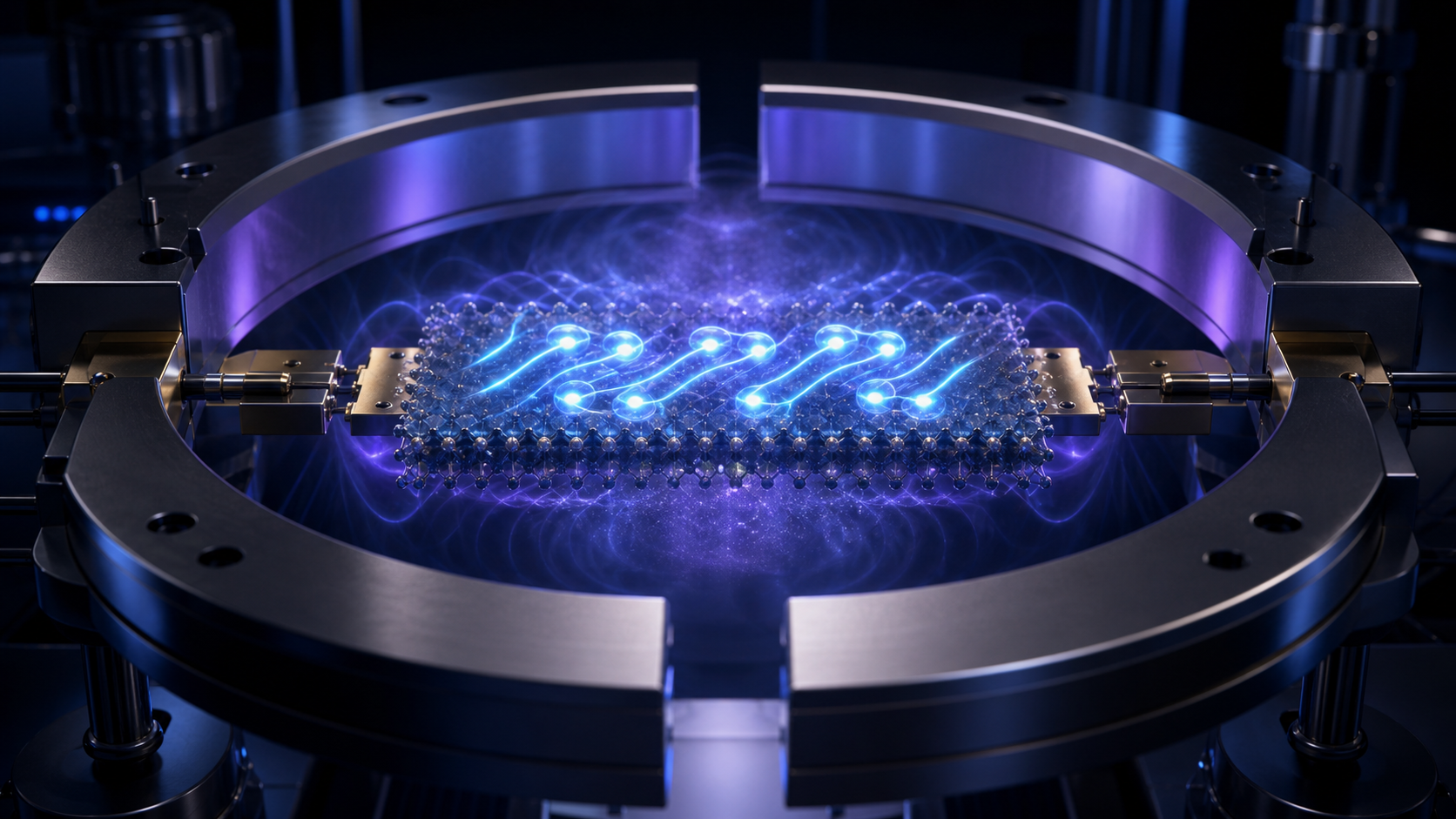
When the researchers placed a thin layer of niobium diselenide (NbSe2) into a ring-shaped resonant cavity, subtle electromagnetic fluctuations in the vacuum enhanced the superconducting state even without external light. The transition temperature, critical current, and critical magnetic field increased together, and the results were published in Nature on August 19.
This does not mean that we have created a room temperature superconductor. This is a proof of principle in one material and specific cavity operating at very low temperatures, and the researchers say follow-up experiments are needed to determine how much the effect scales up in other materials and devices.
How Vacuum Affects Materials
In quantum physics, the vacuum is not completely empty. Even in the lowest energy states, electromagnetic fields fluctuate slightly. The researchers designed a resonant cavity to match the energy of this shaking with the low-energy fluctuations of NbSe2. The strengthening effect was greatest when the two energies matched.
What did you measure directly?
We placed NbSe2 inside and outside a split ring resonator and compared its electrical resistance and response to current and magnetic fields. In the samples inside the cavity, the critical temperature at which the superconducting state begins was raised. The critical current and critical magnetic field near the transition temperature also increased significantly, distinguishing the results from chance changes in only one measurement.
Why it’s important
To change the state of superconductivity, applying voltage to an electrode or emitting strong light is usually used. In this method, the state of the material was controlled non-contactly by designing a surrounding vacuum field without external actuation. It shows the potential to become a new control knob that does not increase heat and noise in quantum devices.
How much can’t I say?
The experiments were limited to NbSe2 and specific resonance structures. The effect has not been confirmed to be repeatable in all superconductors. The transition temperature has not reached real-life temperatures, and this is not a product test that can be used directly in transmission lines or quantum computers. Theoretical calculations are consistent with observations, but other subtle influences require further verification.
What is the next confirmation
Follow-up studies should vary cavity size and frequency and material thickness to see if the effect is replicated. The same resonance pattern must occur in different superconductors and long-term stability must be verified before it can be evaluated as a general-purpose technology. The key now is experimental evidence that vacuum can be a controlling factor in the state of materials rather than a passive background.